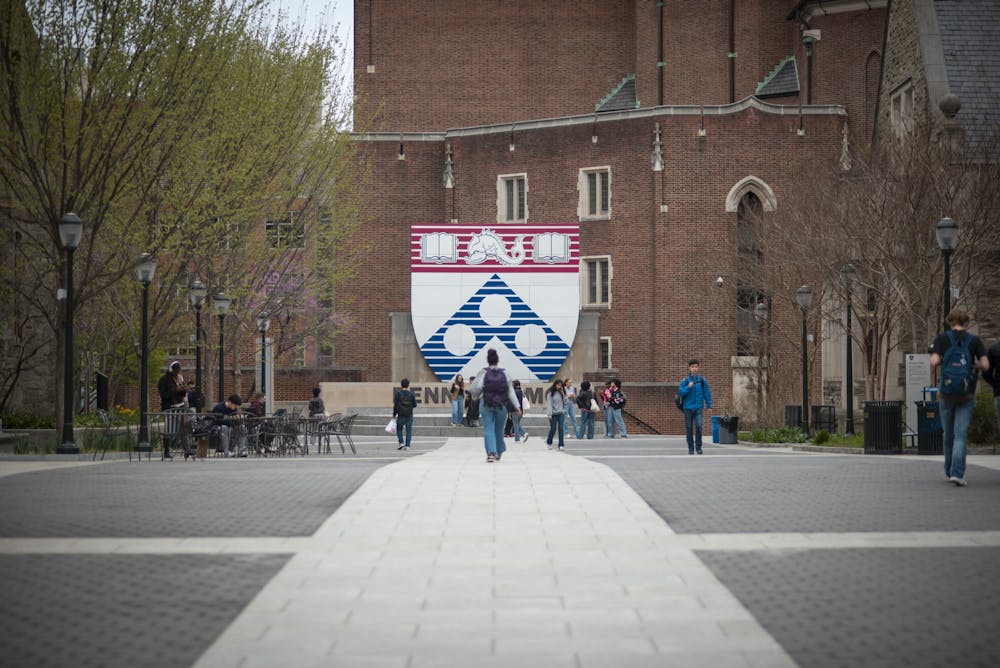
On March 31, a federal judge ordered Penn to comply with a subpoena from the United States Equal Employment Opportunity Commission requesting a list of Jewish faculty and students. Since it was first issued in July, the University has been fighting the subpoena tooth and nail, alleging that it violates constitutional rights and is founded on a faulty claim of discrimination. After the decision, Penn almost immediately announced its plans to appeal. Then, on Monday, the University filed a motion requesting that the court temporarily halt the enforcement of the ruling.
Penn absolutely made the correct decision in refusing to comply with the EEOC’s subpoena and choosing to appeal. The EEOC investigation is based on unfounded and unsubstantiated claims of discrimination at the hands of the University, and it has serious legal consequences for members of the University community. There are significant constitutional implications that come with allowing the federal government to request a list of all faculty and students affiliated with a certain group. Specifically, the request violates the freedom of association granted by the First Amendment.
The subpoena is really an assault on the entire institution of higher education in disguise.
Certain student or faculty groups might be afraid to register with the University or disclose their religious affiliation because of the precedent this sets. The EEOC has actually already been contacting Jewish faculty members on their personal cellphones, completely disregarding their privacy. If the agency is already finding ways to contact Penn affiliates without their permission, giving it access to a list of Jewish community members makes the issue far worse. Faculty and student privacy would be pervasively invaded, all in an effort to substantiate an investigation based on lackluster claims of discrimination.
To fully understand why the claims of discrimination are unfounded, we have to take a look at the timeline of this legal battle. More specifically, we should examine what motivated the EEOC to start this investigation in the first place. In the fall of 2023, right as the Israel-Hamas war was unfolding, there were numerous incidents of antisemitism at Penn, including instances of graffiti and verbal attacks. Soon after, former Penn President Liz Magill testified in front of U.S. Congress about antisemitism on our campus. Then — right before she resigned — the EEOC leveled a Commissioner charge against Penn, accusing the University of “subjecting Jewish faculty to an unlawful, hostile work environment.”
It’s important to understand that the EEOC has two main pathways through which it can begin an investigation. The first and most common way is when an employee of a business or institution files a complaint. This is a bottom-up approach in which the EEOC is explicitly asked to investigate by someone who reports experiencing illegal discrimination. The second way — and the way in which this investigation began — is through what is called a Commissioner charge, in which a commissioner of the EEOC makes the decision to begin investigating certain institutions or businesses. The Commissioner charge paperwork itself states that the allegations are based on “publicly available information regarding the employer.” This means that at the time of beginning its investigation, the EEOC had not received a single complaint from a University affiliate and was only relying on “publicly available information” for its charge.
This initial investigation was presumably launched as a response to publicly alleged antisemitic acts on campus that were perpetrated by individuals, not the University. But the EEOC has failed to find any evidence that the University itself perpetrated antisemitism through any specific incidents or employment practices. The agency is now attempting to retroactively prove their initial allegations by privately contacting Jewish faculty members. But if it hasn’t been able to find any evidence despite extensive investigations so far, allowing the EEOC access to the names and contact information of every Jewish faculty member at the University won’t yield any new information.
Penn has to protect its Jewish community members and continue to stand up to unlawful government practices in all spaces. It is absolutely integral to the privacy of our faculty and students that the University fight this illegal subpoena until it is struck down — as it should have been at the district court level.
LAWSON MILLER is a College sophomore studying philosophy, politics and economics with a minor in legal studies and history from Philadelphia. His email is lawmil@sas.upenn.edu.