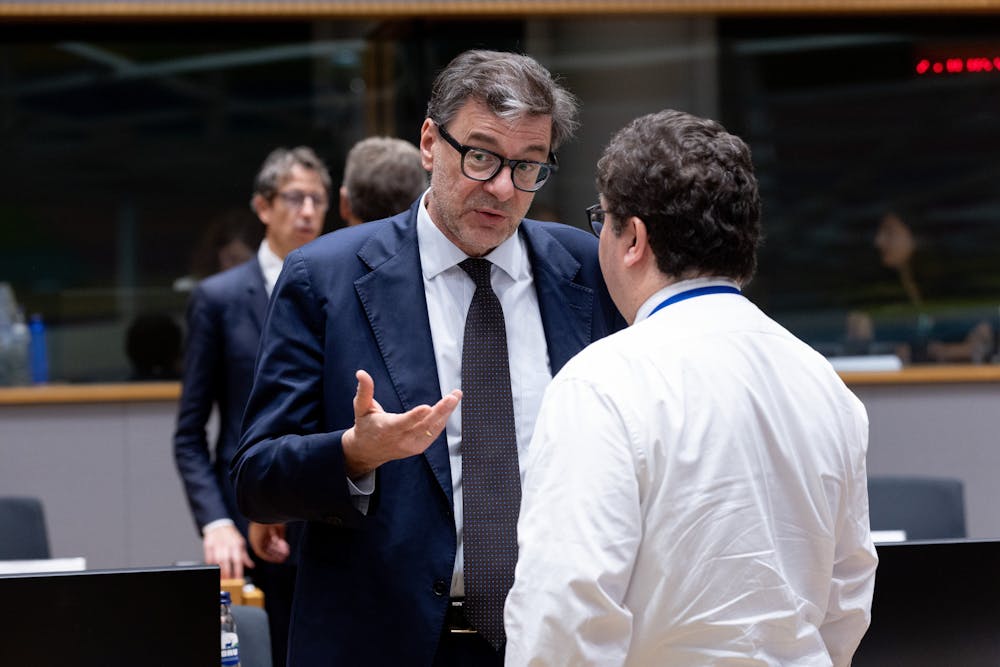
Italian Minister of Economy and Finance Giancarlo Giorgetti discussed global economic instability and the nation’s fiscal outlook on Friday.
The April 17 event — co-hosted by the Lauder Institute and Penn Global — was moderated by Associate Vice Provost for Global Initiatives Amy Gadsden. The conversation, which focused on global trade and economic policy, was followed by a question and answer session.
During her opening remarks, Gadsden described Penn as a “fitting” place for the discussion to occur.
“The Lauder Institute has long been dedicated to fostering deep understanding across borders, combining business policy and cultural fluency,” Gadsden added.
The conversation aimed to explore “transatlantic relations, recent geopolitical developments, and global market dynamics,” according to the event description.
Giorgetti explained that the global economy, which from a “macroeconomic outlook was gradually improving” earlier this year, now faces “uncertainty concerning international trade.”
The global environment has also faced a “major supply shock” following the outbreak of conflict in the Middle East, according to Giorgetti.
“Disruption of maritime traffic through the Strait of Hormuz — which accounts for roughly 20% of global oil consumption and 6% gas — and the damages to energy infrastructure in the Gulf, have brought the energy market into a phase of hybrid quality,” Giorgetti added. “Global output growth has been revised downwards by 0.2 percentage points compared to the January forecast.”
He also discussed how the changing global environment has impacted Italy.
“The Italian economy entered 2026 from a position of strength — both in physical terms and regarding public finances,” Giorgetti said.
He added that the current conflict in the Middle East has led to a “downward revision of short term growth profits” for the nation.
Since taking office, the Italian government has reduced Italy’s budget deficit from “an extremely high level” to approximately 3% of GDP in 2025, according to Giorgetti.
Of the European Union member states, Italy was “among the first” to “overcome the rising inflation caused by the unprecedented increase in natural gas prices in 2021,” he added. Giorgetti attributed this success to a “well-calibrated fiscal policy.”
He also outlined the Italian government’s “targeted measures” in response to the “Iran crisis” — which aim to “mitigate the increase in energy price for firms and vulnerable households.”
In response to a question about balance long-term and short-term challenges that arise for the Italian economy, Giorgetti emphasized the importance of maintaining “stability" when making political decisions.
“The pressure of the people and the minority of the government is to push for short-term policies because it could collect consensus,” Giorgetti said. “To have a long-term perspective, you need time.”