

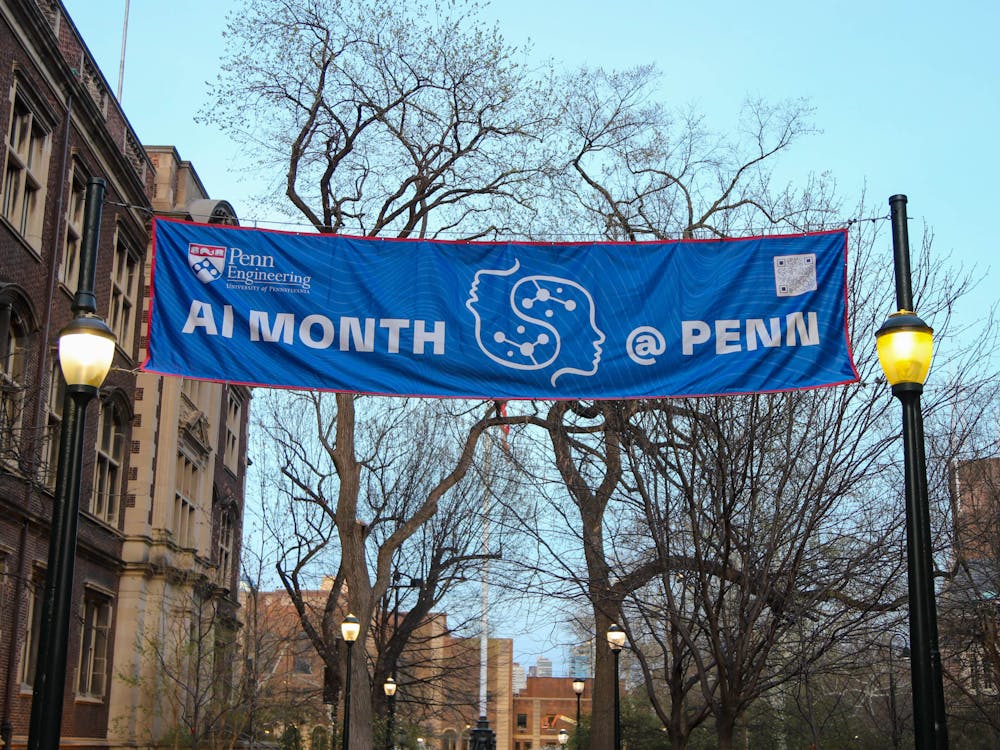
Penn is hosting its third annual AI Month this April.
Schools and centers across the University will organize symposiums, seminars, and workshops covering a variety of fields. The Daily Pennsylvanian spoke with several event organizers about artificial intelligence programming scheduled from March 31 to May 1.
University of Pennsylvania Carey Law School professor and Director of the Penn Program on Regulation Cary Coglianese explained that “AI Month showcases the importance of AI to society and to our economy.”
“It provides incredibly unique learning opportunities for students about these transformative technologies that will be affecting students’ lives for years,” he added.
AI Month programming will include two “Foundations of Optimization, Learning, and Data Science” seminars — a series created this year to address the “increasingly intertwined” advances across these fields, according to professor Jason Altschuler.
Altschuler, one of the faculty members organizing the series, wrote in a statement to the DP that the seminars — which will take place on April 2 and April 9 — serve “as a university-wide hub to bring together the many communities across Penn interested in these areas.”
Wharton Human AI-Research will host a virtual discussion as part of its “AI Horizons” series on April 9 where speakers will consider how the technology has “deskilled” us, and an April 16 event on AI use in building creative organizations.
“AI Horizons” is a “forum where leading faculty research meets the questions people are genuinely grappling with, including whether AI is quietly eroding the skills that students, professionals, and organizations depend on,” Marketing professor and April 9 event host Bob Meyer wrote to the DP.
RELATED:
Penn student launches AI platform designed to remember user conversations, identify patterns
Penn student launches AI mortgage startup through Y Combinator
Meyer, WHAIR co-director, added that this “rigorous, timely inquiry” will be the focus of the discussion.
The School of Arts and Sciences will host an AI showcase on April 15 featuring lightning talks from graduate students and postdoctoral researchers. SAS will host a series of 60-second lectures the same day.
“I’m really hoping it’s an opportunity for us to discover all that’s going on, especially within the School of Arts and Sciences,” Penn’s Executive Director of the Data Driven Discovery Initiative Colin Twomey told the DP.
Twomey explained that AI research within SAS is “not always visible,” adding that the initiative will “highlight different areas in the sciences, natural sciences, social sciences, and humanities” that offer a platform to have “interdisciplinary conversations in a natural way.”
Several AI Month events will focus on the use of technology in areas of health and medicine.
Natural sciences professor and Co-Director of DDDI Bhuvnesh Jain noted that AI Month is more “widely spread” across the University than it had been in previous iterations. DDDI will host an “AI + Us Talk” on April 15 about AI usage in medical diagnoses.
The Perelman School of Medicine will collaborate with the AI-Enabled Systems: Safe, Explainable, and Trustworthy Center in an April 17 symposium titled “AI in Medicine.”
Computer Science professor and ASSET Center Director Rajeev Alur said that the event will focus on the “social responsibility aspect” of AI and how it “can be put to use to improve health.”
“Everyone is talking about AI; they are finding applications in their own disciplines,” he added. “We are hoping that these events will stimulate students to get involved in research in AI.”
From a climate perspective, the Water Center at Penn will collaborate with PPR and Penn Carey Law to host its third annual Spring Water Policy Forum.
“Everyone’s just starting to think through how water systems can be better utilizing AI,” Emma Denison, the Water Center’s communications and student manager, said. “Our hope is that the events that we’re putting on and the research that we’re doing is able to be distilled and provide use to the communities that we’re working with.”
The month will conclude with three major symposiums hosted by the Graduate School of Education, School of Engineering and Applied Science’s Innovation in Data Engineering and Science Center, and the Soft AE Program.
Staff reporter Ana Laura Citalán Limón contributed reporting.
RELATED:
Penn student launches AI platform designed to remember user conversations, identify patterns
Penn student launches AI mortgage startup through Y Combinator
Staff reporter Moukthika Kanakala contributes to data reporting and can be reached at kanakala@thedp.com. At Penn, she studies economics and political science.


