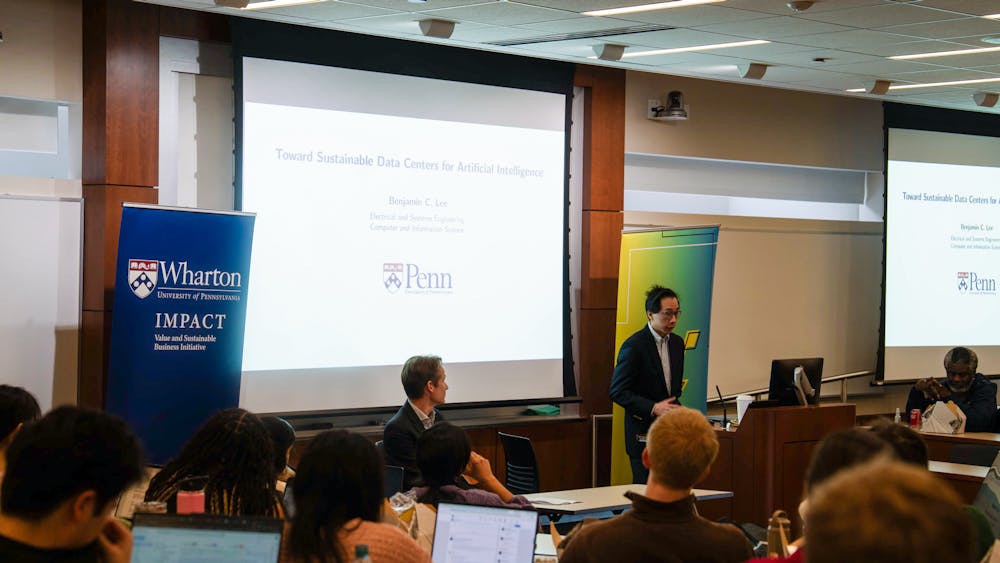
The Wharton School’s Impact, Value, and Sustainable Business Initiative hosted a panel about sustainable computing and artificial intelligence on Thursday as part of Penn’s Energy Week programming.
The Feb. 26 discussion was held at Steinberg-Dietrich Hall and highlighted AI-related energy and water consumption issues. The event featured Penn professor Benjamin Lee and Parnassus Investments senior analyst in sustainability Tyler McCullough and was moderated by faculty co-lead of the Wharton Climate Center Arthur van Benthem.
Lee opened the talk by explaining that data centers have seen “massive growth in computing,” but building these systems to sustain growth is “harder than ever.”
Among the obstacles the industry faces today are technical difficulties and sustainability concerns — particularly because of energy consumption. In 2023, data center energy consumption ranged from 20 to 50 megawatts, according to Lee. In 2026, “the size of the problem has gotten much, much larger,” with consumption reaching 1000 to 2000 megawatts.
Lee explained that energy use is distributed across three categories: data preprocessing, model training, and consumer deployment. While these technologies are becoming “more resource efficient,” an overall increasing demand leads to a higher total consumption of energy resources.
The panelists discussed computing’s significant implications on water, in addition to those on energy.
McCullough explained that medium to large data centers consume about five million gallons of water per day, which is equivalent to the consumption of a town of “about 50,000 people.”
He emphasized that the risks of AI-based water usage do not only concern the volume of consumption, but also the water source.
McCullough cited a major cloud service provider that said 40% of its data centers are in “regions that are projected to face greater water scarcity by 2050” — a trend that can be observed across the board with “about half the industry” currently “expanding in regions that are already water capacity constrained.”
Communications and Student Engagement Manager at Penn Water Center Emma Denison attended the panel and told The Daily Pennsylvanian that she was “excited that they were highlighting the impact of AI on water.”
“Energy dominates the conversation a lot when we talk about the sustainability impacts of AI infrastructure,” she added.
To tackle these challenges, Parnassus entered discussions with over 50 companies this year to “integrate sustainability” into their investment decision making process and engagement strategies.
“A significant part of those conversations” focused on “responsible AI ... and the impacts of this digital infrastructure,” McCullough said during the event.
He shared some advice for those concerned about sustainability in the age of AI, suggesting that students should pose “honest and good” questions to the leadership companies they will eventually “go on to be a part of.”
“It can be really hard to think about these giant issues and not feel helpless,” McCullough added. “Asking good questions is both a key part of risk management, which is essential to all organizations, but also innovation.”
Lee, who referred to himself as “a computer scientist first, and then a sustainability person,” encouraged attendees to contribute to the current “massive experiment” through which technology companies are trying to determine how AI can be used.
“If you’re looking for a socially responsible AI, then showing that there’s a market for it and using it would be incredibly helpful,” Lee added. “Once that dominant application has been identified, then all of the computer science and engineers will go in and start optimizing for efficiency.”