

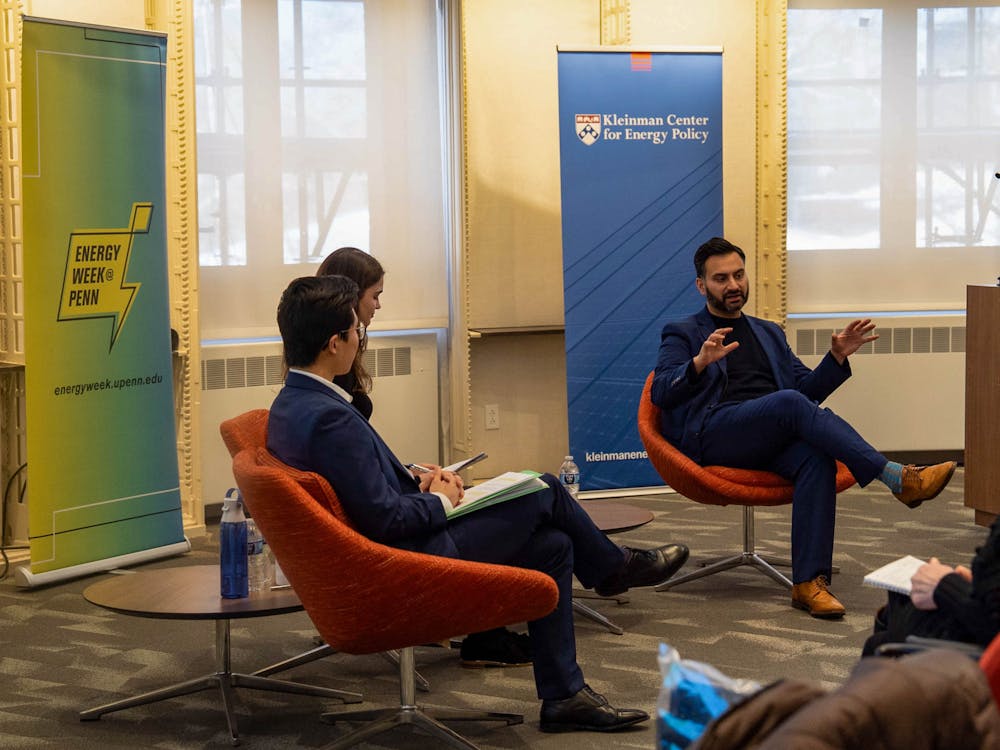
The Kleinman Center for Energy Policy hosted a fireside chat about climate strategy, artificial intelligence, and the future of the global energy landscape on Tuesday.
The Feb. 24 event, titled “Lessons from the White House: Climate, AI, and the Future,” featured a conversation with School of Engineering and Applied Science professor Ali Zaidi. College sophomore Annabel Helmer-Lynn and College junior Max Huang — both Vagelos Integrated Program in Energy Research students — moderated the event.
Zaidi previously served as the White House National Climate Advisor to Former President and Benjamin Franklin Professor of Presidential Practice Joe Biden and held climate policy positions in the Obama administration.
In an interview with The Daily Pennsylvanian, Zaidi urged students to look beyond the classroom and build “a sense of connection” to the future of the energy landscape.
“Dig into primary sources,” Zaidi said. “Try to understand what’s going on not just from a textbook, but also from the people on the front lines.”
During the fireside chat, he explained that his work on the American Recovery and Reinvestment Act — an economic stimulus with significant sustainability investments — initially drew him to environmental energy. Zaidi described his approach to policymaking as rooted in “understanding” the political economy.
“The way that the political economy endures is by making sure that the benefits of the investment of the policy program are shared,” Zaidi added. “When incentives are shared, the unity of purpose remains.”
Extending this framework to artificial intelligence, Zaidi explained that “smart rules” for an AI-driven economy should “allocate the benefits broadly and make sure the costs are carried by very few.”
RELATED:
Sixth annual Energy Week at Penn set to focus on AI, climate action on campus
Perry World House administrators discuss global policy, international climate observatory
When Huang asked about the tension between incentives to use AI and its regulation, Zaidi emphasized the importance of “partnership” over “punitive” approaches in expanding renewable energy.
Drawing on his time in government, Zaidi described efforts to create solar manufacturing jobs in a Republican town affected by the 2008 housing crisis. The initiative, he said, helped residents regain a “sense of dignity and purpose.”
“It’s a Republican town, but now jobs are back, economic opportunities back, and all of a sudden, whether they’re pounding out solar there or something else, kind of doesn't matter to them,” Zaidi said. “It just goes back to this benefits thing — we’re creating jobs in a town that had gotten knocked on its back.”
Helmer-Lynn told the DP that although recent developments in climate policy can feel “disheartening,” she believes “it’s important to believe that the future will get better” and to build trust in institutions.
Zaidi also addressed the “skepticism” and “misinformation” surrounding climate change, arguing that effective governance must rely on a “foundation of clear and rigorous data.” He urged students not to lose faith in collective action.
“If there is one demographic in America that knows that showing up still matters, it’s the people who are in school,” Zaidi said. “I think touching back to that home base for me is an incredible source of wellspring of hope, which is why I choose to spend time here.”
At the same time, Zaidi warned against communicating from what he called an “Ivy League ivory tower.” He urged policymakers and advocates to center “core concepts” that resonate more broadly.
“Can you improve my life? Are you going to deliver in a reliable and consistent way?” Zaidi said.
RELATED:
Sixth annual Energy Week at Penn set to focus on AI, climate action on campus
Perry World House administrators discuss global policy, international climate observatory
Staff reporter Emma Desmet covers administration and can be reached at desmet@thedp.com. At Penn, she studies history and political science.


