

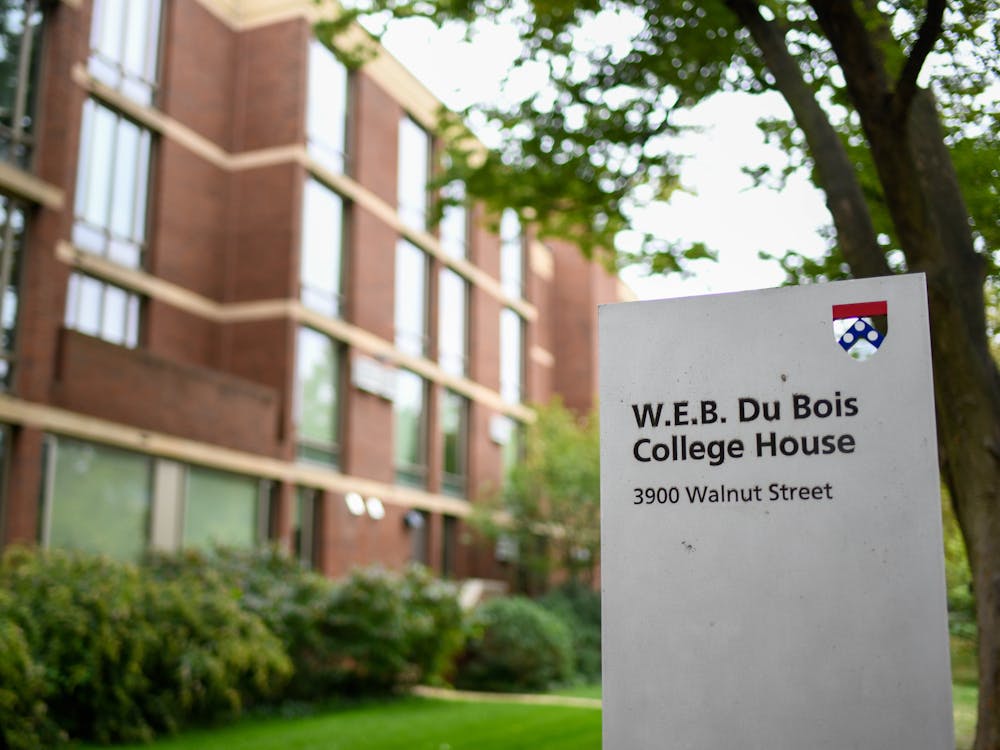
Du Bois and Gutmann College Houses hosted a two-day symposium celebrating the legacy of scholar and activist W.E.B. Du Bois last week.
The 33rd Souls of Du Bois symposium coincided with Black History Month and included both faculty-led panels on Feb. 26 and student research roundtables on Feb. 27. The Thursday panel focused on urban inequality and examined how Philadelphia’s current educational conditions reflect centuries of Afro-Latin history.
The first night of programming — centered around the theme of “Knowledge, Freedom & Healing in Changing Times” — began with a keynote speech from Evelyne Laurent-Perrault, who specializes in the history of the African diaspora in Latin America and the Caribbean and was an education coordinator for a Penn website titled “Dispossessions in the Americas.”
In an interview with The Daily Pennsylvanian, Laurent-Perrault explained that she has been “very concerned with educating and understanding how white supremacy came to be,” especially when considering how to “dismantle it from the normalcy of everyday life.”
After the keynote speech, Penn Graduate School of Education professor and Du Bois Faculty Director Amalia Daché moderated a panel of local educators and scholars who addressed the state of Philadelphia’s public education.
In an interview with the DP, Daché explained that the main goal of the panel was to “challenge the way we think about education from the perspective of the University,” and to focus on a "community grassroots” understanding of education informed by historical knowledge.
Panelist Guy Generals, former president of the Community College of Philadelphia, told the DP that Black History Month “should be about celebrating the accomplishments” and “developing ideas that will enable progress.” He highlighted the importance of bringing educators together to discuss “possibilities” for strengthening Philadelphia’s public school systems and addressing socio-economic factors in education.
Joann Gonzalez-Generals discussed her work as the director of Penn’s Upward Bound program during the panel. She highlighted the challenges many West Philadelphia students face during the college admissions process, including the fact that many “can’t demonstrate their leadership skills because their school doesn’t have clubs.”
RELATED:
Here’s how Penn student organizations are honoring Black History Month
Five Penn courses that highlight Black history this semester
According to Gonzalez-Generals, Upward Bound aims to ensure that students enroll and graduate from college.
Upward Bound is a federal TRIO program — meaning that it receives funding from the Department of Education. Gonzalez-Generals spoke about how the program has recently been “under attack” and noted that its grant application has not “been released.”
“Our program could also expire next August,” Gonzalez-Generals added. “These are very extraordinary times, and we hope that those grant applications will be released soon.”
During her keynote address, Laurent-Perrault used an online database of transatlantic slave voyages to demonstrate that far more Africans were brought to Latin America than the United States — which received “about 4 to 6%” of the slave trade.
“Despite the fact that many continue arguing that slavery in Iberian American world was more benevolent … trading on humans and enslaving them was brutal everywhere,” she said. “It bred whiteness and the disparities it carries today.”
Laurent-Perrault emphasized “the centrality and symbolism” around the Haitian Revolution and said that granting full citizenship to the African and indigenous populations in Haiti “propelled” the prohibition of the transatlantic slave trade in the northern hemisphere.
Haiti’s “relentless black pride remains one of the reasons why Western whiteness continuously keeps sabotaging this nation,” she said. “Embracing Haiti and advocating for it should be made at the core of our struggle to dismantle all forms of racism.”
Laurent-Perrault also emphasized that educators are in “need of intercultural and anti racist curricula.”
The symposium’s second day of programming involved discussions about African cultural identity and student research presentations. The event was co-sponsored by Campus 250.
RELATED:
Here’s how Penn student organizations are honoring Black History Month
Five Penn courses that highlight Black history this semester
Staff reporter Emma Desmet covers administration and can be reached at desmet@thedp.com. At Penn, she studies history and political science.


