

Penn’s School of Arts and Sciences hosted a panel on the recent United States military intervention in Venezuela on Wednesday as part of its Knowledge by the Slice series.
The event, titled “Venezuela: Perspectives and Insights,” was moderated by Spanish and Portuguese professor and Director of the Center for Latin American and Latinx Studies Jorge Téllez. Four Penn faculty discussed the future of the country, along with how U.S. foreign policy will affect Venezuelan citizens.
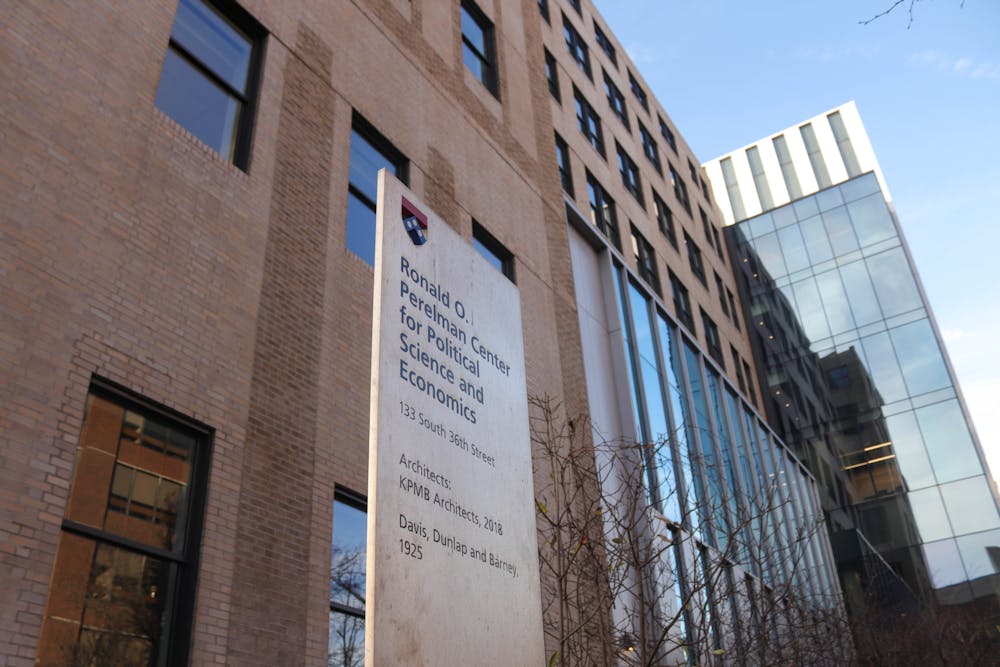
Drawing approximately 100 attendees, the panel took place in the Blank Forum at the Perelman Center for Political Science and Economics.
History professor Amy Offner began the discussion by outlining the events and motivations behind the Trump administration's intervention.
“We’re looking at policies that clearly do not have any singular logic,” she said. She identified multiple “timelines” guiding U.S. action, including the bombing of alleged drug boats in the Caribbean, the resurgence of a policy advocating for global spheres of power, and “shards” of Cold War policy supporting regime change in socialist and communist countries.
Political Science Professor Emeritus Robert Vitalis highlighted that the administration's motivations could extend beyond its stated desire for Venezuelan oil.
“The idea of the United States’ control of oil is a mirage,” he said. “It is in fact no more meaningful than saying that policymakers were or are driven by concerns about credibility, power vacuums, civilizing missions, democracy promotion, and the like.”
Offner added that after an unpopular immigration crackdown, Trump was searching in Venezuela for a “different theater in which to be able to perform dominance.”
RELATED:
Trump appoints billionaire Penn alum Marc Rowan to ‘Board of Peace’ overseeing Gaza Strip
Penn offers support to Venezuelan students following U.S. military action
“I don’t think there’s any domestic appetite,” she stated.
The remaining two speakers — senior economics fellow Angel Alvarado Rangel and Political Science professor Tulia Falleti — focused primarily on the perspective of Venezuelan citizens. Rangel, who is Venezuelan, emphasized the importance of democracy in the country.
“For Venezuelans, Maduro is not our president," Rangel said. “The most popular person now in Venezuela is Donald Trump, the second one is Marco Rubio, and the third one is María Corina Machado.”
Falleti echoed this sentiment, explaining that while the U.S. attack on Caracas constituted a “military invasion that violates international law,” many Venezuelans in the country and abroad considered it “an act of liberation worthy of celebration.”
She stated, however, that a subsequent occupation would be “colonial and imperial in its style.” Falleti called on Americans to advocate for a peaceful, democratic transition of power in Venezuela.
“It is imperative that there will be a transition towards respect of civil and political liberties in Venezuela,” she said.
Outlining the requirements for such a transition, Falleti urged the Trump administration to disclose the whereabouts of detainees taken by the Maduro regime, guarantee civil liberties and freedom of the press, and allow Venezuelans across the diaspora to travel freely.
She also advocated for maintaining open communication between the ruling and opposition parties, investigating human rights violations committed over the past decade in Venezuela, guaranteeing that there will be no retaliation against former Maduro supporters, and promoting a fair economic relationship between the United States and Venezuela.
Offner said that the White House's newly assembled Board of Peace, which is currently focused on Gaza, could play a role in the United States’ handling of Venezuela and Greenland, which Trump has expressed a wish to acquire.
“The charter of the Board of Peace is actually not specific to Gaza,” she explained. “It's a general attempt to create a new international institution that could claim authority in any number of contexts including Venezuela, Greenland, and who knows where else.”
Outgoing Wharton Advisory Board chair Marc Rowan is among the members of the Board of Peace.
Téllez told The Daily Pennsylvanian that it was essential to allow diverse viewpoints on U.S. intervention in Venezuela.
“There are many voices that have the right to express everything they think about what’s going on in Venezuela,” he said following the event.
Spanish and Portuguese professor Iuri Bauler Pereira, who attended the event, described it as an opportunity to hear “some people with a little more connection to Venezuela speak about this in person.”





