

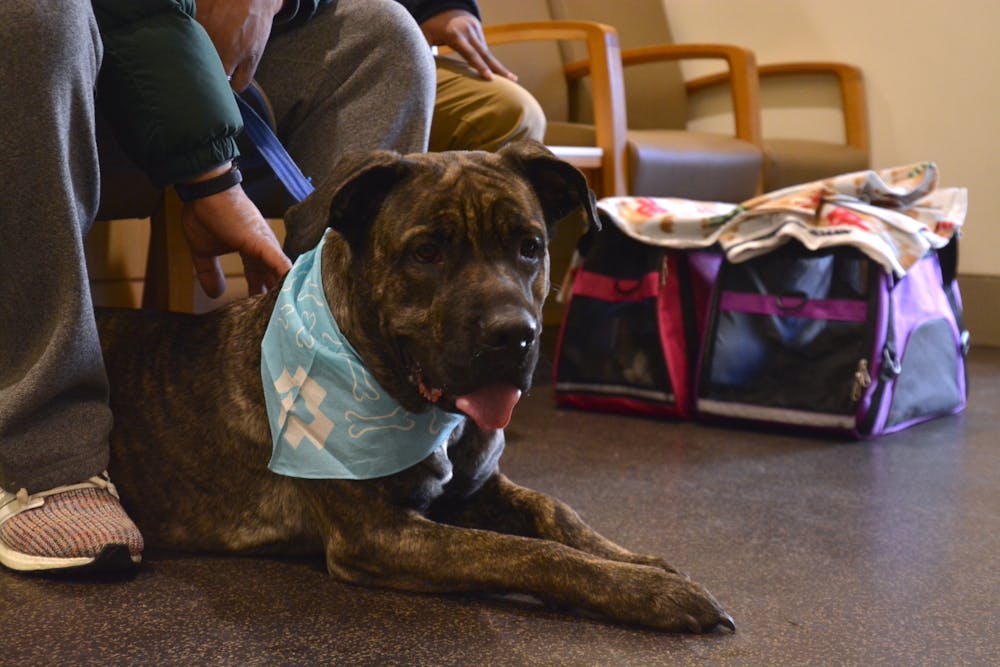
Researchers at the School of Veterinary Medicine’s Working Dog Center published new research on how trained dogs can detect the odor of a certain type of canine cancer in blood samples.
The dogs were trained to detect hemangiosarcoma, a “common, aggressive, and deadly” cancer typically diagnosed in dogs at advanced stages, according to the research paper. The researchers’ findings, originally published in November 2025, mark the beginning of a broader investigation to determine if the volatile organic compound profile of blood can be used as a potential biomarker for cancer.
The research team — including postdoctoral research fellow Clara Wilson — used special instruments called olfactometers, which pumped air from above the blood for the dogs to sniff. In an interview with The Daily Pennsylvanian, Wilson highlighted that the dogs only interacted with the blood samples and not the patients themselves.
Wilson characterized the experiment as “incredibly promising,” noting that the dogs chose the correct cancer sample 70% of the time despite having only a 25% chance of randomly selecting the correct solution.
“There's really no chance that that could have happened by accident,” Wilson said. “This means that there must be a smell.” She added that the experiment’s success answered the question of whether the samples had a detectable volatile organic compound profile.
According to Wilson, the team hopes to “keep investigating” the chemical markers and ultimately build a machine — called an electronic nose — that can perform screening tests. At the moment, Wilson said that the trained dogs “way surpass” any current available detection technologies.
“We don't know exactly what the chemical signature is yet,” she said. “The other difficulty is that we’re constrained by what the machines can do. The dogs are picking up on potentially thousands of chemicals, but a lot of the machines will only pick up on some really strong ones.”
Wilson also explained that Penn engineers are in the process of developing this technology and hoping to increase its accuracy.
“The huge benefit is that it would be a high-throughput option,” she said. “Realistically, we could have a blood test machine in every vet clinic.”
Penn is currently undertaking a $94 million development project to build a new laboratory for Penn Vet’s New Bolton Center campus in Chester County. Construction on the two-story building, coined the Penn Veterinary Diagnostic Laboratory, is expected to begin in fall 2026 and span 63,000 square feet.
Senior reporter Addison Saji leads coverage of science and health and can be reached at saji@thedp.com. At Penn, she studies English. Follow her on X at @addisonsaji.


