

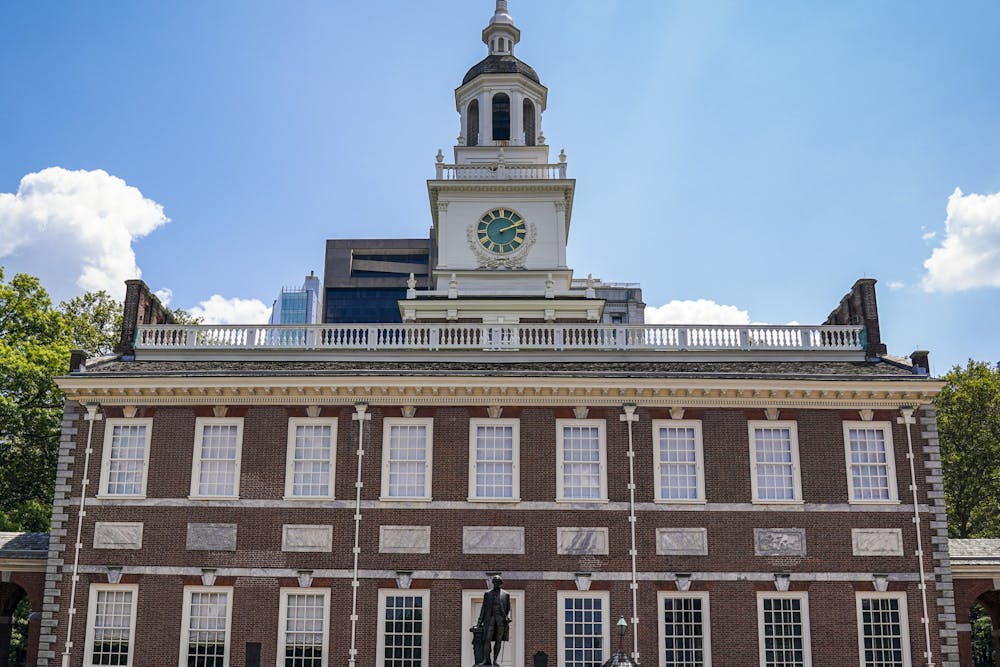
The National Park Service dismantled exhibits about slavery at the President’s House Site in Independence National Historical Park last week.
On Thursday, Independence Park employees began removing all displays at the memorial honoring the nine people enslaved by George Washington. The action prompted a lawsuit from the city of Philadelphia and condemnation from historians, advocacy groups, and elected officials.
The removal of the exhibit comes after 1968 Wharton graduate and President Donald Trump signed an executive order directing the Department of the Interior to review national sites and remove displays that “inappropriately disparage Americans past or living” in March 2025.
The President’s House opened in 2010 after archaeological work found remains of slaves’ quarters in the house Washington lived in during his presidency. More than a dozen displays about slavery were flagged by the Trump administration’s July 2025 review and initially slated for removal in September 2025.
Philadelphia Mayor Cherelle Parker’s administration filed a federal lawsuit on Jan. 22 against the National Park Service and the Department of the Interior.
“The Department of the Interior is implementing Secretary’s Order 3431, which carries out President Donald J. Trump’s Executive Order on ‘Restoring Truth and Sanity to American History,’” a spokesperson for the Department of the Interior wrote in a statement to The Daily Pennsylvanian. “Following completion of the required review, the National Park Service is now taking appropriate action in accordance with the Order.”
In its complaint, the city argued that the Park Service violated federal law and breached a 2006 agreement by dismantling the exhibit “without notice.”
That agreement, which governed the development of the President’s House project and its opening in 2010, granted the city shared authority over the exhibit’s final design. City officials contend that this authority extends to any later modifications, arguing that allowing the National Park Service to alter or remove displays renders the city’s approval rights meaningless.
RELATED:
Independence National Park will ‘alter’ slavery exhibits in accordance with Trump executive order
Independence National Historical Park prepares for ‘scrutiny’ following Trump executive order
A request for comment was left with a Parker spokesperson.
“We encourage the City of Philadelphia to focus on getting their jobless rates down and ending their reckless cashless bail policy instead of filing frivolous lawsuits in the hopes of demeaning our brave Founding Fathers who set the brilliant road map for the greatest country in the world — the United States of America,” the statement from the Department of the Interior continued.
U.S. Representatives Brendan Boyle (D-Pa.), Dwight Evans (D-Pa.), and Mary Gay Scanlon (D-Pa.) sent a letter to Interior Secretary Doug Burgum and National Park Service Acting Director Jessica Bowron on Thursday demanding answers about the removal. The letter argued that the exhibits play a critical role in explaining how slavery coexisted with the birth of the country, and attempting to remove that history is “deeply troubling.”
“Philadelphia and the entire country deserve an honest accounting of our history, and this effort to hide it is wrong,” Boyle, whose district includes Independence Park, said in a Jan. 22 press release.
The representatives requested a written response by Jan. 30 that outlined who authorized the decision, where the removed panels are being stored, and what plans exist for their reinstallation.
The removal also drew condemnation from historians who helped create the President’s House memorial in the early 2000s.
Emeritus history professor at St. Joseph’s University and one of the principal organizers of the Ad Hoc Historians Randall Miller told the DP that the bare walls left behind may be more powerful than the original displays.
“The empty walls and the panels that have been taken down are going to speak louder than when the panels were up,” Miller — who worked to secure interpretation of slavery at the site from 2002 to 2010 — said. “People are going to want to know what was there and why it isn’t there now.”
He also emphasized the site’s unique role in facilitating difficult conversations about American history.
“This is providing something so rare in America, a place, a space where it’s possible, honestly, not only to address and grapple with and really respect our own history … but also where we can find space enough where we feel that it invites us to talk about things we don't ordinarily want to talk about,” Miller said.
1991 School of Arts and Sciences Ph.D. graduate Sharon Holt — who helped facilitate the creation of the President’s House Site as editor of the Pennsylvania Magazine of History and Biography — described her “rage" after hearing about the removal.
“It’s one of the things I’m proudest of in my career that I was part of,” Holt said in an interview with the DP. “It was one of the moments of my life when people across the race line were working together and building trust.”
For Holt, the implications extend far beyond a single memorial site. She told the DP that the removal represents an attack on the foundations of a democratic society itself.
“Falsifying history is an attack, not just on Black people or brown people. Falsifying history is an attack, in my view, on democracy,” Holt said. “We’re one of the only creatures on the planet that creates history, because history is storytelling. History is how we understand ourselves, and so if you start erasing that, you start disempowering the collective mind of the people.”
Graduate School of Education professor Jonathan Zimmerman offered a similar perspective on what the removal represents for American history.
“I don’t think that what we saw last week is an example of falsifying history. I think it’s an example of removing it,” Zimmerman said. “They weren’t distorting the past so much as they were destroying it.”
He drew a historical comparison to past attempts to sanitize slavery, arguing that the recent action taken by the Trump administration represents a different approach.
“The problem here isn’t a distortion, it’s cowardice,” Zimmerman added. “They know slavery was an evil. That’s why they want to take it out of sight, but they don't have the courage to actually address it.”
History professor Kathleen Brown — who serves as the lead faculty historian of the Penn & Slavery Project — wrote in a statement to the DP that physical removal of displays will not eliminate historical reality.
“Taking down an exhibit doesn’t erase the historical facts, conditions, or consequences,” Brown wrote. “It does contribute to ignorance, however, which is never a good state of affairs in a democracy, in which we count on an educated electorate to guide our government.”
Holt also explained that some people involved in the original effort to create the memorial hope the removal will be temporary and that political change will restore the exhibits.
“People are trying to bob and weave and dodge and stay out of the line of fire to survive until the power structure changes,” Holt stated.
Civil liberties advocates also condemned the removal as part of a broader pattern in actions taken by the Trump administration.
“Whether spackling his name onto public institutions or removing museum exhibits that delve into uncomfortable and horrific truths about our country’s past, Donald Trump’s attempts to rewrite American history will fail,” an American Civil Liberties Union of Pennsylvania spokesperson wrote in a statement to the DP.
“America’s greatness lies in its aspirations towards a more perfect union,” the statement read. “We get there by learning from the mistakes and building on the successes of our nation’s 250 years.”
Zimmerman argued against the strategy of waiting for political change, warning that the approach reflects insufficient urgency.
“It’s way too blithe, and way too easy to imagine that this is simply a blip on the radar screen, and after Trump, normalcy will be reinscribed,” Zimmerman said.
Instead, he emphasized that the administration’s success will depend on the public’s response.
“Keep at it,” Zimmerman said. “Whether they succeed or not depends on us and whether we raise our voice about that history.”
RELATED:
Independence National Park will ‘alter’ slavery exhibits in accordance with Trump executive order
Independence National Historical Park prepares for ‘scrutiny’ following Trump executive order
Senior reporter Riana Mahtani covers national politics and can be reached at mahtani@thedp.com. At Penn, she studies political science. Follow her on X @Riana_Mahtani.





