

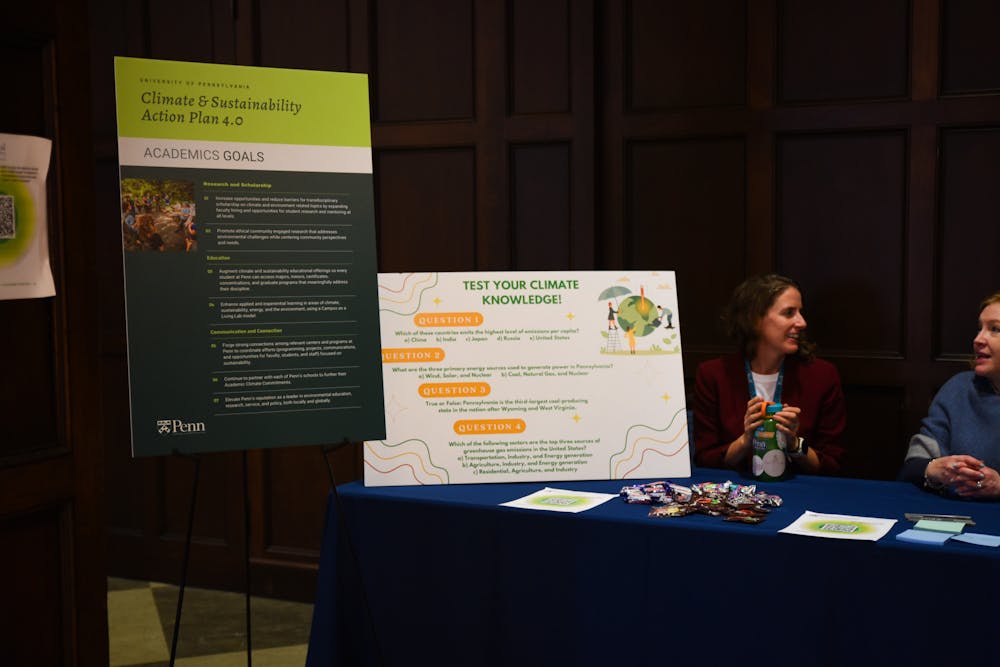
On Dec. 4, Penn Sustainability released its Climate and Sustainability Action Plan 4.0 progress report for the previous fiscal year.
The progress report outlines advancements made by Penn Sustainability and its partners in FY25, such as emissions and waste reduction, green infrastructure development, and carbon offset purchases. The report relies on input from the various subcommittees of the Environmental Sustainability Advisory Committee, which track progress towards their respective goals throughout the year.
In FY25, Penn made notable progress toward its operational goals, achieving a 4.5% reduction in net main campus emissions and bringing the total decrease since FY09 to 49%. The University offset 12,218 metric tons of CO2 equivalent from domestic and international flights taken in the last fiscal year through Penn's Air Travel Offsets program, increasing from prior years. In addition, the Solar Purchase Power Agreement became fully operational this year, helping to reduce main campus electricity emissions by 36%.
CSAP 4.0 is the first to aggregate data from properties beyond the main campus, including Morris Arboretum, the New Bolton Center veterinary hospital, and Penn’s owned real estate portfolio in its overall emissions projections.
“That was a learning curve for us — making sure that we have all of that data completed at the same time,” Sustainability Director Nina Morris told The Daily Pennsylvanian. “That was definitely a challenge, but we were able to overcome that, and all of that is now in our reporting cycle.”
Waste management was another major area of progress this past year, according to Morris.
Penn saw a 33% landfill diversion rate this year — an improvement from 29% last year — as well as a 4% reduction in landfill waste generation. It also began piloting Quaker Kitchen as a near-zero waste dining hall and developed a waste dashboard to track data efficiently.
These efforts contributed to 313 tons of material being composted — a 55% improvement from last year.
RELATED:
Penn Dining donation drive collects nearly 900 meal swipes for students facing food insecurity
Penn Sustainability continues to pilot ‘Leave the Leaves’ initiative to protect campus biodiversity
Morris highlighted the contributions of Penn Dining, staff, building administrators, and building managers to achieving progress towards their composting goals.
“I’m really proud of that, because that really is a great demonstration of how people can really make a difference,” Morris said.
The University also made strides towards its physical environment goals, achieving three LEED certifications for newly constructed energy-efficient buildings. The Vagelos Laboratory for Energy Science and Technology received the platinum designation, Amy Gutmann Hall earned gold, and the Ott Center for Track and Field received silver.
In terms of academic advancements, the Office of the Vice Provost for Climate Science, Policy, and Action was formed, otherwise known as Penn Climate. Additionally, Penn hired 19 new faculty members in environmental fields during the last year.
While CSAP 4.0 includes goals relating to the Pennsylvania Health System, their emissions data will be released on a different timeline because they track emissions separately, operating on a calendar year rather than a fiscal year. The progress report, however, notes that the Health System has developed a carbon reduction strategy to reduce emissions by 50% by 2030 and reach net zero by 2042.
According to Morris, subcommittee input is vital to the construction of the yearly progress report. Subcommittees are chaired by staff and faculty with relevant expertise in areas such as transportation, waste and recycling, energy efficiency, and civic engagement.
“I think what we learned this year was that it’s so important for each of the subcommittees to feel empowered to take action on the goals,” Morris said. “And we’ve come up with better strategies to help support them to do that.”
Morris acknowledged potential long-term financial challenges for certain subcommittee projects that require more funding than others.
“Due to the financial situation, I think those may be a little bit harder to pull off within five years,” Morris said. “But there’s still so much that we can do, even with the financial challenges.”
All data for the report is compiled and approved by Penn Facilities and Real Estate Services, Business Services, and the Provost's Office in a data verification process that takes months to ensure that information is accurately tracked.
“It’s all worth it because we know that we’ve put together data that we can stand behind,” Morris said. “And it’s really important for us to ensure that what we’re saying aligns with what we’re actually doing.”
RELATED:
Penn Dining donation drive collects nearly 900 meal swipes for students facing food insecurity
Penn Sustainability continues to pilot ‘Leave the Leaves’ initiative to protect campus biodiversity
Senior reporter Norah Findley leads coverage of science and health and can be reached at findley@thedp.com. At Penn, she studies environmental studies. Follow her on X @NorahFindley_.


