

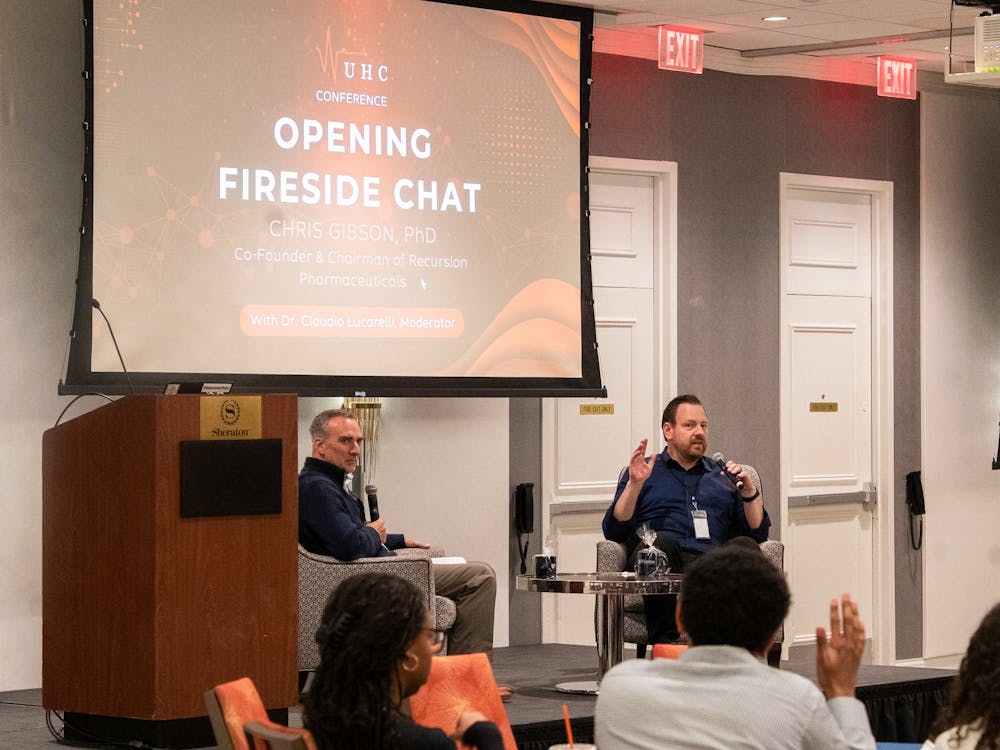
Wharton Undergraduate Healthcare Club hosted its 13th annual conference on Feb. 7 at the Sheraton Philadelphia University City Hotel.
WUHC hosts the largest undergraduate health care conference in the nation. The six-hour event featured a keynote speech and 18 other speakers across four panels who discussed artificial intelligence and innovation in health care.
The conference’s keynote speaker was Chris Gibson, founder and former CEO of Recursion — a “TechBio company.”
During the opening fireside chat, Gibson discussed the current biopharmaceutical landscape and noted that a majority of the industry focuses on “roughly 400 targets,” even though an estimated 20,000 biological targets may be druggable.
“It’s about $2 billion worth of R&D investment for every new medicine that’s approved … the vast majority of new medicines that are getting approved are actually just follow-ons to medicines that have already advanced,” Gibson said. “We believed it was worth trying going after the rest of that space.”
Gibson explained that Recursion was founded on the idea that technology can help explore neglected biological spaces.
“If you could reduce the failure rate from 90% to even 80%, you could change the pharmacoeconomics of this,” he said. “We’re talking about failing 80% of the time and still changing the world.”
Gibson also addressed the potential risks associated with increased use of AI and argued that it will reshape work rather than eliminate it entirely.
“If there’s toil in your work, that’s going to be automated,” he said. “What’s left is people who can take that and then make the moral, thoughtful decision.”
In an interview with The Daily Pennsylvanian, Gibson offered career advice to students, emphasizing the importance of “serendipity” and remaining open to unexpected opportunities.
“One of the things that’s been most transformative in my career has been to be open to the serendipity that comes and the opportunities that show up — even if they become side quests,” Gibson said.
Alongside Gibson’s speech, the day included four panels on topics of health care investment, AI innovation, founders “fueling” the future, and Philadelphia’s pharmaceutical “leap.”
Professor emeritus of Health Care Management Mark Pauly hosted a panel on health care investment, where he questioned whether health care can “regain a positive feeling on the part of the American public.”
During a panel about AI’s role in accelerating research, speakers discussed how these tools cannot replace scientific intuition.
“When we live in a world where a lot of key decisions around scientific discovery can be automated by AI … well, what if you need to create a new assay, what if you need to discover new biology?” Shaan Gandhi, head of strategic partnerships at Pfizer Ignite, said. “That’s something we’re thinking about a lot — maybe that’s where Pfizer can go in the future.”
Jasmin Patel, a panelist and co-president of a-connect, echoed similar sentiments in an interview with the DP.
“I think we are at a time where there is a rapid pace of acceleration of innovation in health care and life sciences,” Patel said. “The advances in medical science and in technology are breathtaking in nature … these things can really contribute to us doing a lot more to transform how diseases are treated, how patients are managed, and so forth.”
Patel added that he was “impressed” by the audience’s engagement. He encouraged Penn students to focus on making “connections between science and between the people who are around … because that’ll help you in your career, but it will also help us, because you will do amazing things.”
WUHC’s executive board and members have been preparing for the 2026 conference since spring 2025, shortly after last year’s event concluded.
College and Wharton senior Corey He, co-president of WUHC, told the DP that one of the conference’s main goals was to connect current members with leading figures in the field and alumni pursuing careers in the life sciences. He described hosting the largest annual undergraduate-led health care conference in the nation as “a huge team effort” and “something we’re really proud of.”
“Our event has been recognized as Wharton’s best event for the past two years,” he said. “It’s really the moments that we see engaging with our speakers and our members that mean more than more to us than any award could.”
College senior Alina Zaidi, the former vice president of WUHC’s conference committee, told the DP that organizing the 2026 conference presented logistical challenges — particularly due to a venue change that led to “different scheduling.”
“Everybody in the committee has been outreaching since last year, trying to get the keynote speakers finalized, all the panel speakers and even the career fair companies,” she added.
The WUHC conference was open to attendees from Penn and outside the University. It included a career fair that featured companies such as Boston Consulting Group, Deloitte, Insmed, Northwell Health, and Penn’s Mack Institute for Innovation Management and Leonard Davis Institute for Health Economics.





