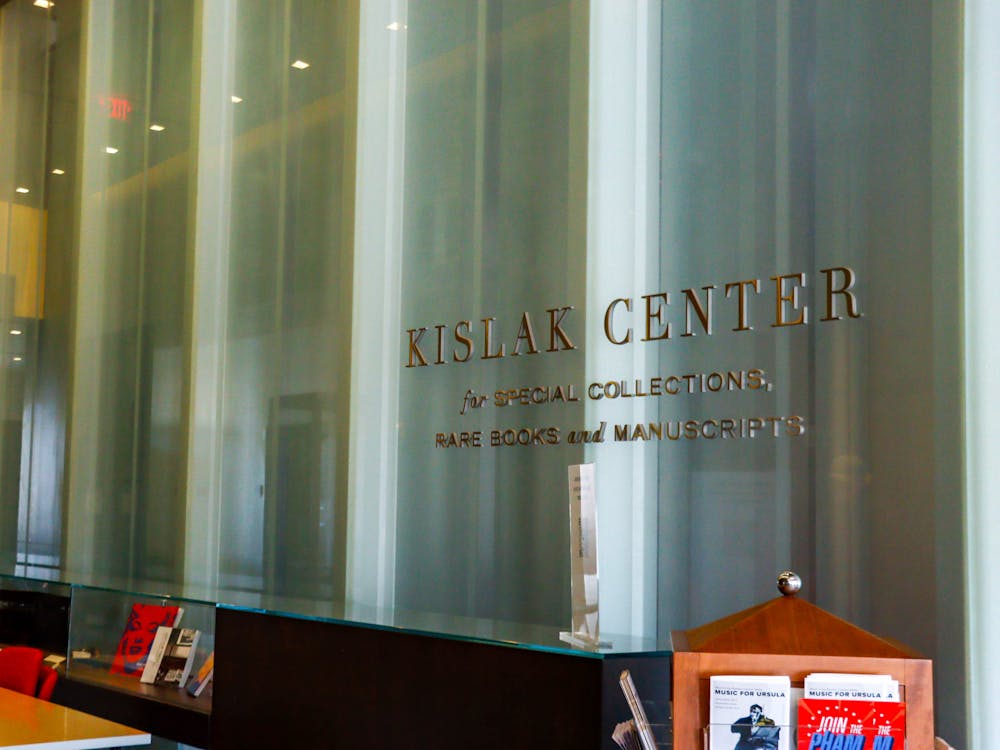
Penn Libraries unveiled an exhibit in Van Pelt-Dietrich Library showcasing protest and unrest during the United States’ 200th anniversary.
The Kislak Center for Special Collections, Rare Books, and Manuscripts launched the exhibit on Feb. 9 in preparation for the semiquincentennial and will keep it open for viewing until May. The display draws upon posters, newspaper clippings, and photographs to highlight the “protest culture” of 1976 — a stark contrast to more well remembered bicentennial celebrations.
Mitch Fraas, senior curator at the Kislak Center and the exhibit’s creator said that it focuses on “the role of dissent in celebrating American history” in an interview with The Daily Pennsylvanian.
“I wanted to showcase the lesser-known story of that — the story of the people, organizations and groups who wanted to raise questions about the celebratory narrative of 1976,” Fraas added.
The exhibit — titled “Celebrate or Demonstrate: Philadelphia and Bicentennial Discontent” — is meant to contrast “commercialized” material from the bicentennial period and show artifacts from various groups that made “strident critiques of a wholly celebratory approach to American history and the mythos of the founding father.”
The curation highlights two of the “most prominent groups” — the July 4th and Rich Off Our Backs coalitions — that advocated for workers’ rights in Philadelphia on July 4, 1976. Several supporting organizations are featured through newspaper advertisements, flyers, and buttons that were in circulation.
The didactic panels accompanying the collections state that the coalitions were endorsed by over 100 organizations and had over 20,000 people in attendance at protests.
The display is part of extensive programming organized by Penn Libraries in preparation for the United States’ 250th anniversary and is open to the public.
RELATED:
Here’s how Penn plans to celebrate America’s 250th anniversary
Penn’s Kislak Center hosts photographer to discuss Black history
Fraas expressed hope that viewers will “take away a sense of curiosity and interest in the way historical moments are told or remembered.”
Sean Quimby — associate vice provost and director of the Kislak Center — told the DP in January that it is “important that the University make an effort to really engage with 2026” as “the ideals, the actual individuals, are so much a part of our own founding and early development.”
Future events will include a reading of the book “Bicentennial: A Revolutionary History of the 1970s” by author Marc Stein and a display showcasing the French, American, and Haitian revolutions — both of which will take place in April.
RELATED:
Here’s how Penn plans to celebrate America’s 250th anniversary
Penn’s Kislak Center hosts photographer to discuss Black history
Staff reporter Tanvi Shah covers science and health and can be reached at shah@thedp.com. At Penn, she studies neuroscience.