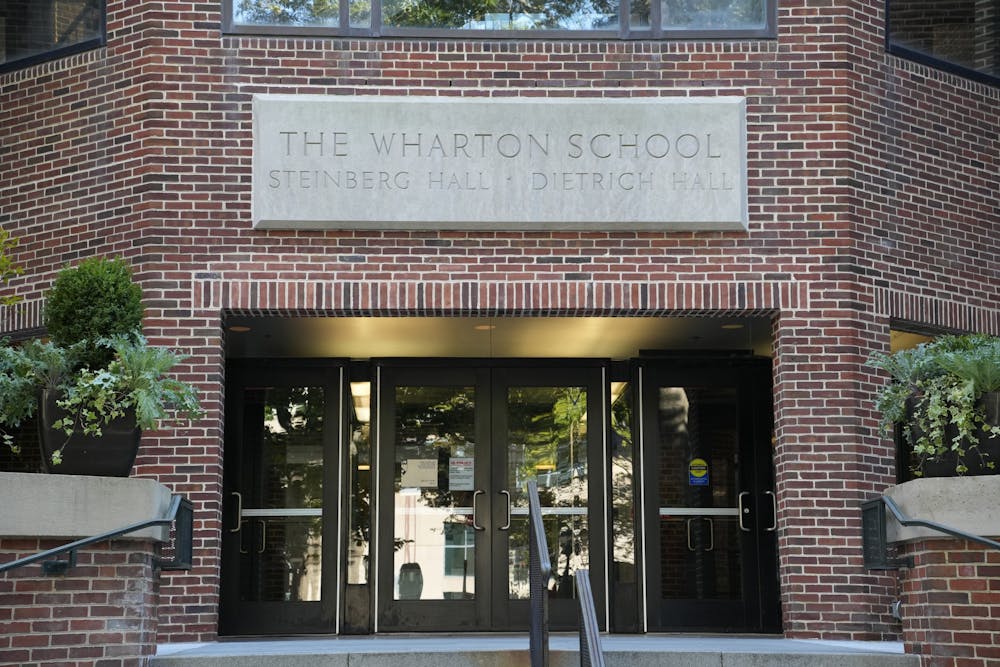
In a recent opinion piece, a Daily Pennsylvanian columnist argued that the Wharton School’s undergraduate division should be abolished, framing it as a betrayal of the liberal arts and a symptom of higher education’s moral decay. However, this caricature of the “evil” business student dramatically misrepresents Wharton, and it confuses profit and purpose as complete opposites.
A business education does not exist as the antithesis of the liberal arts at Penn. Wharton prepares future leaders and entrepreneurs by honing in on important skills: oral and written communication, critical thinking, and problem solving. Each of these skills is key to professional success, according to the Department of Labor. The Wharton undergraduate curriculum recognizes this, and it incorporates these ideals through its course requirements.
Of the 37 course units required by Wharton to graduate with a bachelor’s degree in economics, at least nine CUs relate directly to the liberal arts — more if you count the foreign language classes that many students are required to take. Beyond this basic requirement, 22% of Wharton undergraduates go beyond their foundational business courses and pursue minors, most of which are housed within the College of Arts and Sciences. Thus, a Wharton education does not exist entirely outside the study of the liberal arts.
At the same time, studying solely the liberal arts, though it may be “beautiful,” does not save one from a job dedicated to “denying your grandmother’s medical coverage,” as the recent column posits. Even within the College, 47.5% of Class of 2022 graduates reported that they would enter jobs in consulting or finance after graduation. Why would learned students in the liberal arts choose to contribute to “crimes,” as the column claims, in working for these large for-profit organizations?
This is likely because the private sector is not a moral failure. The private sector comprises approximately seven out of 10 jobs in the United States. These workplaces offer opportunities to apply one’s skills to innovate, facilitate, and grow one’s own career and knowledge, and they just so happen to do so in search of profit. Profit isn’t a dirty word. It is the mechanism that encourages progress and innovation.
To vilify profit is to misunderstand what it represents. Profit is a way to measure how much value a product or service delivers to consumers in society. It is how the market recognizes solutions that work, from groundbreaking pharmaceutical therapies to educational technology platforms like Canvas, and even everyday innovations like Owala water bottles which make it more fun to stay hydrated. A study done by the National Institutes of Health showed that the amount that would have to be spent by the government to maintain the development of all new drugs currently being produced by the private sector would have to be over 2.5 times the current total budget of the NIH. Profit is not exploitation, it’s reciprocity. Profit is often a precondition for creating lasting progress as it funds research, attracts talent, and helps good ideas come to life.
Even without buying into the notion that profit is progress, the column’s argument against undergraduate business education overlooks its potential to create social mobility. First, college is expensive. Even at a school like Penn that provides hefty aid packages, these packages generally only cover up to the cost of tuition, leaving as much as a $30,000 estimated gap that must be filled by families. For students facing this reality, pursuing a practical and employable degree is prudent, not greedy.
Especially for students from low-income backgrounds (23% of the Class of 2029 is estimated to be Pell Grant-eligible), the opportunity to earn six figures right when you graduate can be life-changing for not only the student but also their family. Many of these high-paying jobs facilitated by a business education provide social mobility that uplifts historically underprivileged students and their families.
It’s no coincidence that 86% of business-related degree recipients are extremely or very satisfied with their education, compared to only 70% of liberal arts graduates — it represents a tangible path to stability.
The liberal arts may teach us how to think, but Wharton shows us how to apply those thoughts. To pretend that profit corrupts the beauty of knowledge is to forget that every library, lab, and lecture hall stands because someone once built a business. Profit is not the enemy of morality. It incentivizes innovation, opportunity, and value for all.
An undergraduate business education is meant to turn understanding into impact. Wharton’s undergraduate program does not corrupt education or lessen the importance of the liberal arts, but instead makes them actionable. And for those who still don’t like Wharton, well, Penn has four undergraduate schools and 12 graduate and professional programs. There is something for everyone to learn from the art of enterprise.
MALIA SANGHVI is a Wharton senior from Fort Wayne, Ind. studying finance and management. Her email is malia1@wharton.upenn.edu.