“How can my child transfer to the Wharton School?”
The Kite and Key tour guides notoriously tally some version of this question across each day’s campus tours. Its framing — Wharton as an aspirational alternative to declining values of liberal arts education — reflects the semiotic power of the world’s top business school. The notion that a business education at Penn is intrinsically superior to the liberal arts has been materially disastrous. The University, the world, and Wharton students themselves would all benefit from the abolition of Wharton’s undergraduate division.
The first of its kind, Wharton’s undergraduate school sought to offer an alternative to the millennia-old liberal arts education whose goals were building well-rounded citizen-subjects. Fundamentally, undergraduate business education is premised upon replacing the traditional training of worldly knowledge, engagement across perspectives, and evaluation of claims with skills-driven education in accounting, finance, management, and business economics. Business education shifts the impetus of job training from the market to the University, a concept unthinkable before Wharton’s founding in 1881.
This program has proven fabulously effective at creating top-notch consultants and financial professionals, but it is bankrupt in the production of people. An education at Wharton isn’t building adults ready to engage with the world, but rather workers most equipped to maximize profit — an economic proposition instead of a human one.
Wharton students go on to work at the firms that have remade the American economy through endless financialization since the 1970s. They spend lifetimes at the companies denying your grandmother’s medical coverage, laying off your father, and raising your energy bills. For these crimes, they are celebrated and emulated. It is a plague on this institution that the moral character of one’s postgraduate professional life is silenced by the offer of a six-figure salary. Rather than question the premises upon which the private sector has achieved domination over public life (or gain the ability to do so through the faculties developed in undergraduate education), students are trained in the private sector’s interests.
By contrast, the liberal arts are beautiful. They are generative. While liberal arts institutions have long been places of immense contradiction, simultaneously tools of empire and ideologues of liberation, the promise of their education acknowledges that people are made, that reason is trained, that compassion is taught. Disciplinary knowledge is the vehicle to understanding the world, rather than the final goal.
To the liberal arts, knowledge is an instrument in becoming. An opening to multiple futures. It is education at its best, far from the allegations of singular perspective thrust in the compact championed by two Wharton alumni, Marc Rowan and Donald Trump.
Rowan’s criticisms of indoctrination should really be levied at Wharton, but, of course, those concerned with “indoctrination” tend to ally with the hallowed halls of capital. Whether profit is “good” is not an object of study. It’s taken as truth and never reckoned with. Promoting the collective good is treated as a small part of the calculus of organizing society, instead of its central goal. Wharton can pretend to offer the world a service, but the truth is clear: Its dogma hollows its students and enriches the ultra-wealthy.
This is not something that can be reformed. As long as Wharton’s hyper-visible exterior markers of success exist, its ethos will be replicated by students conditioned on elite reproduction. Six of the other seven Ivy League schools do not offer undergraduate business degrees, and they do not suffer from the rot that Wharton brings onto our campus. As long as we institutionally back business education, the slowness required to mull on the questions of being alive will be eschewed for a fourth coffee chat and eighteenth job application. “Education” and universities will continue to be career credential-ers, the gateways for top companies, instead of places of making and remaking the self.
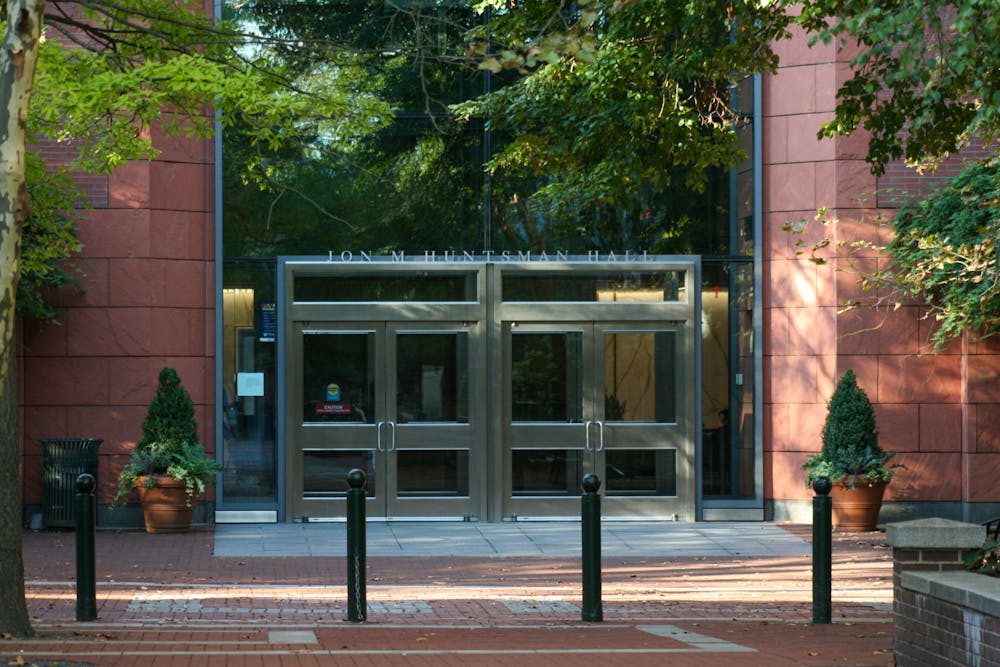
This is not to say that the College of Arts and Sciences, or the liberal arts, are perfect. The College’s evil alumni list includes the ranks of Elon Musk, the richest man in the world. Nor will I pretend liberation will ring from the halls of a place premised on maintaining the power of the upper class. But true education has no chance to succeed with the dome of Huntsman Hall looming overhead. A re-grounding in liberal arts is a minimum step to dampen the social ill that emanates from Penn.
Business students and their spiritual allies across the University have given up the greatest opportunity college offers: personal and intellectual development. It is clear to anyone not blinded by shiny objects that undergraduate business education is a failed experiment. It’s time to abolish Wharton.
NIHEER PATEL is a College junior studying History and English from Atlanta. His email is niheerp@sas.upenn.edu.