

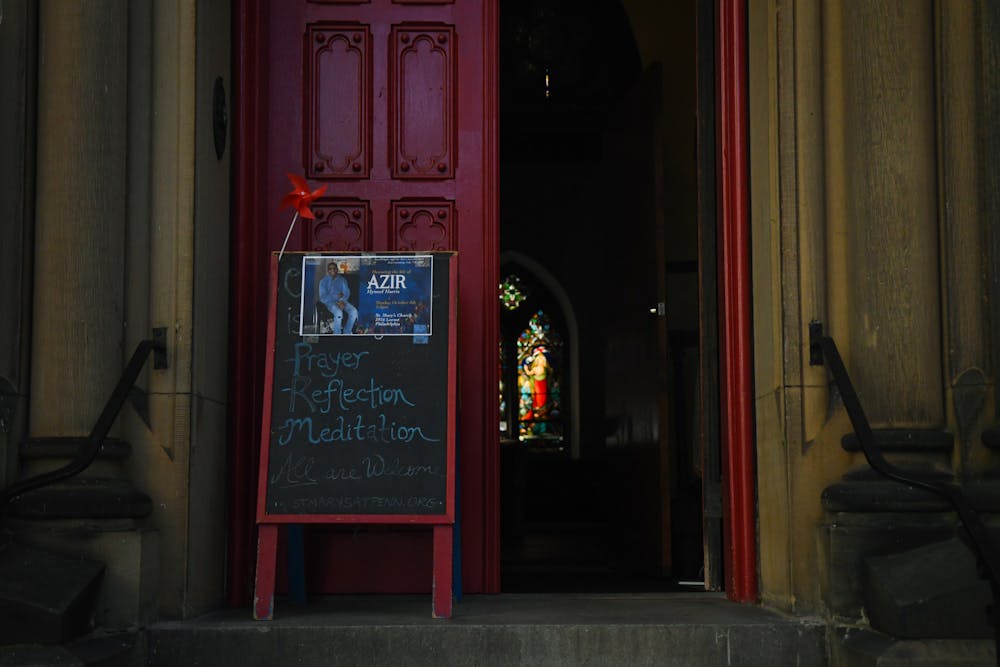
Around 40 members of the Penn and Philadelphia communities gathered for a vigil honoring the life of Azir Harris on Sunday evening.
Harris — the youngest son of Troy Harris, who has worked at Penn Hillel as a Kosher chef for 25 years — was shot and killed in the Grays Ferry shooting on July 7. The Oct. 5 vigil took place at St. Mary’s Church on Locust Walk and was organized by the Harris family and the Lotus Collective, a student group at Penn dedicated to alternative forms of protests.
During the event, speakers took turns reflecting on the life and legacy of Harris, who was 24 years old at the time of his death. Following the remarks, attendees lit candles in his memory.
“After Azir died, I felt — and I think we as a group felt — that we needed to speak directly about what is happening to Black youth in the city,” 2019 Wharton graduate and vigil co-organizer Michelle Lyu said in her introductory speech. “This is a stand that we wanted to take to say that this is a young man who deserved to live, who should not have died."
Several of Azir Harris’s family members also spoke about his positive impact on their community.
“He lived with strength and courage to the best of his powers,” Azir’s mother, Debbie Harris, said during the vigil.
Azir’s sister, Tory, described how Azir “cherished [his] loved ones, family and friends” and “always gave [his] support.”
Many speakers also emphasized the importance of education and institutional support for the Black community in Philadelphia — and criticized Penn for failing to provide that support.
RELATED:
Penn alumni donations establish Jewish Studies endowed professorship, graduate program
Penn Hillel welcomes parents of Oct. 7, 2023 hostage Itay Chen to speak at event
Lyu expressed her belief that Penn has not "lived up to the potential of what it can be," adding that the University has an “extractive relationship” with “the people of this city and the Black community in particular.”
“Instead of providing a steady education and stable jobs for the community, it has been a force of violent private gentrification for decades,” she said.
Troy Harris similarly reflected on his own personal experiences, describing Penn as “a place where [I felt] like [I’d] get a decent [chance at the] dream of education here … to save [my] family.”
“I’ve been on this campus for twenty-something years without ever being offered that,” he said.
Still, Harris mentioned his optimism for the future of his “next generation.”
“Knowledge is power,” he said. “If we [got] that power now, that'd make it worth my 27 years at this Ivy League institution.”
Lyu spoke with The Daily Pennsylvanian after the event about the process of organizing the vigil, recounting the "disappointing decision” from the administration to reject their initial request to host the event on College Green. She attributed Penn's decision to the fact that "members of the non-Penn community who were expected to attend."
“Something in our lives as students is definitely missing until we're able to inherit the experience and the meaning of somebody like Azir's life,” she said. “We each need to work and struggle where possible to overcome these artificial divisions that have been made between us and the people of the city, especially the people who suffer in the city and suffer unjustly.”
RELATED:
Penn alumni donations establish Jewish Studies endowed professorship, graduate program
Penn Hillel welcomes parents of Oct. 7, 2023 hostage Itay Chen to speak at event
Senior reporter Christine Oh leads coverage of student life and can be reached at oh@thedp.com. At Penn, she studies English and philosophy. Follow her on X @ChristineOh_.


