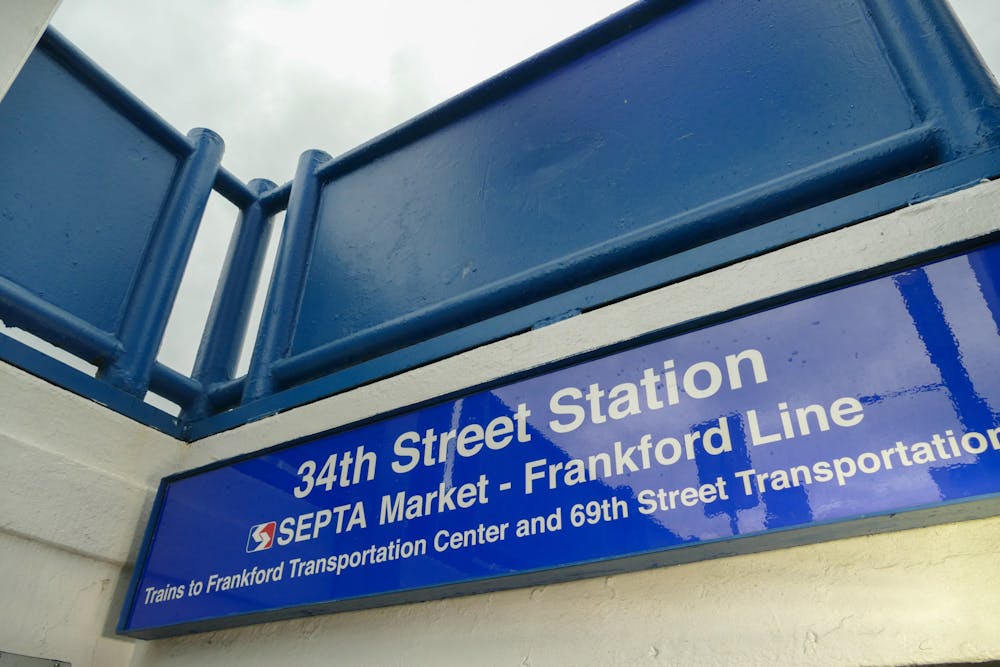
The Richards Transportation Initiative at Penn — led by former CEO of SEPTA and Weitzman professor in practice Leslie Richards — is set to launch on Oct. 17, connecting academic research with the “practical needs” of transportation agencies across the country.
Housed in the Institute for Urban Research, the program will convene transportation practitioners, private-sector partners, students, and faculty to tackle challenges including safety, mobility access, technology deployment, and procurement. R-TRIP will be advised by a public sector advisory committee of 20 leaders from major transit authorities and state departments of transportation.
Richards will lead the initiative as founder and executive director. She said that running two of the nation’s largest transportation agencies showed her how difficult it was to stay updated with academic research while managing daily crises.
“When I was leading those agencies, I was not aware of all the wonderful research that was being done around me,” Richards said in an interview with The Daily Pennsylvanian.
A central priority for R-TRIP is helping transportation agencies modernize technology systems.
Richards explained that many agencies still rely on outdated mainframes and need support adopting tools like data analytics and artificial intelligence to improve day-to-day operations. The initiative will also take on procurement reform by studying Pennsylvania’s state regulations for contracting transportation projects.
“We hope to show other states what we've learned, and if they choose to, they can take that information and cater it to their own states,” Richards said.
Priority areas include artificial intelligence and predictive analytics for crash prevention, smart infrastructure that responds to real-time user behavior, and mobility data platforms to support decision-making.
RELATED:
From internships to exploration, impacts of SEPTA cuts felt across Penn community
PennDOT approves use of capital funds for SEPTA, paving way for service restorations
Connecticut Department of Transportation Secretary Garrett Eucalitto — a member of R-TRIP’s advisory board — wrote in a statement to the DP that he joined the committee because of Richards’ “forward thinking” and ability to recognize the diversity of the nation’s multimodal system.
Eucalitto added that R-TRIP’s value lies in translating complex academic work into tools state agencies can actually use.
Since DOTs and other transit systems are “zero-fail organizations,” where safety leaves little room for risk, the initiative can give agencies a trusted space to compare strategies and feel more confident adopting new technologies.
Denver's Regional Transportation District General Manager and CEO Debra Johnson — also a part of R-TRIP’s advisory board — highlighted the role of practitioners in shaping solutions.
She said the committee will ensure that researchers hear “the right voices in the same room,” pointing out practical considerations such as engaging labor unions when deploying AI in scheduling.
“We have to ensure that we are engaging with our organized labor … so they don’t feel as if they’re going to be replaced,” Johnson said.
Weitzman City and Regional Planning Chair Megan Ryerson, who will serve as lead faculty advisor, first approached Richards about creating the initiative. She emphasized that R-TRIP reflects Penn’s ability to convene across disciplines and connect research directly with the nation’s most urgent transportation challenges.
“We are bringing collaborations to scale and connecting transportation leaders across the U.S. with the engaged transportation scholarship happening here at Penn,” Ryerson wrote in a statement to the DP.
Co-director of Penn IUR Eugenie Birch said the Institute saw R-TRIP as a natural fit given its history of incubating initiatives and Penn’s depth in transportation research. She added that Richards’ national network of agency heads will allow the initiative to advance both new directions for the field and applied research opportunities for students.
“The idea is that [Richards, Ryerson, and the advisory board] will engage in research, show best practices, and convene to get lots of ideas out there,” Birch said in an interview with the DP. “It’ll be a great benefit to transportation throughout the United States, but also of great benefit to Penn.”
Birch added that students at all levels, from undergraduate researchers to PhD candidates, will have access to various potential projects associated with R-TRIP. She pointed to opportunities such as the Urban Research Colloquium, senior theses, and master’s and PhD projects as entry points for students to connect with R-TRIP.
Sponsors of the initiative include major industry partners such as Google Public Sector and Bentley. The Oct. 17 launch will feature student showcases and interactive discussions, concluding with a fireside chat with Vice President of Google Public Sector Leigh Palmer.
Richards hopes the initiative will produce measurable outcomes that improve everyday life.
“When mobility works well, our quality of lives are better and people’s lives work better,” Richards said.
RELATED:
From internships to exploration, impacts of SEPTA cuts felt across Penn community
PennDOT approves use of capital funds for SEPTA, paving way for service restorations
Staff reporter Phoebe Anagnos contributes to data and enterprise reporting and can be reached at anagnos@thedp.com. At Penn, she studies architecture and earth science. Follow her on X @phoebeeanagnos.