

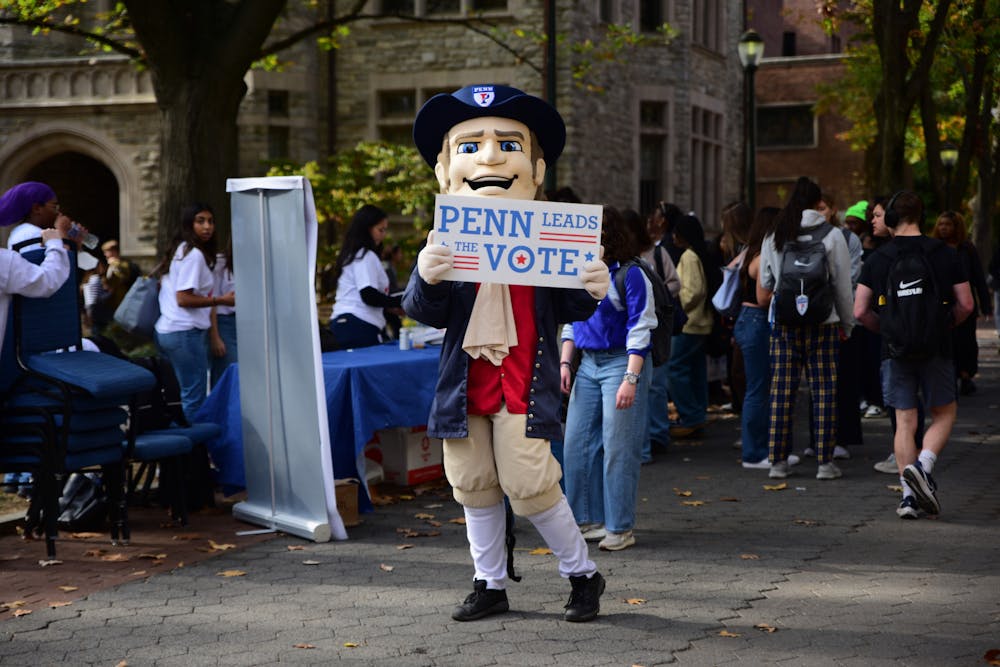
As Pennsylvania's Oct. 20 voter registration deadline approaches, The Daily Pennsylvanian spoke to experts and professors at the University about the importance of local and state elections.
The faculty members said that this year's off-cycle elections could serve as a crucial metric of the first months of 1968 Wharton graduate and President Donald Trump's second term. Amid lower, off-year turnout, they argued, individual voters will have an outsized impact on several notable local and state races.
In Pennsylvania, the state Supreme Court race has gained a heightened level of competition and scrutiny.
Stephen Pettigrew — a Penn Political Science professor and faculty member at Penn's Program on Opinion Research and Election Studies — told the DP that in previous years, local races did not garner much attention. However, Pettigrew said that the "new normal" is for formerly overlooked down ballot elections to gain increased media coverage.
"This Supreme Court race here in Pennsylvania — it's going to be basically like a partisan type election," Pettigrew said. "You don’t have a [Democrat] and [a Republican] on the ballot itself, but it's probably going to break down along pretty predictable partisan patterns."
Director of Domestic Policy Programs at Penn Washington Elizabeth Klein attributed the increased attention on state court elections to several factors, including ongoing debates over voting rights.
Klein said that the Supreme Court's 2022 overturning of Roe v. Wade has resulted in a situation in which state laws take a more "outsized and important role in how reproductive health rights are either curtailed or supported state by state."
State judicial elections have the power to now serve as a benchmark for future state and national elections, according to several University faculty members.
RELATED:
Here’s what could happen if Penn signs the White House compact
Marc Rowan helped draft the White House compact. The ideas echo his 2023 plan to reform Penn
"The court has made significant rulings on abortion, gun rights, mail-in voting, and redistricting in the past decade, and these issues will no doubt come up again in the future," Political Science professor Matthew Levendusky wrote in a statement to the DP.
Levendusky encouraged citizens to research judicial candidates' positions and "decide for themselves if they deserve another term on the bench."
Penn Political Science professor and PORES Director John Lapinski additionally highlighted that this year’s election will "decide who controls the Supreme Court in a battleground state in the 2028 presidential election."
Alongside the state Supreme Court election, there are several city-wide offices on the ballot this year – including an election for the Philadelphia District Attorney and City Controller. Political Science professor Daniel Hopkins told the DP that a previous DA election indicated popular opinion on Trump after the start of his first term in 2017.
Hopkins said that DA incumbent Larry Krasner — who is up for reelection this year — benefitted from "an electorate where many liberals were mobilized and energized" and did not have the opportunity to vote in federal elections for another year.
He said that it remains unclear whether the same phenomenon will occur this year.
"Is it possible that some of the communities here in Philadelphia that are the most anti-Trump are going to show high levels of turnout? Yeah, that is possible. It’s also possible that there is some level of political apathy," Hopkins said, adding that national polling seems to indicate a "somewhat more limited anti-Trump mobilization than there was eight years ago."
Penn faculty also emphasized that the smaller scale of local elections means individual votes have a greater impact on the outcome.
"A feature of these local races is that there's a higher chance that there's going to be some really close elections out there," Political Science professor Marc Meredith told the DP. "Inevitably … there'll be some local race that's decided by a very small margin — maybe even a tie or a single vote — and so I think your votes have more chances to be consequential about who wins in those types of elections."
Hopkins similarly noted that the "electorate is meaningfully smaller" in local elections, so the "probability that we … can have an impact is higher in these kinds of elections."
The lower turnout, Pettigrew argued, may benefit Democratic candidates up for election this year.
"Republicans used to have sort of a built-in advantage because prior to Trump, a lot of the Republican base was like highly educated, wealthy folks in suburbia, and people who have college [and] graduate degrees," Pettigrew said.
This demographic has "disproportionately shifted toward the Democrats," he added, noting that Democrats have performed better in special elections over the past decade. Looking ahead to the results, Pettigrew suggested that Democratic performance relative to the 2024 presidential election would serve as a "key barometer for both parties."
"If these races are extremely similar to the results from 12 months ago in the presidential election, I think the Democratic Party is going to be hitting the panic button," Pettigrew said, adding that momentum "should be in their direction."
The elections in Pennsylvania come amid several other notable races across the country — combined, Penn experts argue, the races will help set a tone for the 2026 midterms and the 2028 presidential race.
"The nationalization of politics has just made it so that however people are feeling about the president or the party in control, it trickles all the way down to these local races, and that's what is on top of mind when people enter the voting booth," Pettigrew said.
The New Jersey gubernatorial race has drawn particular attention after Trump lost the historically blue state by single digits in 2024, a significantly narrower margin than in previous election cycles. According to Klein, races in both New Jersey and Virginia could have major impacts on environmental policy.
"Virginia has the greatest concentration of data centers in the country right now," Klein told the DP. "Lots of communities have expressed concern about the energy demands associated with data centers and what it's going to do to energy prices and renewable energy."
Klein also noted that New Jersey has emerged as a climate policy leader, particularly as federal action has stalled.
"New Jersey has been a real leader in its climate policy and its setting of emissions reduction goals," she said. "Particularly at a time when the federal government is leaving the field, so to speak, on climate policy, the states play an incredibly important role."
Besides key issues, off-year elections typically focus more heavily on local concerns and candidate personality than presidential or midterm years. In national elections, Klein said that "down-ballot races can ride the coattails of higher-profile campaigns."
Pettigrew told the DP that voters around the country will likely be motivated by issues like immigration, the ongoing government shutdown, and healthcare — as well as "bread and butter issues" like grocery prices and inflation.
"The people who tend to turn out in a low turnout election tend to be the ones who are most upset about what's going on," Pettigrew said "It's easier to get people motivated to vote when they're mad about something than when they're happy about how things are going."
The last day to register to vote in Pennsylvania is Oct. 20. Election day will take place on Nov 4.
Staff reporters James Wan, Rachel Erhag, Kathryn Ye, and Ananya Karthik contributed reporting.
RELATED:
Here’s what could happen if Penn signs the White House compact
Marc Rowan helped draft the White House compact. The ideas echo his 2023 plan to reform Penn
Senior reporter Riana Mahtani covers national politics and can be reached at mahtani@thedp.com. At Penn, she studies political science. Follow her on X @Riana_Mahtani.
Senior reporter Alex Dash covers administration and can be reached at dash@thedp.com. At Penn, he studies history and political science. Follow him on X @AlexBDash.


