

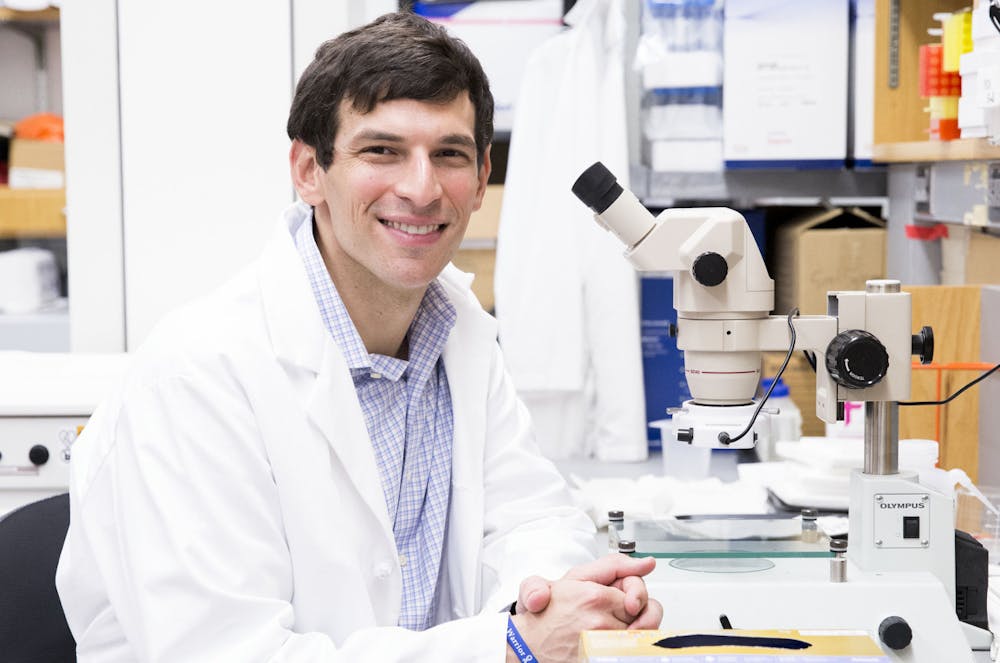
Perelman School of Medicine graduate and Penn Medicine immunologist David Fajgenbaum was recently awarded the John Scott Award, one of the oldest science awards in the United States.
The John Scott Award, which Fajgenbaum is set to receive by the American Philosophical Society, is presented to individuals whose inventions have improved the “comfort, welfare, and happiness” of humankind. Two other scientists, both faculty at Princeton University, will also receive the award, which includes a $10,000 cash prize.
As a third-year student in the Medical School in 2010, Fajgenbaum was diagnosed with idiopathic multicentric Castleman disease, a rare, life-threatening disorder associated with organ dysfunction and systemic inflammatory symptoms. To test for abnormalities, he began storing vials of his own blood.
After discovering that a specific protein in his blood tests was high, Fajgenbaum remembered something he learned in class: A specific drug used on organ transplant recipients helps to suppress the very same protein. Fajgenbaum convinced his doctors to repurpose the drug and try it on himself, and it ended up saving his life.
Fajgenbaum has since founded the nonprofit Every Cure, which uses artificial intelligence technology to identify matches between available drugs and information on rare diseases. When scientists looked for these matches prior, they had to look at each disease and drug individually. The AI technology thus increases research efficiency.
Additionally, Fajgenbaum co-founded the Castleman Disease Collaborative Network in 2012 with the hopes of accelerating research and treatment for Castleman disease. Fajgenbaum has also authored over 100 scientific papers in journals like “The Lancet” and wrote the bestselling memoir “Chasing My Cure: A Doctor’s Race to Turn Hope Into Action,” the story of which will be adapted into a movie.
Since Fajgenbaum’s recovery, other Castleman disease patients have also seen more effective treatments and higher survival rates. He has helped to advance 14 repurposed treatments for cancer and rare diseases.


