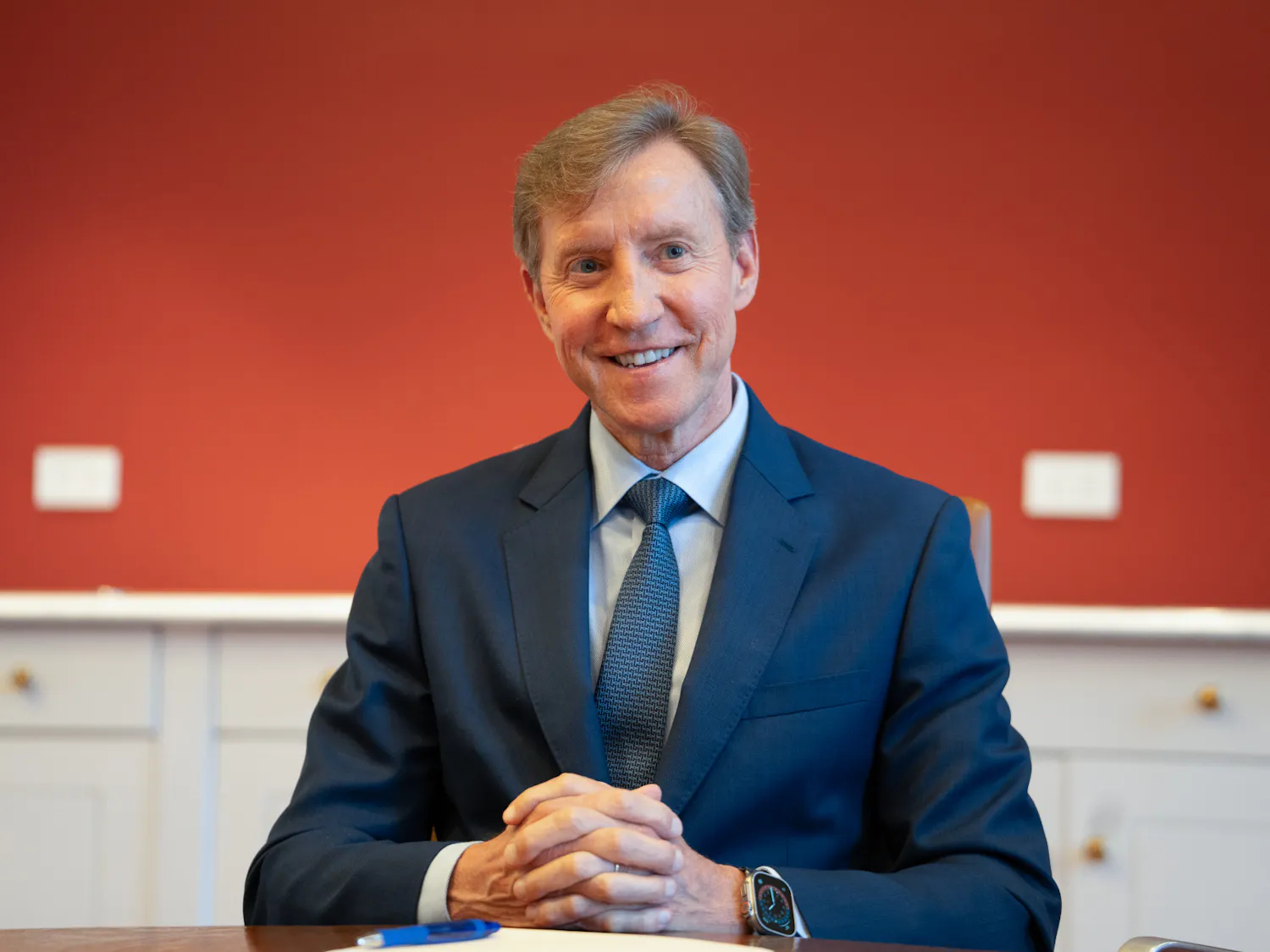
The Wharton School’s Board of Advisors Chair Marc Rowan has long been one of the University’s most influential figures. But in recent years, Rowan has become a defining force in shaping not only Penn’s internal governance, but also national politics.
Since the reelection of 1968 Wharton graduate and President Donald Trump — who considered Rowan for a seat on his cabinet as secretary of the Department of the Treasury soon after his election victory — Rowan’s political influence has steadily grown. A Daily Pennsylvanian analysis found that in the first two fiscal quarters of 2025, Rowan contributed millions to primarily Republican-aligned groups and candidates.
A spokesperson for Rowan did not respond to a request for comment.
As evidence of Rowan’s sustained efforts to leverage political influence during the second Trump administration continues to surface, the DP analyzed disclosures of his political contributions from the first six months of 2025.
According to Federal Election Commission disclosures, Rowan contributed over $3 million to political committees and candidates in the first and second 2025 fiscal quarters. His giving pattern shows a strong concentration in Republican-aligned groups, with most of his contributions directed toward high-level party and political action committee entities and a smaller share distributed among individual candidates.
The majority of Rowan’s contributions were made in two $1,000,000 donations to the Congressional Leadership Fund and Senate Leadership Fund — GOP super PACs that work to elect Republicans to the U.S. House of Representatives and U.S. Senate, respectively.
He made an additional $310,100 contribution to the National Republican Congressional Committee, the House GOP’s campaign arm, and donated $289,100 to the National Republican Senatorial Committee — the GOP’s upper chamber campaign arm.
Rowan also made $100,000 donations to two super PACs: Security is Strength PAC — a group associated with Sen. Lindsey Graham (R-S.C.) — and Texans for a Conservative Majority, another high-dollar committee backing Republican candidates.
The campaign contribution records show that Rowan donated $7,000 — the maximum amount an individual can donate to a candidate per election cycle — to nearly a dozen congressional officials.
Among them was a $7,000 contribution to Rep. Tim Walberg’s (R-Mich.) campaign, who has made investigating allegations of antisemitism on college campuses a priority of his tenure as chair of the U.S. House Committee on Education and the Workforce.
Under Walberg’s leadership, the committee has launched several investigations and hearings into alleged antisemitism at universities and public schools.
The Committee on Education and the Workforce played a key role in shaping Penn’s administration and actions over the two years following the Oct. 7, 2023 Hamas attack on Israel.
U.S. Rep. Virginia Foxx (R-N.C.) — who preceded Walberg as the chair of the committee — launched several investigations into antisemitism at Penn and presided over the 2023 hearing that led to the resignation of former Penn President Liz Magill.
After the former University leader's remarks during the testimony faced national scrutiny, Rowan orchestrated a pressure campaign that ultimately led to the resignation of Magill and former University Board of Trustees Chair Scott Bok.
U.S. Rep. Jason Smith (R-Mo.) has chaired the U.S. House Ways and Means Committee since January 2023. Rowan contributed $315,100 to Smith Victory, a joint fundraising committee associated with Smith’s campaign, and an additional $5,000 to a PAC supporting the Missouri representative.
Penn was subject to a Ways and Means Committee investigation in 2024, which challenged the University’s tax-exempt status. The committee — citing Penn’s “failure” to protect Jewish students on campus — alleged that the University failed to comply with antidiscrimination laws and was therefore ineligible for tax exemptions.
The Education and Workforce, Judiciary, and Ways and Means Committees joined three other House Committees in a broad investigation of “ongoing and pervasive acts of antisemitic harassment and intimidation” on college campuses — including Penn — in June 2024. A letter sent to universities being investigated claimed that they had violated Title VI of the Civil Rights Act by failing to “ensure a safe learning environment for all students.”
Rowan also donated $12,000 to the campaign and associated PACs of U.S. Rep. Jim Jordan (R-Ohio), who serves as chair of the U.S. House Judiciary Committee.
Under Jordan’s leadership, the committee launched a price-fixing investigation into Penn and other Ivy League universities in April. The investigation alleged that the Ivy League violated antitrust laws by colluding to raise tuition costs and engaging in unfair financial aid practices.
The committee subpoenaed Penn in July, accusing the University of inadequately submitting the documents on tuition pricing and communication with peer institutions requested during the probe.
Rowan, who holds a 1984 bachelor’s degree and a 1985 MBA from Wharton, has been a prominent donor to Wharton for years.
In 2018, Rowan gave a $50 million gift — at the time the largest single contribution in the school’s history — and made an anonymous $10 million gift in May. The latter came around a year and a half after Rowan publicly announced that he was withholding donations to the University in protest of Penn’s response to campus antisemitism allegations.
In May, Rowan also publicly called for “fundamentally reforming” higher education across the country, arguing that the Trump administration was in a uniquely apt position to usher in an era of change.
On Oct. 1, Penn and eight other universities received the Trump administration’s wide-ranging compact — a document whose language closely mirrored a list of reform questions Rowan had sent to the University Board of Trustees nearly two years earlier.
The New York Times later reported that Rowan was a chief architect of the document and insisted that the compact be sent to his alma mater.
One day after Penn rejected the federal government’s proposal on Oct. 16, Rowan joined a call with University leaders and senior White House officials as discussions over the compact continued.
Senior reporter Alex Dash leads coverage of politics and can be reached at dash@thedp.com. At Penn, he studies history and political science. Follow him on X @AlexBDash.
Jasmine Ni is the Executive Editor of The Daily Pennsylvanian, Inc. and can be reached at ni@thedp.com. At Penn, she studies English and political science. Follow her on X @JasmineNi_.