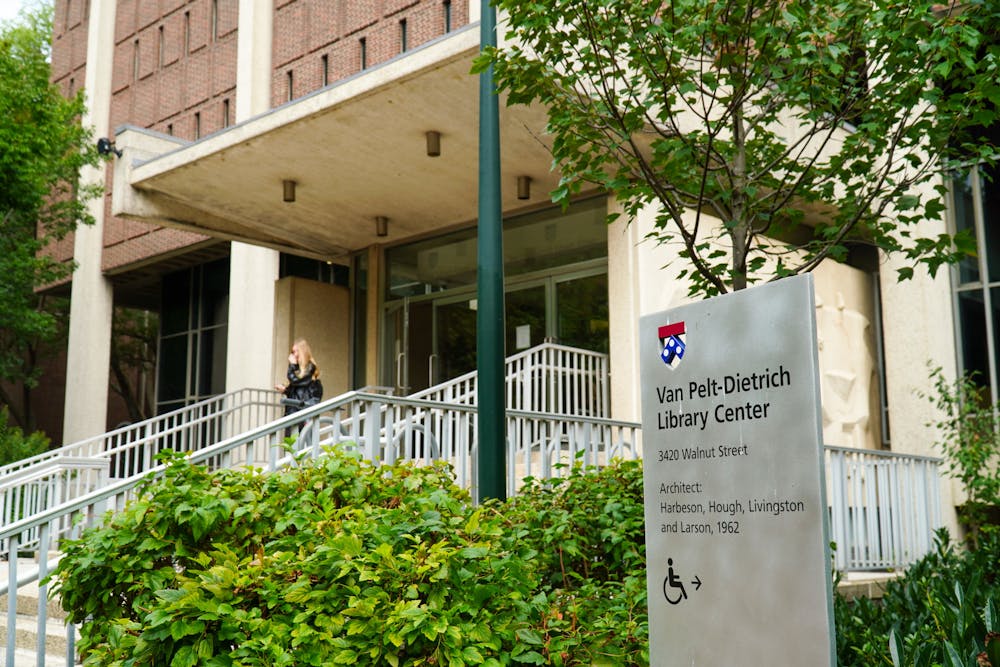
On Friday, Penn Libraries opened a new exhibit in the Van Pelt-Dietrich Library Center that explores the reception of Aristotle’s texts and ideas throughout time.
The exhibit, titled “Reinventing Aristotle,” opened on Oct. 3 in the sixth-floor Goldstein Gallery. It draws upon Penn’s extensive Aristotelian archival collection, including translations, commentaries, and even texts mistakenly attributed to the Greek philosopher.
Exhibit co-curator Eva Del Soldato, who also serves as a professor of Italian studies, spoke to The Daily Pennsylvanian about how Penn’s vast resources inspired the co-curators to pitch the idea for the exhibit to Penn Libraries in 2024.
Lynne Farrington — director of programs and senior curator of special collections at the Kislak Center, and another co-curator of the exhibit — similarly emphasized the inspiration of Penn’s “major collection” of over 1,000 editions of Aristotelian texts.
The exhibit displays items ranging from the fourteenth-century manuscripts to a twenty-first-century cardboard cutout of Shaquille O’Neil — the “Big Aristotle” — and draws the attention of visitors towards Aristotle’s prevalence across time periods. A “huge proportion" of this collection comes from sources written before the 18th century, Farrington told the DP.
Given the age of some of the manuscripts in the collection, all objects put on display underwent a thorough conservation review to “make sure that things are safe enough to be displayed,” Director of Exhibits at Penn Libraries Brittany Merriam explained, with the page and pitch of books approved by conservators.
Exhibit co-curator and 2009 College graduate Hannah Marcus underlined the translingual dissemination of Aristotle in the Early Modern world.
She told the DP that the “texts that were circulating in Ancient Greek are being translated into Arabic and Persian,” while also observing the Turkish, Syriac, and Hebrew traditions that adopted Aristotle.
RELATED:
Kislak Center exhibit showcases formation of Penn through Revolutionary War
New Penn Museum exhibition features archaeological images taken by students and researchers
“This is what it means to reinvent Aristotle,” Marcus said, “[it] is to reinvent a new vocabulary, a new language for thinking about Aristotle.”
The co-curators also highlighted the reception and appropriation of Aristotle among various religious groups.
“We’ve got a great case [in the exhibit] on religious debates about who gets to claim Aristotle,” Marcus said, adding that multiple religious groups were “laying claim to Aristotle’s religious orthodoxy at the same time.”
Del Soldato highlighted this instance as one example of how Aristotle has been “ventriloquized” throughout the centuries.
The exhibit as a whole seeks to “challenge” the notion that Aristotle is a “boring” and “authoritative” figure, according to Del Soldato.
“The main goal [was] … to present a friendly face of Aristotle,” Del Soldato said, in order to “foster conversation about issues that commonly would be perceived as settled.”
Alongside the physical exhibit, “Reinventing Aristotle” is accompanied by an online curation. This project was developed by two Penn graduate students: second-year Italian studies Ph.D. student Sarah Marie Leitenberger and second-year French and Francophone Studies Ph.D student Youri Buyle.
Using Manifold software, Leitenberger and Buyle uploaded and arranged high-quality scans and photographs of the artifacts on display at the exhibit to create an online learning resource.
“One of our main concerns has been not just to have [the exhibit] broadly accessible … but to have it accessible also after the exhibition has ended,” Leitenberger said to the DP.
Buyle also stressed the importance of the online exhibit in making material more widely available.
“I think knowledge should be shared, because if you don’t … it’s not that useful,” she added.
The Schoenberg Center for Electronic Text and Image digitized manuscripts within the Penn Archive, enabling the digital curators to assemble the online collection. Students may access this digital archive through the Colenda Digital Repository.
On Dec. 2, Penn Libraries will host Mary Fissell, a professor of history at Johns Hopkins University, to speak about the material contexts of ”Aristotle’s Masterpiece.” The 1684 first edition of the manuscript is currently on display at the exhibit.
The ”Reinventing Aristotle” exhibit will remain open to the public until January 2026.