

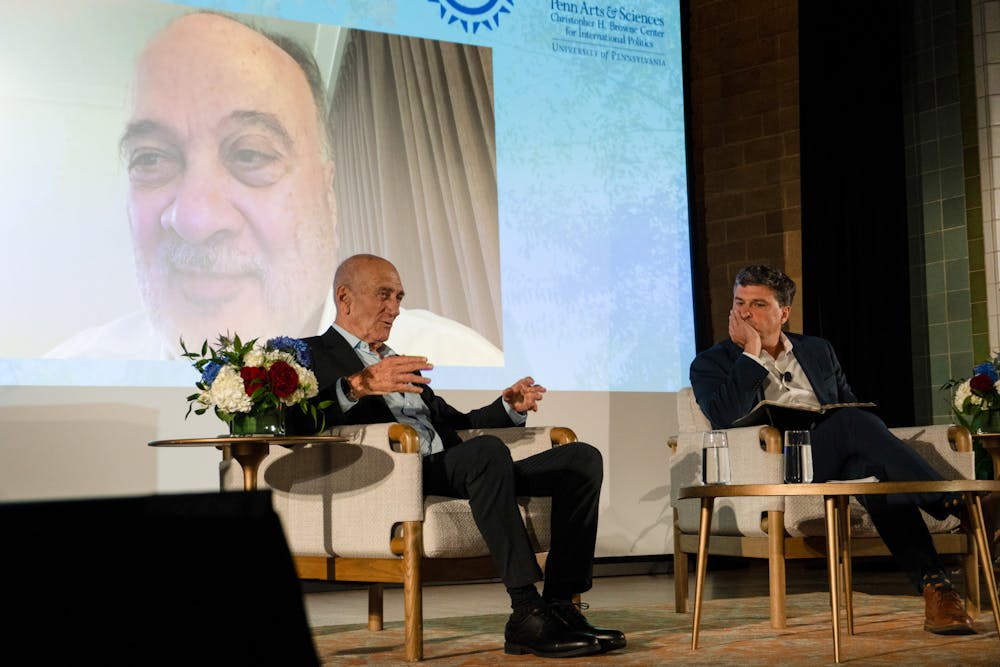
Penn hosted a discussion between former Israeli Prime Minister Ehud Olmert and former Palestinian Authority Foreign Minister Nasser Al-Kidwa about the ongoing conflict in Gaza on Monday.
The event — moderated by New York Times reporter Mark Mazzetti — was open to the University community and organized by Perry World House, alongside other Penn organizations like the Andrea Mitchell Center for the Study of Democracy. The discussion focused on the creation and possible outcomes of a peaceful two-state solution between Palestine and Israel.
Two weeks after Israel and Hamas agreed to the initial phase of the Trump administration’s plan for a ceasefire, both speakers expressed that the proposed plan “might lead to something slightly better than the current situation” if the right steps are taken to address the reconstruction of Gaza and find a solution. Olmert — who served as Israel’s prime minister from 2006 to 2009 — cited the ceasefire in Gaza as “an important step” but warned that it should not be mistaken for an end to the conflict.
“This is not a peace treaty,” Olmert explained during the event. “These are 20 points which, if implemented, may bring an end to the war in Gaza, but it’s only the beginning.”
Al-Kidwa, who virtually attended the event from the West Bank, emphasized that Palestine should lead its own reconstruction and future governance.
“Any Palestinian territory must be governed by Palestinians,” Al-Kidwa said during the event. “You cannot have a board of directors governing Gaza. The alternative should be a new Palestinian body that is organically linked to the president’s authority. Hamas must end its control over Gaza in all its forms — political, administrative, and security.”
He expressed that the United States could take a larger role in negotiations because 1968 Wharton graduate and President Donald Trump “is the only one left that Netanyahu can be assisted by.”
“What I’m hopeful for, and want, is that Trump will use this power of association that he possesses on Netanyahu to force him another step forward into what may start the process of this negotiation,” Al-Kidwa continued. “If the U.S. president takes it one step further and forces the sides to enter into a dialogue about comprehensive peace, it may become a turning point.”
Olmert previously attended the 2007 Annapolis Peace Conference and proposed a two-state peace plan to Palestinian President Mahmoud Abbas in 2008. He acknowledged that deep political polarization in Israel, alongside lingering trauma from the Oct. 7, 2023 Hamas attacks, has hardened public opinion against negotiations.
“In modern Jewish history, there has not been a day since the Holocaust that felt as dark as that Saturday,” he explained. “This is not something that can be changed rapidly.”
Olmert also condemned “violent settlers” in the West Bank from Israel who are “committing crimes of the worst possible kind against innocent people living in the West Bank.”
Both speakers addressed the humanitarian crisis in Gaza, calling for immediate aid.
“It is incumbent upon Israel to make sure that humanitarian supplies are provided,” Olmert said. “We can’t afford even one person starving.”
Al-Kidwa called it “imperative” that the international community “solve the humanitarian crisis” and bring the “people in Gaza to some kind of situation that resembles normal.”
The speakers also discussed the question of future Palestinian leadership following the potential release of imprisoned political figure Marwan Barghouti, with Al-Kidwa explaining that leadership should ultimately be determined through election.
The event concluded with both leaders emphasizing the importance of “hope” for the future.
“We need to be able to rid ourselves of the experiences of the past in order to be ready to look towards a different future that offers hope for the younger generations of Palestinians and Israelis,” Olmert said. “They are sick and tired of fighting and killing and trying to eliminate each other.”
For many Penn students in attendance, the forum was an opportunity for civil discussion about a complex issue.
College seniors Sarah Usandivaras and Meal Dhaliwal expressed that the event was “really important” because it provided a “unique” opportunity to hear different perspectives.
“The dialogue was extremely essential to what Penn wants us to learn about the world,” Usandivaras told The Daily Pennsylvanian. “[The speakers] combined real-world situations, but they also represented their respective perspectives.”
Dhaliwal told the DP that she appreciated the balanced tone of the discussion.
“I really appreciated that there were two sides,” Dhaliwal said. “I thought it was very indicative of a two-state solution, and it gave me a lot more hope and positivity that it could actually happen.”
Staff reporter Mishal George covers University finances and can be reached at george@thedp.com. At Penn, she studies journalism and political science. Follow her on X @mishalgeorgee.





