

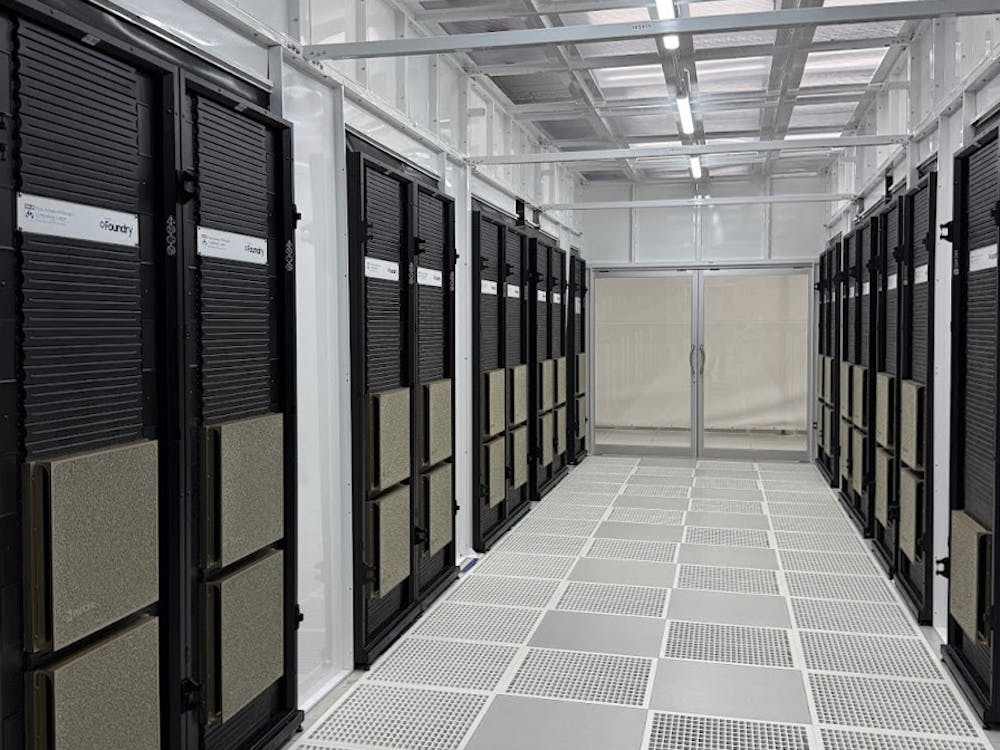
Six months since Penn’s supercomputer — named Betty — became operational, The Daily Pennsylvanian spoke to experts about its energy footprint and potential to support University research.
The supercomputer, ran by the Penn Advanced Research Computing Center, was added to the Flexential Philadelphia Collegeville data center in July 2025. Located approximately 30 miles from Penn’s campus, Betty was designed to handle artificial intelligence programs that can interpret large datasets and produce increasingly refined results.
John Quigley, senior fellow at the Kleinman Center for Energy Policy, described that while data centers are often criticized for their massive energy demands, Betty’s electricity consumption is actually far lower than that of other facilities in the state.
According to him, Betty consumes approximately one megawatt of electricity, or enough to power 1000 homes.
“That sounds big, but the biggest data center proposal in Pennsylvania is 4500 times that,” Quigley said. “It probably will grow, [but] even if it doubles, it’s still going to be tiny compared to the major commercial data centers.”
Vice Provost for Research and bioengineering professor David Meaney said Penn made the choice to “co-locate” Betty in Flexential’s larger facility to avoid draining resources from local communities.
“Consolidating computing into a colocation facility reduces the need for duplicative non-scalable data centers across campus, and it is more energy‑efficient and lowers long‑term environmental and financial costs,” Meaney described.
PARCC Associate Director of AI and Technology Kenneth Chaney previously told the DP that by locating Betty in a data center off campus — rather than in Philadelphia — Penn researchers were able to expand their computing capabilities without straining the city’s power grid.
RELATED:
Wharton partners with consulting company to model skill valuation for jobs in an AI era
Here’s how Penn faculty are finding ways to make AI more sustainable
According to PARCC Executive Director Jaime Combariza, the supercomputer will assist Penn research in a variety of fields.
“PARCC provides resources that advance research in genomics, new materials design, astrophysics, condensed matter, computational fluid dynamics, natural language processing, and many other disciplines that make effective use of computational tools,” he wrote.
Engineering professor Benjamin Lee also explained how the center could help lower research costs at Penn.
“By building its own data center, they are able to negotiate independently with providers of hardware and then also figure out what their own pricing model is,” he said. “Researchers in the Penn community will be able to access GPUs at lower rates, at lower prices than they might otherwise.”
Data centers have undergone increased political scrutiny in Pennsylvania since Betty’s installation. In a budget proposal earlier this month, Pennsylvania Gov. Josh Shapiro acknowledged “real concerns” state residents had about data centers.
At a recent press conference, Shapiro announced his Governor’s Responsible Infrastructure Development standards, which would require data center developers to pay for their own power and “commit to strict transparency standards and direct community engagement.”
Pennsylvania state Rep. Rick Krajewski (D-188) wrote that he is “deeply concerned that if we are not careful, data centers are going to become the new fracking, endlessly pillaging local communities for profits at the expense of working-class people.”
“Electricity costs are already shooting up across the state. Penn has an obligation to ensure that they are protecting water and energy resources and engaging responsibly with the surrounding community,” he added.
Some local residents remain concerned about the potential impacts of data centers on their communities.
2003 School of Social Policy and Practice graduate Wendy Graham — a Montgomery County resident — explained that she and other residents were worried when they learned that a data center was coming to Montgomery County, Pa. While Graham does not live in Collegeville, Pa., where the data center is located, she knows people who do.
“What I’m concerned about is the usual: the energy consumption, the water consumption, and the effect it’s going to have on the community out here, but even more so, just the lack of transparency,” she said. “There’s very few jobs that are created with these data centers.”
In a statement to the DP, Flexential Chief Revenue Officer Patrick Doherty wrote that the company “is committed to being a responsible neighbor in every community where we operate, including Montgomery County.”
He added that the facility’s cooling system limits water consumption — another concern frequently voiced by data center critics.
“The high-performance computing environment supporting Penn’s research at our Collegeville facility is fully air-cooled, with no liquid cooling, which significantly limits water usage,” he described.
Graham thought it was still unclear how Betty and Flexential’s data center would benefit her community.
“We know what Penn is getting,” she said. “We know what the AI world is getting, but what does Collegeville get from this? What is Montgomery County getting from this? … This is all so new, and I think if we don’t start talking about this, we’re going to be really sorry in a couple years.”


