

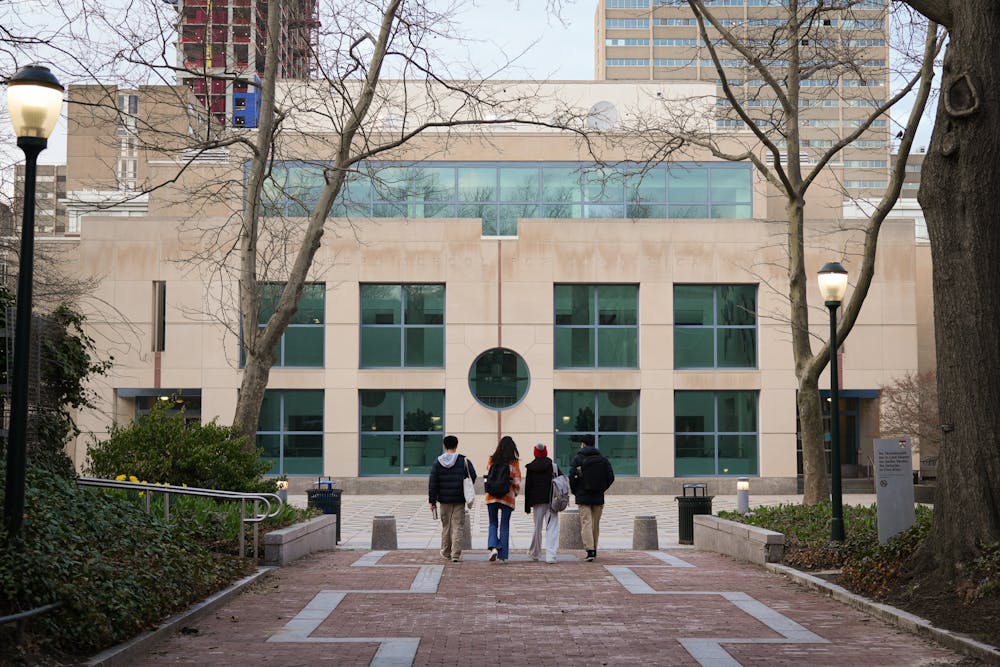
The Annenberg School for Communication hosted a event to discuss the impact of media fragmentation on democracy on Oct. 21.
The event — organized by the Penn Center on Media, Technology, and Democracy — featured lightning talks by two Penn professors as well as veteran journalist and media executive S. Mitra Kalita. The three then engaged in a panel discussion about the intersections of their experiences.
Communications professor Sandra González-Bailón shared her research on how people encounter news online across various digital platforms. Her findings show that the largest divide when it comes to news consumption is between those who follow the news and those who avoid it.
“[News watchers] are a committed minority of engaged users who produce most of the traffic around news content,” González-Bailón said at the event. “The vast majority of people do not consume news online. They do other things.”
Computer and Information Science professor Duncan Watts added that there are three different venues to interpret media fragmentation: the production, consumption, and absorption level.
“If you’re on the production side, you’re getting different versions of reality, but people are looking at multiple versions,” Watts said. “If you’re on the consumption side, which is also segregated, then that is potentially a real problem.”
Josh Nguyen, a third-year Computer and Information Science Ph.D. candidate who works with Watts in the Computational Social Science Lab, appreciates how the Center brings together expertise from diverse fields and highlights the “interdisciplinarity of Penn.”
Kalita, former managing editor for editorial strategy at the Los Angeles Times from 2015 to 2016, discussed how media fragmentation forces people to “choose a camp,” which can increase polarization.
Annenberg School hosts inaugural event for new distinguished lecture series
Annenberg School graduate students host panel on future of presidential endorsements in journalism
“Most journalists enter journalism with a great purpose: to change the world,” Kalita said. “But when you enter a newsroom [with] large, sophisticated news operations where one person’s job is to game the Facebook algorithm, another person’s is looking at what’s trending on Twitter. … We are trying to meet the needs of the audience and basically win.”
In an interview with The Daily Pennsylvanian, González-Bailón highlighted the presence of this same tension within the news industry’s business mode.
“I found Mitra’s ideas very insightful because it is true that in academia, sometimes we care a lot about the robustness of our findings and providing evidence that can be published in good venues that other researchers will take seriously,” González said. “But beneath those data sets, there’s a lot of stories of how newsrooms think about the products they create and how they keep afloat.”
Alex Engler, executive director of the Center, noted the uncertainty surrounding generative artificial intelligence and the decline of traditional television for the future of media.
“The media ecosystem is so complicated that we do not have enough information to answer basic questions like is it getting better or is it getting worse as we move from TV to online,” Engler said. “The goal of the Center is to do better and more expansive, more thorough research and get more access to the systemic data.”
Annenberg School hosts inaugural event for new distinguished lecture series
Annenberg School graduate students host panel on future of presidential endorsements in journalism
Staff reporter Ariel Zhang contributes to data and enterprise reporting and can be reached at zhang@thedp.com. At Penn, she studies international relations. Follow her on X @arielchuyan.


