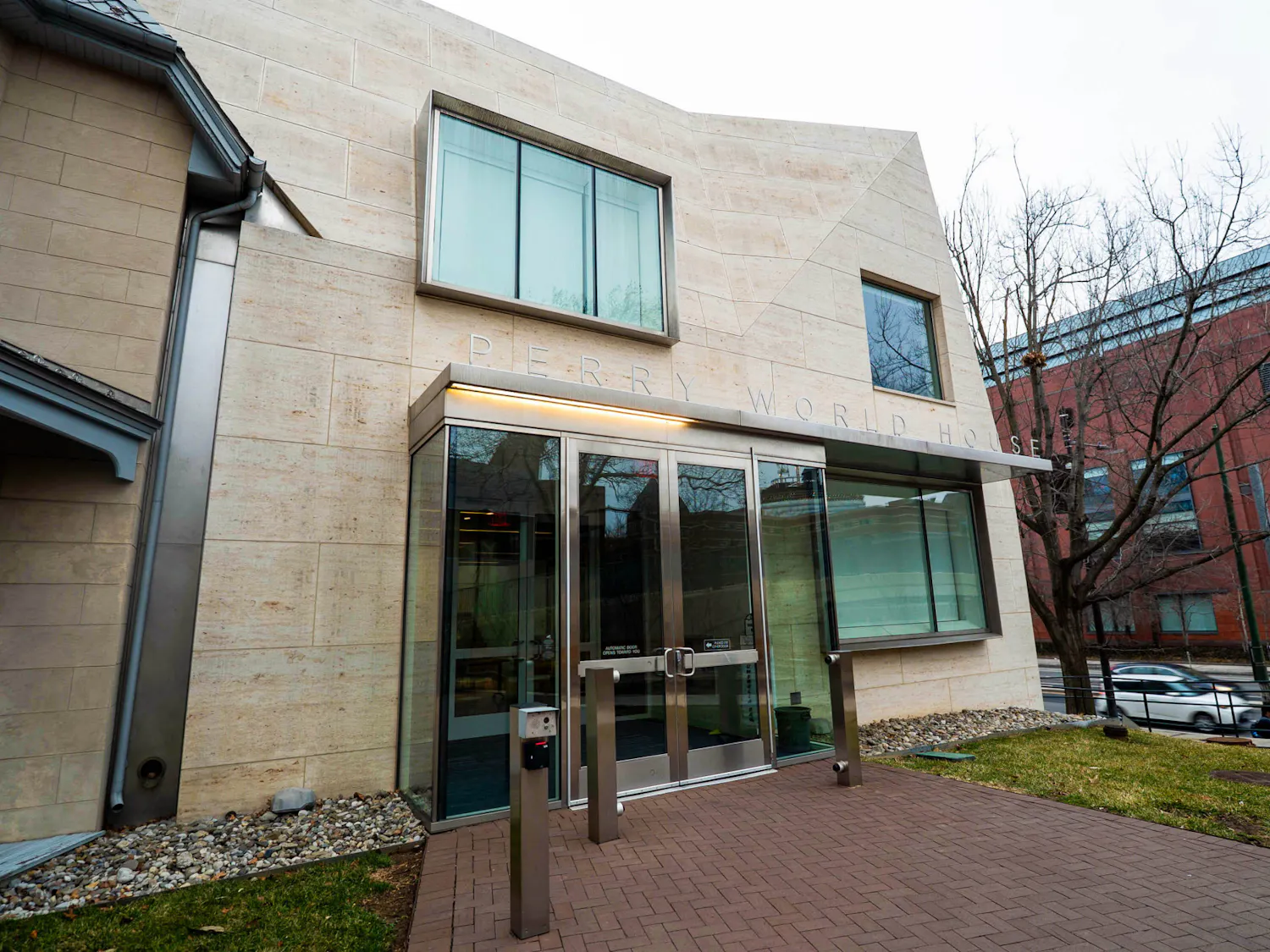
The Center for Advanced Research in Global Communication at the Annenberg School for Communication hosted the inaugural Annabelle Sreberny Distinguished Lecture on Oct. 15.
Renowned for her scholarship in global communication and comparative media studies, University of Southern California cinematic arts professor Anikó Imre was invited by CARGC to share her work with the Penn community. During the lecture, Imre explored how authoritarian states in Eastern Europe manipulate the film industry to create entertainment media that reinforces nationalist and populist political agendas.
“Rather than appealing to rationality, populist leaders spread simple, mythical stories that appeal to fundamental fantasy needs,” Imre said during the lecture. “In other words, their narrative coherence lies in the fact that they fulfill a collective need for safety and security in the wasteland that neoliberal capitalism has left behind.”
Imre's talk was the first of what will become an annual lecture series hosted by CARGC in honor of professor Annabelle Sreberny, a British academic whose research on the role of media communication in social movements in the Middle East helped shape the emerging field of global communication studies.
Communications professor and director of CARGC Aswin Punathambekar explained that a goal of this talk is to “expand our field to think about events, media industries, how media operates, [and] what audiences do with it in a more global, transnational kind of setting.”
“We wanted to dedicate this annual lecture in honor of a scholar who’s done really foundational research in moving media scholarship away from the assumption that the theories [in the field of communication] all emerge solely from an Anglophone western context,” Punathambekar added.
Reflecting on her own academic career, Imre remarked that Sreberny’s work was deeply formative. In connection with her childhood experience living “on the other side of the Iron Curtain,” Imre was inspired to investigate media and communication in Eastern Europe, a region often overlooked in research.
Imre’s work in investigating media use in Eastern Europe parallels Sreberny’s lifelong effort to study underrepresented geographic regions and promote a global approach to communication studies. Punathambekar explained that CARGC selected Imre as the speaker because of her work’s broader relevance to current challenges democracy faces by all parts of the world.
“Many of us had known that Anikó had been developing this project on a topic that is of importance to virtually every world region at this point,” Punathambekar said. “We wanted to make sure that our community [can] broaden their focus and say, if we move to another context, can we enrich our understanding of illiberalism and the risks to democracy within the U.S.?”
Professor Pallavi Guha, a visiting scholar at CARGC from Towson University, attended the event and shared her takeaways from the lecture.
Throughout the lecture, Imre emphasized the working relationship between authoritarian governments and liberal media platforms.
“The political economy influences the media industry transnationally, not just in one country, but globally,” Guha said. “So as audiences, we are consuming media which has a lot of background to it, like who is propagating what kind of representation, and how do we make sense of it based on our identity?”
Imre is currently a Harvard Radcliffe Fellow, working on a project examining the role of storytelling in “competitive authoritarian” media ecologies.