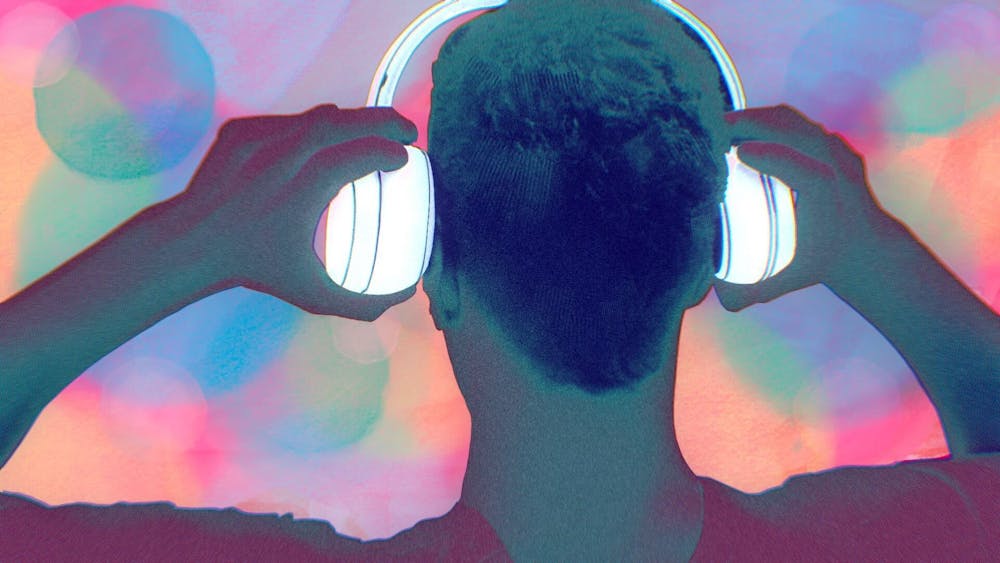
It was a rare moment on Locust last semester that you didn’t find me in the company of my headphones. I’m sure that for many of you it’s the same. What better use of the 15-minute interval between classes than listening to some of your favorite music? An understandable sentiment, but also perhaps detrimental to your mental health.
Like many, I’ve always loved being in the presence of music. Some of my best memories lie in Brooklyn, 2011, Rihanna on mom’s boombox, drowning in the sonic. Music is a powerful thing. Whether it’s nostalgia, excitement, or sadness, people throw on their headphones to regulate their emotions. But is this serving them?
Especially on a college campus, is this serving you?
This question came to me in an unorthodox way. Over the summer, I worked a series of odd jobs, some of which required calamitous commutes. The construction site I worked at was in Park Slope, Brooklyn, and consequently two hours away from home on public transit.
Two hours is a long time to sit in silence, which is why I’m grateful to have been accompanied by my Spotify. Rides to and fro were packed with different playlists and genres. My transit was a great time for me to be “experimental”.
On the eleventh of June, half past five, tragedy struck. The battery on my headphones died on the F train, right between 2nd and Broadway-Lafayette. My mood shifted considerably.
I found I had a visceral reaction to the prospect of sitting on the train for two hours with my thoughts. The whole thing just seemed like a disagreeable phenomenon. Chiefly, it gave me anxiety. I then had a visceral reaction to the realization that my own company gave me anxiety. Which then gave me … more anxiety.
I was scared because this wasn’t the first time I’d experienced angst in relation to music. Upon reflection, I realized that a lot of random stress in my life occurred when, instead of melody in the air, I was surrounded by vacuums of space.
Why was I so uncomfortable with this silence? The answer may actually be simple science.
This idea has been explored before, and there is sufficient reason to place music in the same conversation as addictive substances. Why? Because of dopamine.
Substance use releases dopamine in the brain. Let’s call these substances exterior inputs – common examples of such are cannabis and alcohol. Over time, the brain relies on these inputs and decreases the natural level of dopamine. Therefore, the brain is dependent on these inputs to return to the previously natural emotional balance. The result for the individual without the input? A sense of anxiety. Withdrawal.
Music is similar to these exterior inputs in the sense that it’s an artificial shot of dopamine. Hence, if the exterior input withdrawal causes anxiety. I’m putting music in the class of exterior inputs.
Am I arguing that music is as anxiety-inducing as other addictive substances? Absolutely not. Yet, do I think it causes a similar, yet admittedly, less extreme, withdrawal effect? Well, yes, I think it does. Music is a pleasure inducer, and can definitely be a rush of dopamine. A constant dose of this dopamine causes anxiety when one exists without it.
Why is that relevant at Penn? Let me pose the question: what anxiety inducers already exist on campus?
Many. There are many.
We all have academic pressures, preprofessional pressures, familial pressures, social pressures, and romantic pressures. It makes sense that people listen to music to calm themselves. We need breaks before psychotic breaks.
But the problem with music as a therapeutic practice lies in its accessibility. One can listen to music at really any opportunity, at any time interval, outside of class. Sometimes even in class! I love this about my earphones. However, I believe this only confuses the brain's delicate dopamine balance and adds angst to existing reserves of angst.
I’m not saying to turn off the Bluetooth forever, but I do think there can be some benefit to actually experiencing one’s audible environment. Just taking in the campus can actually be quite meditative. Quite relaxing.
Music is a good thing. I still believe in that much. And like all good things, it’s really just a question of moderation. So maybe next time you unconsciously move to throw on the headphones, just think about your existing balance. Be intentional in curating it. Hopefully, you’ll be all the calmer for it.
ZAKHIR BENTHAM is a College sophomore from Montclair, NJ, studying mathematical economics and international relations. His email address is zbentham@sas.upenn.edu.