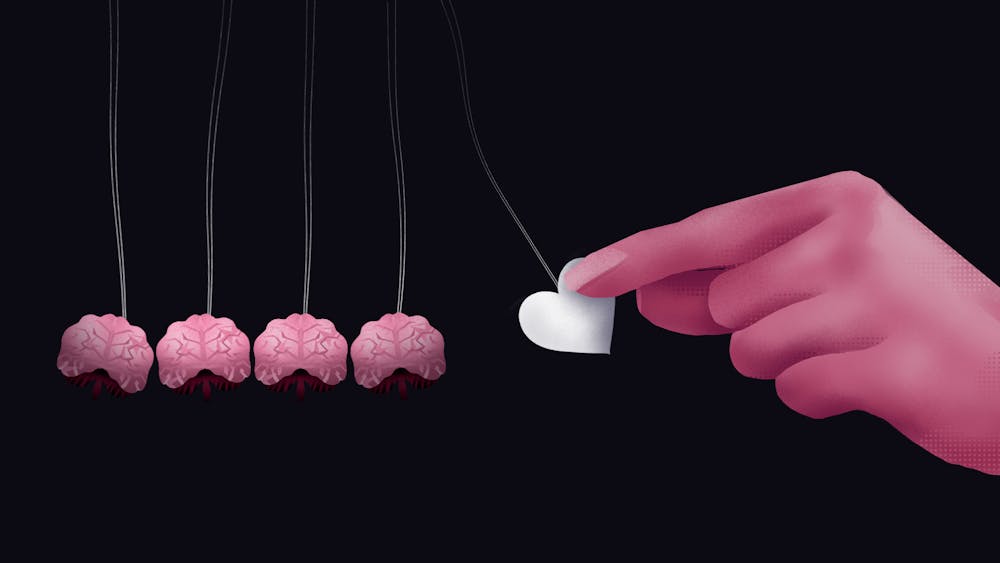
A great many of us consider ourselves to be superb socialites and capable conversationalists: “I can talk to anyone.” Such assertions might be true. Yet those abilities are minuscule compared to the most essential variable in sustaining relationships — one I think we lack. We are heavily deprived of emotional intelligence (EI).
It’s a buzzword, so what is it? Emotional intelligence is the ability to understand and manage your emotions, as well as recognize and influence the emotions of those around you.
It’s made up of many factors, but what’s important is that possession of EI leads to success in the greatest pleasure of life: relationships.
Having a strong EI allows you to develop deeper connections with your friends, your partner, your family, et cetera. Not to mention greater self-acceptance, as well as the development of your leadership ability and designation as a confidant.
There’s much to say about EI and its merits, which is why I’m pained to diagnose our campus, and our greater generation in totality, as utterly deprived of the emotional quotient. It’s today’s greatest tragedy.
A rapid rise in social media has resulted in our EI capacity falling into a deep crisis. We’ve experienced decreases in measures of well-being, self-control, and emotionality.
Unfortunate as it is, this isn’t shocking news. Today’s other quick fixes for dopamine — scrolling, shopping, and gaming — definitely aren’t great for self-control either. Nor is screen time for anxiety. Nor was COVID-19 for people skills. Yes, these factors definitely impede the ability of people to build sustainable relationships. Once again, the greatest tragedy. Which is why it’s even more tragic when one realizes that Penn as an institution may reduce EI even further.
What am I talking about? Well, let’s think about empathy.
Defined as “the ability to understand the feelings, thoughts, and experiences of others,” empathy is a key part of emotional intelligence. It’s a shame, but it can be argued that the empathy of students at Penn is threatened by the transformation they undergo whilst in University.
Now, yes. It’s naive to presume that the University transforms students in a single manner. But for argument’s sake, let’s list what it is that we know.
We know that Penn’s culture is heavily influenced by pre-professionalism. It’s not uncommon to enter as a budding archaeologist and leave an already exhausted consultant.
This drive to enter industry is connected to a want to build wealth. An understandable conviction indeed. It’s evident that the goal of many Penn students, throughout their education, is to become affluent. This is reflected by the 50% of us who leave to work in either financial services or consulting.
To this effect, Penn is successful in boosting the old net worth. The University produces the most billionaires out of any undergraduate program, and the fifth most CEOs of any university.
So what effect does this bachelor’s to billionaire pipeline have on emotional intelligence? It’s tough to say. What is definitely true is that wealth correlates with lower compassion and empathy levels. It’s also true that there exists a correlation between CEOs and psychopathic traits.
So if Penn students are becoming incredibly wealthy, and reaching these corporate leadership positions, the question becomes the following: Do we leave University with these Machiavellian tendencies? Or do we develop them as we climb the professional ladder and build wealth?
We might assume the former. If Penn is attempting to set students up for success in the professional world via their education, and success in the professional world comes to individuals with less empathy and more psychopathy, then one could argue that the Penn process transforms students into less emotionally intelligent individuals, in hopes of setting them up for “success.”
That’s bad. Our generation already suffers from a deficit in emotional intelligence. An institution specializing in nurturing the next American Psychos can’t be great for this arrangement.
So what can we do to counteract this? Don’t fret, the good thing about EI is that it’s variable throughout one’s lifetime. It’s a skill that can be trained, and the steps are quite simple.
Developing EI means practicing active listening when you’re with your friends, taking the time out of your day to ensure you’ve communicated with your loved ones, or even engaging in meditation in hopes of a better understanding of the self.
Maybe we aren’t psychopaths. That would be a lovely conclusion to come to. Nevertheless, we should still be making an effort to strengthen our EI anyway. Our generation’s relationships depend on it.
ZAKHIR BENTHAM is a College sophomore studying Philosophy, Politics, and Economics from Montclair, New Jersey. His email address is zbentham@sas.upenn.edu.