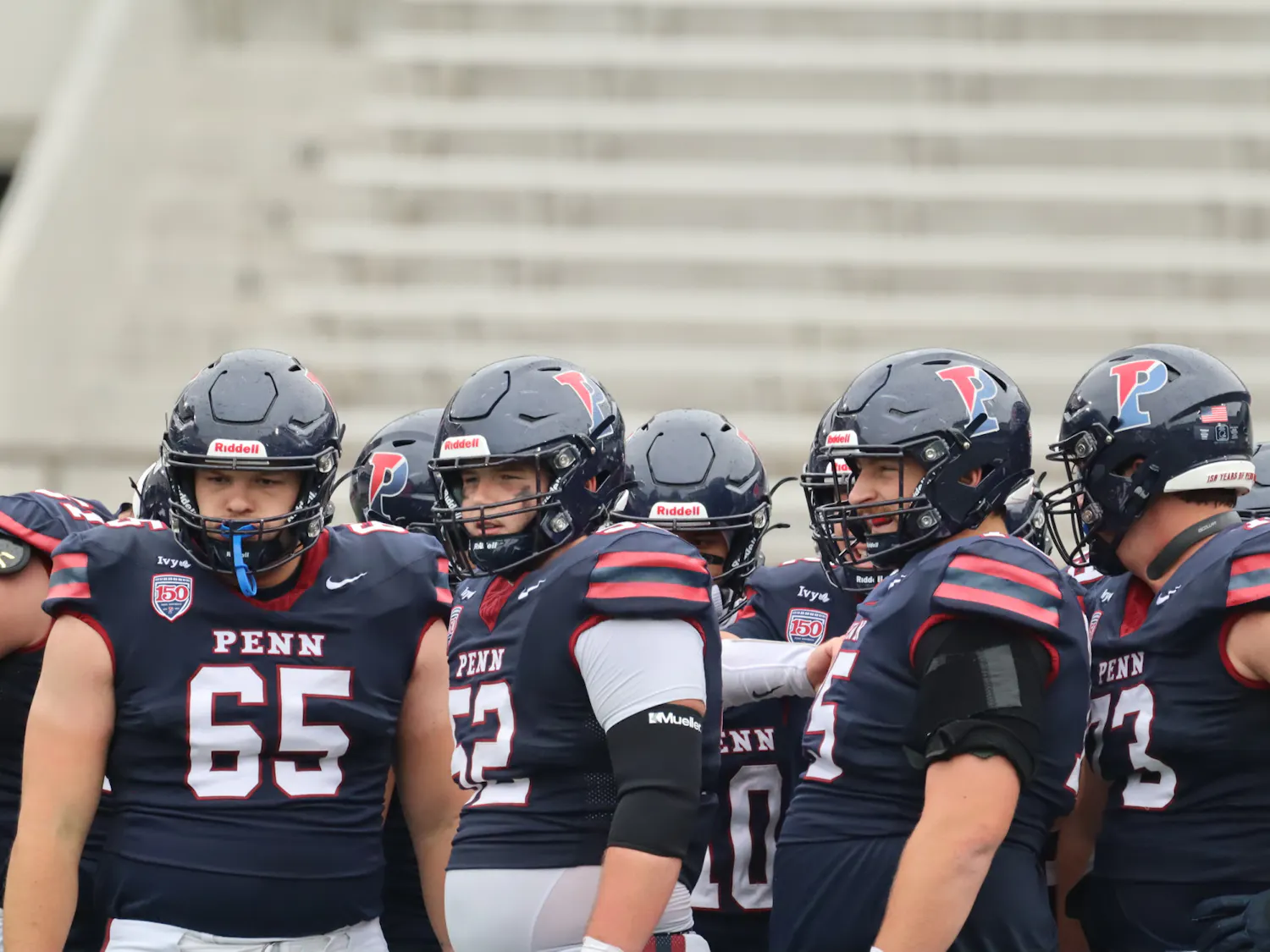
In every team within Penn athletics, there comes a time when players must rise to the challenge of playing in the first string. Whether it’s an injury, illness, or a coach’s decision, the hierarchy of the team can change, and every individual on the roster must be prepared. The “next-man-up” mentality of feeling empowered and ready to step up to the plate is especially important on these occasions.
For Penn football, one name comes to the forefront of players’ and fans’ minds when they think of a paradigm of the next man up: now-senior quarterback Liam O’Brien.
After being the backup quarterback to star Aidan Sayin, O’Brien’s junior year was decorated with glory when he had to step in after Sayin was injured. In just his second game as a starter, O’Brien set program records for passing and overall touchdowns in a game, earning Ivy League and FCS Offensive Player of the Week nods. The remainder of that season would be no different: O’Brien notched 13 total touchdown passes and 300 rushing yards in his remaining games.
Now, as the starting quarterback, O’Brien knows that the goal is a championship, but he ultimately wants to be remembered for being a supportive leader.
“I don’t really care if they remember me, [but I want to be remembered as] just a good teammate, encouraging everyone, [a] good guy to be around, and able to lead a team of 100 guys,” O’Brien said.
Senior wide receiver Bisi Owens said O’Brien was always ready to take the reins.
“[Sayin,] our starting quarterback for four years, goes down, and [O’Brien] picks up right where he left off and actually goes on to win two-straight games in a very epic manner,” Owens said. “He was ready for it the whole season, and he was extremely excited and prepared when his number was called.”
O’Brien’s example has set the tone for the rest of the team, and his efforts last season are a product of the deep dedication and preparation that Penn football coaches and players give their second- and third-string players.
RELATED:
One last ride: Who does senior quarterback Liam O’Brien want to be in his final season?
Storylines to follow ahead of Penn football’s season opener at Stonehill
A priority for this team is instilling confidence in every individual on the roster, from No. 1 to No. 99. To do so, the team prioritizes practice time for everyone, regardless of how much action they see on the field.
“The key ones are the ones who are on the [third string], who are borderline being a backup but they’re not,” coach Ray Priore said. “We set aside an hour a week; we call it ‘Young Guns.’ Those were all of our younger players — guys who are not the number one player … but we need to continue to develop them, especially in the season as well.”
Developing a strong mindset off the field is equally as important as the extra practice time on the field. For these Quakers, finding time to build connections with every player comes easily due to the abundance of time spent together. The veterans devote much of their time to bringing their second and third strings up with them in terms of playing style and competitive mentality, and this mentorship especially pays off when the younger players finally have their days in the sun.
This season, the “next-man-up” mentality and connection between players is further exemplified in junior running back Sean Williams Jr. and senior running back Julien “Juice” Stokes. They will be the ones to watch on the ground after the departure of last year’s No. 1 and 2 running backs.
For these two — and the four other running backs on the team — mentorship and personal efforts are the main features that comprise the ”next-man-up” mentality.
As he took to the field for the first time as a sophomore, Williams Jr. adopted the “next-man-up” mentality to prove himself to his coaches. With no one but himself to motivate him as he ran onto the turf, he demonstrated his confidence and determination to do well, and he was able to play in three more games that season.
“First game, you’re always going to be nervous,” Williams Jr. said. “It feels like the big leagues [because] the first time, everyone is bigger than you [as] you look around. You’re actually dazed, caught up in the moment, but then you have to learn to focus up. Focus on the plays; focus on the next drive.”
While the coaches devote their time to the Young Guns practice, second and third strings must also find time off the field to round out their skillsets and study the starters from the sidelines.
“You always have to do your own stuff, work out in your own time, because what we do on the field is just, quite frankly, not enough time,” Williams Jr. said.
Mentorship is different from the veteran’s perspective. Captains and senior players who have been in younger players’ shoes can understand the difficulty of waiting for one’s finest hour, so their advice is informed. Producing a welcoming and comforting environment is one of the best ways for veterans to encourage their mentees.
“We got a great bond in the running back room,” Stokes said. “We all help each other with the routes [and] the footwork. Everybody’s supportive of each other, and when you have a group like that, it just makes it so much easier when you step onto the field knowing that your guys have your back and you know what you’re doing out there.”
Being the “next man up” is more than a mentality — it’s a lifestyle that warrants confidence, going the extra mile, and expecting the unexpected in any game.
Penn football has cultivated a culture that empowers every player and ensures preparedness for all, which means that in the 2025 season, injuries, illnesses, or other circumstances will be no match for the Quakers’ spirit.