

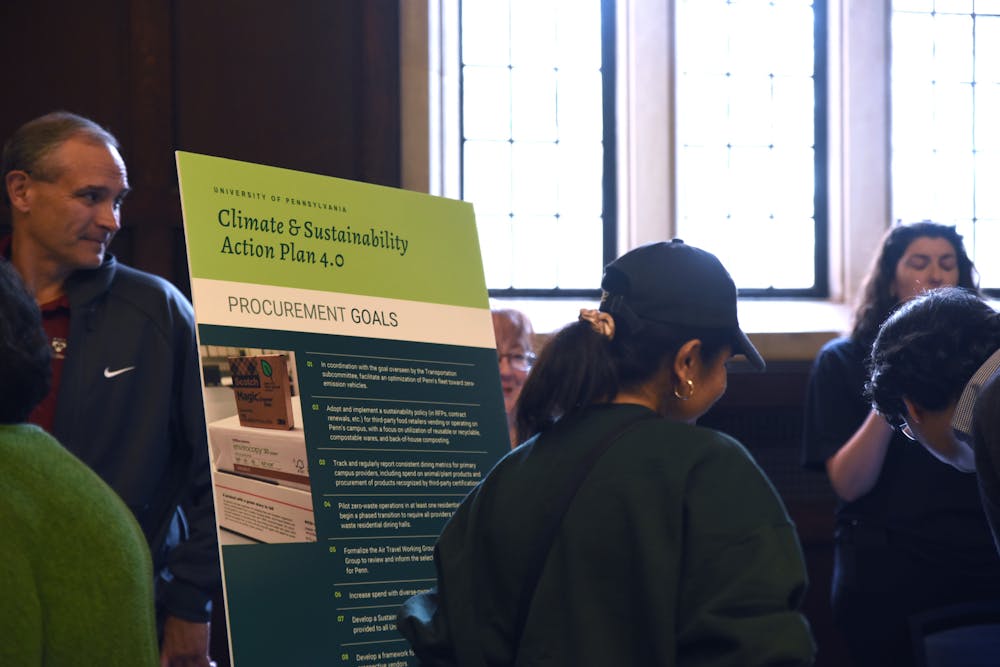
Penn’s new Climate and Sustainability Action Plan 4.0 — which aims for carbon neutrality by 2042 — could face pushback from federal regulators as the University expands its climate efforts.
Unveiled in spring 2024, the five-year plan introduces 38 new initiatives across Penn’s main and medical campuses, building on previous climate action strategies. Administrators say the roadmap demonstrates the University’s heightened commitment to sustainability, but experts warn that recent federal policies may complicate Penn’s path toward its goals.
CSAP 4.0 is based on more than a decade of University-led climate strategy. Penn has already reduced emissions by 47% since 2009, and now roughly 70% of its campus electricity is derived from solar power. The new plan attempts to continue action across several areas — including energy, transportation, biodiversity, and waste reduction.
Conversely, the Trump administration has systematically rolled back nearly 100 pro-environment policies — effectively threatening to undermine and potentially hinder Penn’s progress.
As Enne, co-chair of the West Philadelphia & Beyond subcommittee of the Student Committee of Undergrad Education, explains that these rollbacks “targeted a wide range of foundational environmental protections rather than one single area,” affecting clean air, water, wildlife protections, and emissions limits for power plants and vehicles.
One major target is the Environmental Protection Agency’s Endangerment Finding — the legal basis that gives the federal government authority to regulate greenhouse gas emissions — which Trump has sought to weaken under his “America First” agenda.
Another significant rollback is Executive Order 14162, which outlines a complete withdrawal of U.S. financial support from the United Nations Framework Convention on Climate Change and a reversal of commitments made under the Paris Agreement.
Without external fiscal support, Penn’s plan to expand Power Purchase Agreements — which fund renewable energy procurement and research — may require alternative strategies.
“It is always an easier lift for sustainability and climate work at all levels, from local to international, when the U.S. federal government is also dedicated to climate and sustainability,” executive director for Climate Science, Policy, and Action Stephen Decina said.
Enne pointed to ongoing debates about Pennsylvania’s participation in the Regional Greenhouse Gas Initiative, a multi-state cap-and-trade program aimed at reducing emissions from the power sector.
“Upcoming legislative changes, particularly in state energy policy, are probably going to have a pretty significant impact on Penn's CSAP 4.0 strategies,” Enne said.
While CSAP 4.0 represents Penn’s most ambitious climate plan to date, it is unfolding in a political environment that no longer aligns with its vision. The University may face increasing pressure to fill gaps that were previously supported by national policy.
Despite these challenges, Decina emphasized Penn’s continued commitment to sustainability.
“We believe in our principles and will always pursue climate and sustainability work in the face of any challenges,” Decina added.
Last November, the University appointed climate scientist Michael Mann as vice provost for climate science, policy, and action. Penn is also preparing to launch “Penn Climate,” a new initiative that will debut at UN Climate Week in New York City this September and at Penn Climate Week in October.
“This will be a major milestone to engage the larger Penn and Philadelphia communities to advance climate science, policy, and action here at Penn, nationally and internationally,” Decina said.


