

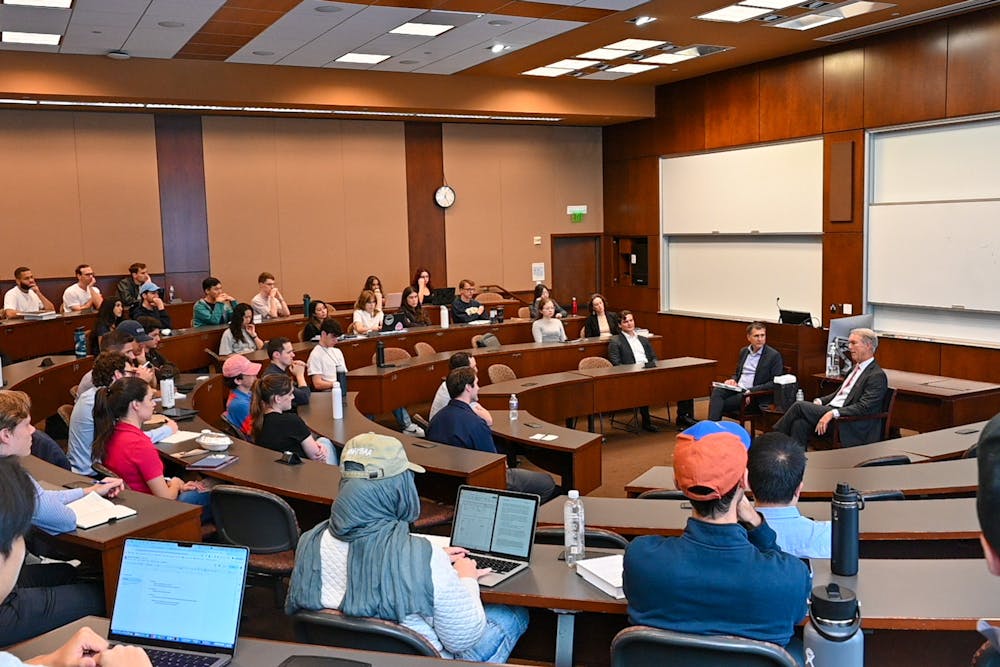
Former University Board of Trustees Chair Scott Bok discussed his recently released book at an event hosted by the University of Pennsylvania Carey Law School on Thursday.
The Sept. 25 discussion was moderated by Penn Carey Law professor Eric Feldman and addressed Bok’s career in investment banking. The book — titled “Surviving Wall Street: A Tale of Triumph, Tragedy, and Timing” — came out in May and culminated in Bok’s resignation as chairman of the Board of Trustees in 2023.
Bok spoke on the evolution of Wall Street since beginning his career in the 1980s.
“The day I graduated as an undergrad from Penn, the Dow Jones was under 1,000… [mergers and acquisitions] essentially didn’t really even exist,” Bok said. “Terms like private equity and hedge fund hadn’t been created yet. Over time, of course, the Dow went from 1000 to over 40,000. Private equity went from nonexistent to owning 30,000 companies worldwide.”
He also advised the students in attendance about how to make a good first impression, as well as the role a mentor can play in one’s career.
“I know a lot of young people give a lot of thought to this whole issue of mentorship,” Bok said. “I would say this is a starting point. You have to think broadly about what a mentor or role model might be. But it's also good to have a bit of a portfolio of mentors, really, because you learn different things from different people.”
Bok discussed his tenure as chair of the Board of Trustees and his December 2023 resignation after criticism of Penn’s response to antisemitism on campus. He said that he thought the book was finished in September 2023, but when the events began to unfold, he thought they might make “an interesting epilogue.”
“I think in some ways, that period marked the start of some things that have really advanced since then, right? The attack on universities — let’s call it what it is, really a right-wing attack driven by oligarchs and very wealthy people who want to have control over these things and on free speech,” Bok said.
RELATED:
He connected his resignation and government influence on universities to a broader trend of the federal government attempting to expand its influence under 1968 Wharton graduate and President Donald Trump, criticizing those who have settled instead of pushing back.
“In the early phases, it’s easy to think, let’s just settle and move on,” Bok said. “The problem is, each entity that settles makes it harder for the next one not to settle. You set a precedent that says it’s okay to settle and compromise your principles.”
RELATED:
Senior reporter Alex Dash covers administration and can be reached at dash@thedp.com. At Penn, he studies history and political science. Follow him on X @AlexBDash.


