In spring 2024, amid mounting student protests nationwide, pro-Palestinian students and community members launched an encampment on Penn’s College Green.
Over the course of 16 days, protesters issued three demands: for Penn to disclose its financial holdings “in the spirit of transparency and shared governance,” divest from corporations linked to Israel’s military actions in Gaza and occupation of Palestinian territories, and defend Palestinian students and their allies by “granting amnesty” for pro-Palestinian protesters.
On the morning of May 10, 2024, officers from Penn Police and the Philadelphia Police Department forcefully disbanded the encampment at the word of senior University leadership. Officers in riot gear arrested 33 protesters, including nine Penn students. The protesters were taken to the police station, processed, and released after being issued code violation notices.
One year after the Gaza Solidarity Encampment, The Daily Pennsylvanian compiled Penn’s responses to pro-Palestinian student protests.
Temporary expression guidelines
In June 2024, a month after the encampment was disbanded, Penn launched new temporary guidelines for campus demonstrations and initiated a review of the Guidelines on Open Expression.
The announcement of the new policy, which was signed by Interim Penn President Larry Jameson, Provost John Jackson, Senior Executive Vice President Craig Carnaroli and deans from all 12 Penn undergraduate and graduate schools, contained updated guidance on “when, where, and how open expression can take place” and announced the formation of a task force to review the existing open expression policies.
The task force is chaired by professor of medicine and Chair of the Committee on Open Expression Lisa Bellini and professor of education and Faculty Director of the SNF Paideia Program Sigal Ben-Porath. According to the University Council Committee on Open Expression’s recently published year-end report, the task force approved a revised draft of the guidelines in late February 2025.
RELATED:
The Graduation Issue 2024: Penn’s Gaza Solidarity Encampment, from beginning to end
Pro-Palestinian encampment on College Green brings nationwide student protests to Penn's campus
A DP analysis of the temporary guidelines found that the policies increased the powers of Penn’s vice provost for University Life, redefined events on campus as inherently private to the University community, and prohibited many of the tactics used by demonstrators on campus in recent years.
Suspension of Penn students
In July 2024, Penn suspended four students who participated in on-campus pro-Palestinian activism, according to an Instagram post from the Freedom School for Palestine. The post stated that the students received semesterlong or yearlong suspensions in letters notifying them of their updated disciplinary status on June 27, 2024.
The suspensions came after Penn had placed six student organizers affiliated with the Gaza Solidarity Encampment on mandatory leaves of absence in May 2024.
Barricades on College Green
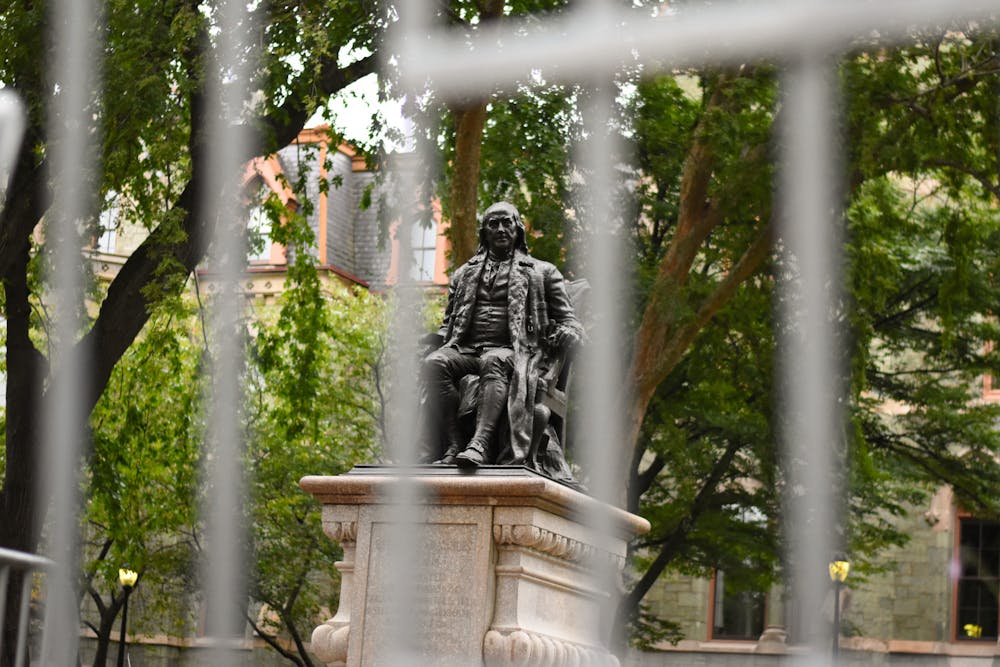
In September 2024, Penn installed barricades around the perimeter of College Green and along Woodland Walk. The University attributed the decision to precautions related to the presidential debate that occurred the day prior to the installation.
Portions of College Green had also been fenced off during the Gaza Solidarity Encampment. Six-foot fences surrounded much of the area, alongside heightened security presence, into the summer of 2024.
Shift to institutional neutrality
On Sept. 10, 2024, Jameson announced in an email to the community that the University would limit statements on local and world events that do not have a direct impact on Penn, in a shift toward institutional neutrality. Jameson cited aims to protect the “diversity of thought” central to the University’s mission as the primary motive of the decision.
“It is not the role of the institution to render opinions — doing so risks suppressing the creativity and academic freedom of our faculty and students,” Jameson wrote.
‘Raid’ of pro-Palestinian student activists’ home
On Oct. 18, 2024, Penn Police officers executed a search warrant at an off-campus residence belonging to pro-Palestinian student activists and seized a Penn student’s cell phone. The search was part of an investigation into Sept. 12, 2024 vandalism of the Benjamin Franklin statue on College Green, which pro-Palestinian organizers had previously claimed responsibility for on social media.
Penn Police utilized surveillance methods, including CCTV footage, Wi-Fi router data, and phone records, to identify suspects, according to three search warrants obtained by the DP. The warrants — the first of which was served on Sept. 24 and the other two on Oct. 18 — listed violations of criminal mischief and conspiracy.
Undergraduate Assembly resolution on disclosure
At a Jan. 26 general board meeting, the Undergraduate Assembly passed a resolution calling for the University to formally disclose its investments and initiate a review of its securities in external funds. The resolution was passed by a 15-6 vote after months of increased discourse surrounding the transparency of Penn’s finances.
A UA member at the board meeting shared concerns that the passage of the resolution would be “a political statement” related to the ongoing Israel-Hamas war.
The resolution came after the Gaza Solidarity Encampment called on Penn to divest from “corporations that profit from Israel’s war on Gaza and occupation in Palestine,” disclose its financial holdings under the Associated Investments Fund — the pooled investment vehicle for the majority of Penn’s endowment — and defend Palestinian students.
Months earlier, Penn’s Muslim Students Association put forward a successful campus-wide divestment referendum and submitted a formal proposal to the University Council Steering Committee. The committee declined to advance the proposal, reiterating Penn’s opposition to boycotts, divestment, or sanctions against Israel.
Protest at Jameson’s house
Penn students, alumni, and Philadelphia community members gathered at Jameson’s private residence on March 21 in opposition to the University’s “complicity in Palestinian genocide, violations of free speech, and refusal to protect Penn’s non-citizen community from invasive I.C.E. raids.”
A University spokesperson denounced the characterization of the event as a “protest,” and called the demonstration “an unlawful intrusion and a deliberate act of intimidation.”
“The right to protest does not include the right to threaten and harass,” the spokesperson wrote in a statement to the DP. “This is not protected speech. These actions are not acceptable, and certainly not from members of our university community.”