

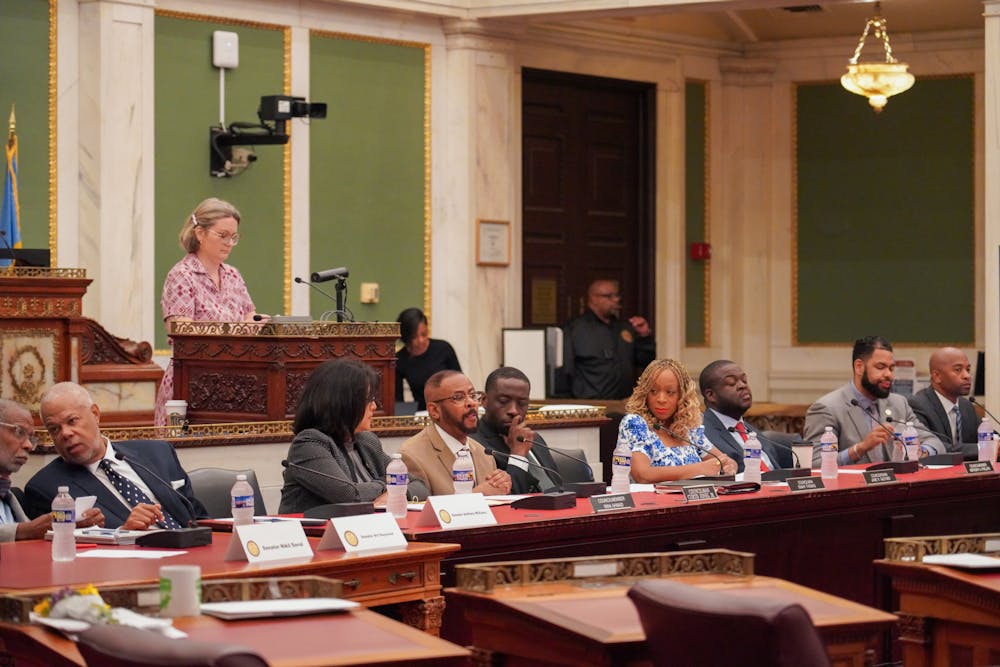
Local lawmakers convened at Philadelphia City Hall on Friday to condemn Penn’s “mind boggling” rollback of diversity, equity, and inclusion programs — and University leaders’ “refusal” to attend the hearing.
The May 9 joint committee hearing — held by Philadelphia City Council’s Education Committee and members of the Pennsylvania General Assembly — interrogated Penn’s rollback of DEI policies in response to recent federal policy changes. A press release stated that the goal of the hearing was to “better understand how colleges and universities are responding to the Trump Administration’s crusade against diversity, equity, and inclusion” and “help defend efforts by universities to make their campuses welcoming to everyone.”
Penn President Larry Jameson was invited to testify at the hearing but did not attend. According to a statement from Philadelphia City Councilmember Jamie Gauthier’s office, the University “did not provide a reason” for Jameson’s absence.
In his place, Vice President for Government and Community Affairs Jeffrey Cooper submitted a written testimony for the hearing, which was read into the minutes. The testimony emphasized that “Penn has always upheld the law” in regard to affirmative action cases.
A request for comment was left with a University spokesperson.
“[Jameson] just decided that this [hearing] doesn’t mean that much,” Pennsylvania state Sen. Anthony Williams (D-Delaware, Philadelphia) told The Daily Pennsylvanian after the hearing. “It’s very disrespectful.”
Pennsylvania state Sen. Art Haywood (D-Montgomery, Philadelphia) questioned the University’s absence from the hearing and asked whether Penn is “only available to talk in hearings about antisemitism.”
“You are not here when our topic is the treatment of Black, Brown, and other individuals,” he said.
RELATED:
Penn schools scrubbed their DEI websites. Here’s what’s left.
‘Cowardice’: Pa. lawmakers express disappointment with Penn’s DEI response at meeting with admin.
State Sen. Nikil Saval (D-Pa.), who was present at the hearing, wrote in a statement to the DP that “Penn’s absence today shows the institution’s continued willingness to be submissive and servile in the face of the Trump administration in the face of the Trump administration’s attempts to resegregate our country … [and] displays a new level of disrespect for our communities and our people.”
“As Philly’s largest employer, we deserve an institution that fights on behalf of our city,” he said. “Philadelphia deserves better than Penn’s cowardly race to the bottom.”
Gauthier — who graduated from Stuart Weitzman School of Design with a master’s degree in 2004 and represents the district that includes Penn — said in her opening remarks that DEI at universities means “giving Philadelphians the same economic, professional and academic opportunities that our higher education institutions offer to young people around the world.”
She said she felt “disappointed and frankly insulted by institutions like the University of Pennsylvania for abandoning their promise to make their campuses more inclusive at the first sign of danger.”
Penn’s four undergraduate and 12 graduate schools have made substantial changes to their respective DEI policies, programs, and initiatives following a Jan. 20 executive order by 1968 Wharton graduate and President Donald Trump, which required federally funded universities to eliminate certain DEI programs.
On Feb. 11, Penn erased references to diversity and affirmative action from its nondiscrimination policies. By Feb. 14, the University had taken down its central DEI website, replacing it with a brief statement on equal opportunity.
“The University of Pennsylvania refused to show up to this hearing and explain their decision to abandon DEI,” Gauthier said. “Penn bent over backwards to scrub any mention of DEI from the website after Trump’s executive order, which did not have the force of law, yet Trump still froze $175 million in funding. If Penn continues to wave the white flag, we can only expect more of the same.”
Gauthier pointed out that while “Penn cowers in the corner,” peer institutions — such as Harvard University and Princeton University — are “doubling down on DEI.”
Philadelphia City Councilmember Curtis Jones also discussed Trump’s targeting of higher education, along with the University’s role as a tax exempt institution within the city’s larger goals. He described the contradiction that emerges when tax exempt institutions “cast shadows on impoverished neighborhoods.”
Jones expressed his support for Philadelphia universities pursuing “deliberate … anti-discrimination measures,” but cautioned that if institutions choose to not uphold DEI “because you fear number 47, let me assure you, you should fear us too.”
Philadelphia City Councilmember and 1990 Penn graduate Nina Ahmad similarly condemned Penn’s lack of “accountability and transparency.”
“I am appalled that the University of Pennsylvania is lacking a spine at the time when we need them most — at the time when we need a message that we are not going to buckle down,” Ahmad said.
Ahmad encouraged all universities within the Ivy League to “stand up” as a “united front.” She suggested that Penn “rethink” its rollback of DEI initiatives, given that “there has been affirmative action for mediocre white men for hundreds of years.”
Williams recalled a “chilling” conversation with Jameson during a Feb. 25 meeting between local lawmakers and Penn’s senior administrators at College Hall, saying that he voiced his frustration regarding Penn’s removal of DEI programs — to which Jameson replied, “‘I’m feeling a bit uncomfortable about how you’re talking to me.’”
“I don’t think he understands, to this day, how that was interpreted,” Williams said. “I had every right to be insulted by the way that Penn had proceeded in wiping out DEI and in fact, they admitted in the meeting they had done it improperly.”
Williams also rebuked how, during that meeting, one of Penn’s attorneys described diversity as “a lightning rod word.”
“[Jameson] gets paid millions of dollars to represent an institution of higher learning, higher thinking, and he felt comfortable with his attorney turning around, saying, ‘diversity is now a lightning rod,’ and not scolding her or removing her from the room,” Williams said.
Williams said that Penn has “left the wreckage of what they’ve done across the public because they believe we’re not going to affect their funding.”
At the conclusion of his remarks, Williams said that he was told that “Penn is a victim — they’re caught between Donald Trump, his policies, and what to do.”
“When you have $22 billion, you ain’t no victim,” Williams said, referring to the University’s endowment. “$22 billion makes you a bully on the block.”
In an interview with the DP after the hearing, Williams described Penn and Jameson’s position as “privileged.”
“[Penn has] no understanding of the fact that they are standing on someone else’s foundation and they’re betraying it, and that’s what’s seriously disturbing, because we need allies,” Williams told the DP. “We don’t need people who are working against us who think they’re working with us.”
At the hearing, Pennsylvania state Rep. Napoleon Nelson (D-Montgomery) questioned whether institutions like Penn have the “clarity to place moral values over financial assets.” Nelson described the purpose of the Friday hearing as more than “simply about a few universities and how they are appropriating tax dollars or how they are reviewing student applications.”
“Today’s hearing is to seek clarification on where our heralded universities and learning institutions stand when history is being erased, thought is being censored, and identity is being criminalized,” Nelson said.
In an interview with the DP after the hearing, Nelson reiterated that the committee was making a “moral ask.” He said that Penn needs to engage in “productive conversations” and “lead with values.”
He emphasized that this is a moment where the “very fabric of the University of Pennsylvania is under assault.”
“There are an awful lot of us who ought to bear a bit more responsibility for how we stand in this moment, not just Penn, because they’ve got money in the bank,” Nelson told the DP. “[Penn] can stand and join with other lawsuits that are already in process. They don’t have to establish a whole new war room to say diversity is important.”
Pennsylvania state Rep. Rick Krajewski (D-Philadelphia) concluded the opening remarks by urging Penn to “fight back.” He pointed to the University’s moral responsibility, given its endowment of over $22 billion — “four times the size of the entire budget of the School District of Philadelphia.”
Krajewski spoke not only as a Pennsylvania lawmaker, but “as an alum” of Penn’s class of 2013. He described sharing the panel’s “disappointment” in Penn’s failure “in the face of political pressure.”
“What they are saying is [that] their investments are more important than their students,” Krajewski said. “That is unacceptable.”
Philadelphia City Councilmember Kendra Brooks directed questions toward Penn — despite Jameson’s absence — including whether the University has “communicated with Trump” and if it plans on imposing additional changes to DEI policies.
Representatives from Penn Libraries and Penn’s largest student union, Graduate Employees Together — University of Pennsylvania, also testified at the hearing.
Yvonne Harris — who serves as the president of the the American Federation of State, County and Municipal Employees Local 590, which represents about 150 support staff and personnel at Penn’s libraries — read Penn’s statement of belonging into the record.
She added that “students benefit from interactions within a learning environment, representing a range of social and economic backgrounds, including different gender and sexual orientations.”
Critical Writing Program lecturer Justin Mullikin, a representative of Penn’s Chapter of the American Association of University Professors, read a statement on behalf of AAUP’s executive committee.
“This spring, the Penn administration must end its backtracking on racial and social justice,” Mullikin said. “It must uphold basic principles of equity, and it must reaffirm that diversity and open inquiry are essential to research, teaching and the advancement of knowledge.”
Mullikin added that “the Penn administration must cease instructing faculty, staff and students to censor programs, funding, proposals and websites.”
“[Penn] must restore policies, websites, and programming that were in place to make the University open and accessible to all, before the publication of executive orders,” Mullikin said.
RELATED:
Penn schools scrubbed their DEI websites. Here’s what’s left.
‘Cowardice’: Pa. lawmakers express disappointment with Penn’s DEI response at meeting with admin.
Finn Ryan is a News Editor at The Daily Pennsylvanian and can be reached at ryan@thedp.com. At Penn, he studies political science and Russian. Follow him on X @FinnRyan_.


