In late March, a private Signal chat between several high-level Trump administration officials was accidentally exposed when a staffer for National Security Advisor Mike Waltz added Atlantic editor-in-chief Jeffrey Goldberg to the conversation. While media outlets fixated on the blunder itself, the real story is in the content of the messages, particularly what they reveal about America’s growing hostility toward its postwar global position.
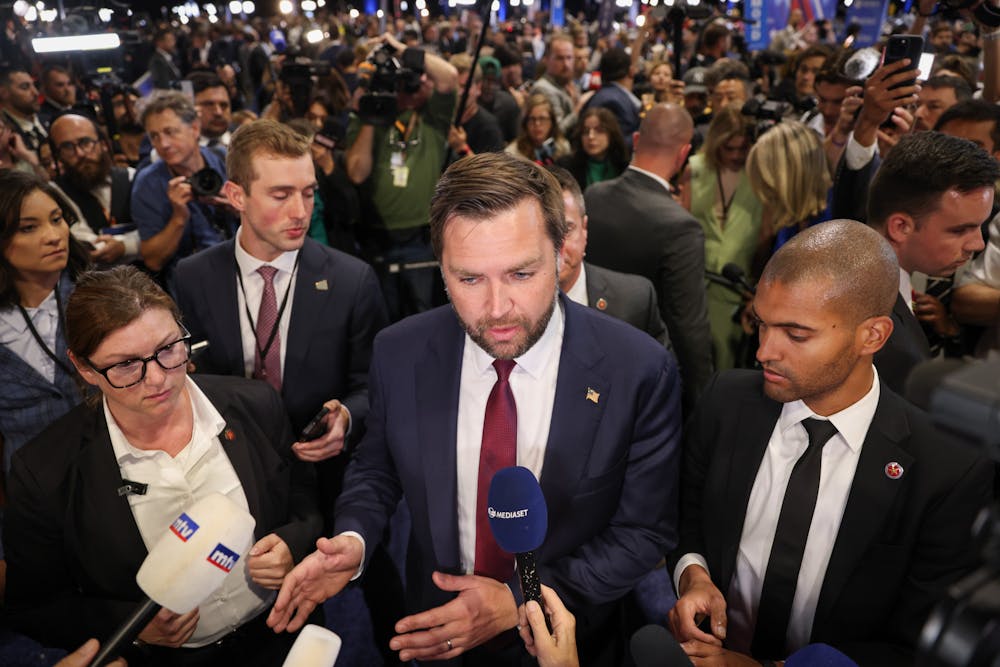
In one exchange, Vice President JD Vance weighed in on the strategic importance of the Suez Canal, writing, “I think we are making a mistake. 3 percent of US trade runs through the suez. 40 percent of European trade does.” Later, Vance doubled down, announcing to the chat: “I just hate bailing Europe out again,” to which Defense Secretary Pete Hegseth responded, “I fully share your loathing of European free-loading. It’s PATHETIC.”
What these officials are overlooking is not just the importance of the relationship with Europe, but the implications of abandoning the global economic structure that underpins the United States’ power. Abdicating our leadership role doesn’t just hurt the world, it hurts us.
In a globalized economy, dismissing 3% of U.S. trade as insignificant is dangerously short-sighted. The United States doesn’t operate in a vacuum. Disruptions to global shipping ripple through supply chains, drive up costs, and strain consumers at home. When the Ever Given cargo ship blocked the Suez Canal in 2021, it delayed billions of dollars in goods, sent freight prices soaring, and pushed up oil prices — effects that were directly felt in U.S. stores and gas stations. Pretending otherwise ignores how deeply our economy is tied to the stability of global trade.
This point is much broader than just the Suez Canal. The post-World War II international order created by the U.S. was not built out of charity. It was a deliberate strategy, one spearheaded by the U.S. to solidify its economic dominance and global influence. At the 1944 Bretton Woods Conference, U.S. policymakers helped design the economic system that still largely defines global capitalism: a system built on open trade, stable currencies, and American-led institutions. In doing so, we made the U.S. the undisputed center of global finance and commerce.
American dominance wasn’t a coincidence — it was the plan. Institutions such as the International Monetary Fund and the World Bank were created to stabilize global finance and support development, but they were also tools for projecting American influence. The United Nations gave us diplomatic legitimacy while North Atlantic Treaty Organization gave us military strategic leverage. In return for underwriting global stability, the U.S. got what no other country could claim: global trust and control.
Our dollar became the world’s reserve currency, U.S. Treasury bonds became the global safe haven for investors, and our companies thrived in the open markets we created.
Now, leaders like Vance want to pull back from these precedents, pretending we can do so without severe costs. But, if we abdicate leadership, we don’t just walk away from its burdens, we walk away from its privileges.
Lost in the wreckage of our isolation will be the very advantages that make the United States wealthy and powerful. This means weaker capital flows, higher borrowing costs, and diminished influence in setting the standards in trade.
When Vance and others scoff at “bailing out” allies, what they’re really doing is forfeiting decades of American leverage in exchange for a populist soundbite.
This isn’t just about money. It’s also about political credibility. Without credibility, the United States’ power crumbles.
For decades, our allies — from NATO members like France and Germany to Japan and South Korea — have relied on more than just our military might. They have relied on the promise that the United States values its alliances. Today, countries such as Vietnam, India, and the Philippines are watching how we handle old alliances to decide whether they can trust us in the future. If we signal that alliances and economic agreements are expendable, they will hedge towards the one superpower willing to fill the emerging power vacuum: China.
The new populist isolationist movement argues that global engagement is just code for endless wars. They slap the “neocon” label on anyone who believes the United States has a role to play in defending global stability. But this is a false binary. You can believe in the “peace through strength” philosophy that ended the Cold War without advocating for endless intervention and forced regime changes.
It is not warmongering neoconservatism to suggest that the U.S. should help secure global shipping lanes, maintain credible deterrence, or uphold alliances. American leadership has always been more self-interested than charitable.
Misled by populist leaders on both sides of the political spectrum, American sentiment has shifted away from global leadership. We assume that the stability we inherited is a permanent feature of the world. It is not. In fact, it is quite the opposite. Global stability is built on deliberate American leadership and sacrifice, and has been defended by generations who understood that protecting freedom abroad protects prosperity at home. Instability abroad will not stay abroad. It will reach our ports, our markets, and our communities.
The United States’ position as a global leader is not our birthright. It is the result of political choices. If we choose isolation, we are not protecting American interests; we are handing them away to self-interested countries who are more than willing to seize them.
As Penn students prepare to enter a globalized workforce, we cannot afford to be ambivalent about United States’ place in it. If we want a future shaped by open markets and stability, we must defend the system that made all that possible.
BO GOERGEN is a College junior studying political history and international relations. His email is rgoergen@sas.upenn.edu.