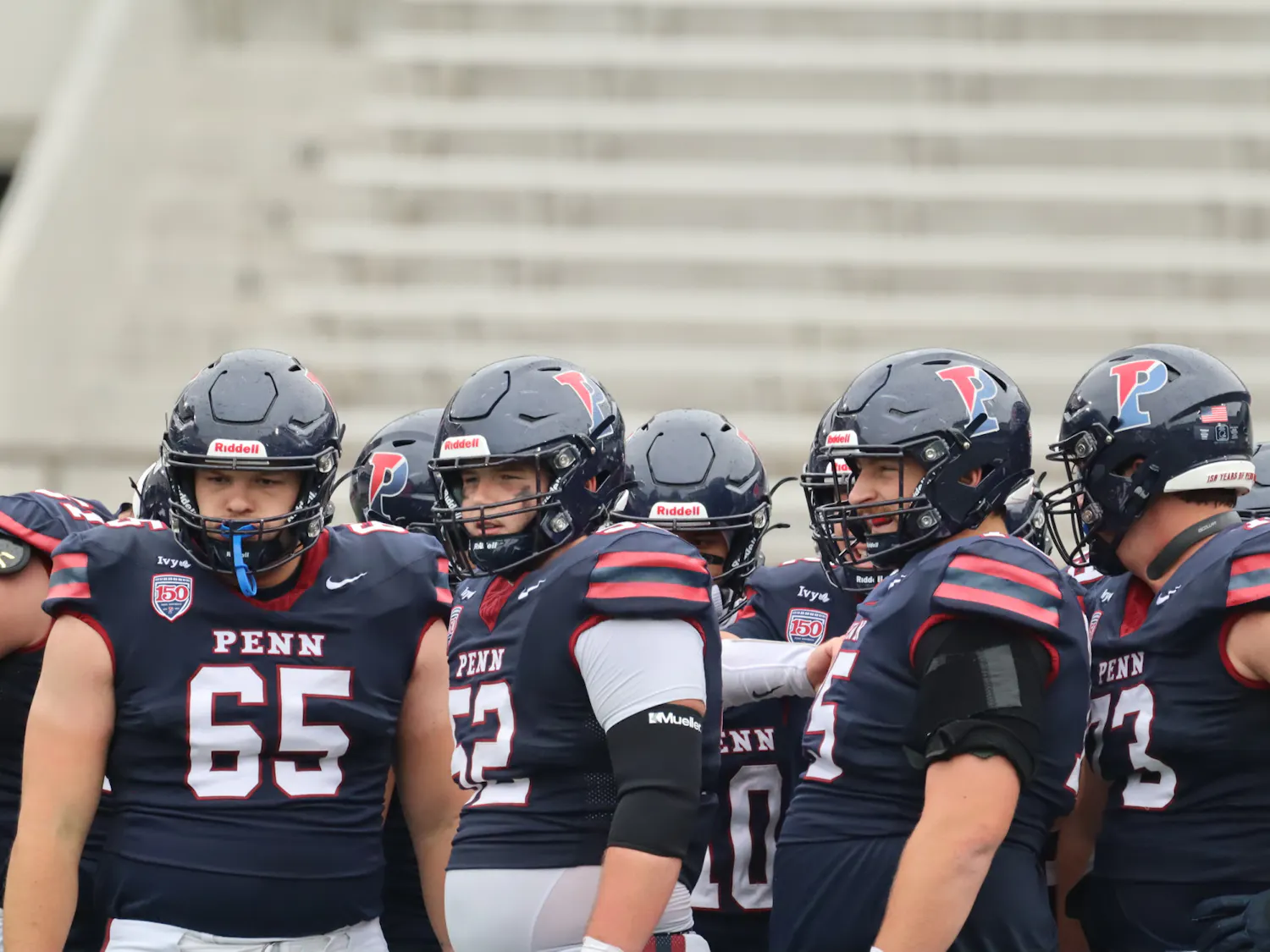
Kenneth Dunn knows a little something about perseverance.
It was learned on the storied gridiron of Franklin Field, where Dunn was one of 10 football players to have played all four years from the over a 100 who played on the freshman team. It has been exhibited in the way he has risen from a claims clerk in the New Jersey racing circuit to one of top executives in the horse racing industry.
Dunn is the senior vice president of Churchill Downs Management Company, a component of the publicly traded Churchill Downs Incorporated. CDI owns and operates five courses across the United States, including the world famous Churchill Downs, site of the Kentucky Derby.
Dunn serves as the president of one of these courses -- Calder Race Course in Miami, which hosts such prestigious racing events as the Festival of the Sun. He oversees more than 1,500 employees at Calder while running the day-to-day operations, which includes everything from racing management to maintenance to marketing. Dunn also meets monthly with his fellow CDI members to discuss ideas that promote the well-being of horse racing in the United States. Simply put, Dunn is at the epicenter of American horse racing.
He grew up just across the Delaware River in Cherry Hill, N.J. His athletic prowess in football and baseball caught the attention of Philadelphia's William Penn Charter School, a place known for its athletic pipeline to Penn.
With the help of local businessman Bob Levy, of whom Dunn refers to as his "second father," Dunn was able to receive a scholarship to Penn Charter. Although he excelled in athletics, Dunn never lost sight of the importance of his education.
"My priority was to get into the best possible school from an academic standpoint, but also one that would allow me to play football."
Needless to say, Penn was that place. Dunn played both football and baseball while at Penn, majoring in history, of which he jokes, "prepares you for absolutely nothing."
During the summers, he got his first taste of the racing industry with the help of Levy, who set him up with a job at Atlantic City Racetrack.
But one of his more prominent memories comes from one of his early campus jobs.
"I had the interesting experience of working in the girl's dorms as a freshman," Dunn said. "The only problem that became of it was because of football practice, I would constantly be late for cleaning up the tables in the dorm."
On the field, Dunn played wing-back for four years, overcoming tough sophomore and junior seasons with a memorable seven-win season in his senior year. But above all, Dunn fondly recalls his days on the Penn athletic fields, not for the accomplishments, but for the lessons they have taught him.
"My experience in organized sports was a great teacher," Dunn said. "Number one, you have to learn to be a team player, which is important in any business."
Dunn also cites his playing days as vital in the cultivation of his competitive spirit.
"You don't participate in athletics unless you want to win," Dunn said. "In business, as in every aspect in life, although you have to temper it a little bit, you want to win."
After graduating from Penn in 1969, Dunn took his winning attitude to work full time for the Atlantic City Racetrack. The business of horse racing was, at that time, very hard to infiltrate; the prominence of family-owned racetracks meant that the workforce was primarily composed of those who were there from the beginning.
"Most of the people in the official end of it and even most of the people in the executive level were people that had grown up in the industry," Dunn said. "I was one of the few college graduates working in the New Jersey circuit and was probably about 25 years younger than anyone else in the department."
An "outsider" with an Ivy League degree, Dunn received his second education while working in the racing secretary's office.
"It was the real training ground to understand and learn the business from the roots," Dunn said.
Dunn used that knowledge, as he served in a variety of positions on the New Jersey circuit for the next five years before being named sales director of Atlantic City Racetrack.
By 1976, Dunn was the vice president and general manager of the track, a position that opened up many opportunities nationwide. He then served similar posts at the Fair Grounds in New Orleans and Arlington Park in Chicago, before arriving to Calder in 1990.
One aspect of his job that Dunn prides himself on is his commitment to community service. Calder Race Course has partnered with numerous local charities, including the United Way, the Make-a-Wish Foundation and the Miami Project to Cure Paralysis.
Such community involvement is an activity that Dunn feels can curb the negative image that sometimes surrounds racetracks.
Community service "has become extremely important to us," Dunn said. "People sometimes don't understand a racetrack, especially our goals in the community. Any business, in my view, has to be involved in the community."
Calder is primarily involved in educational and childcare programs. This, according to Dunn, breeds positive effects both ways.
"The more you are known in the community for doing good work, the greater chance you are going to have to convince customers to come try your product," Dunn said. "It's a win-win."
Success has no means gotten to Dunn, as he is quick to point out his luck at being in the right places at the right times. But to those who want to enter the sports management industry someday, he has some pretty simple advice.
"Spend the time now to cultivate an opening, a door," Dunn said. "If you have to sweep the floors, sweep the floors. If you get an opportunity to work in the summer as an intern, do it. ... Any opportunity that you get to work in any aspect of the sports business world, you do it."