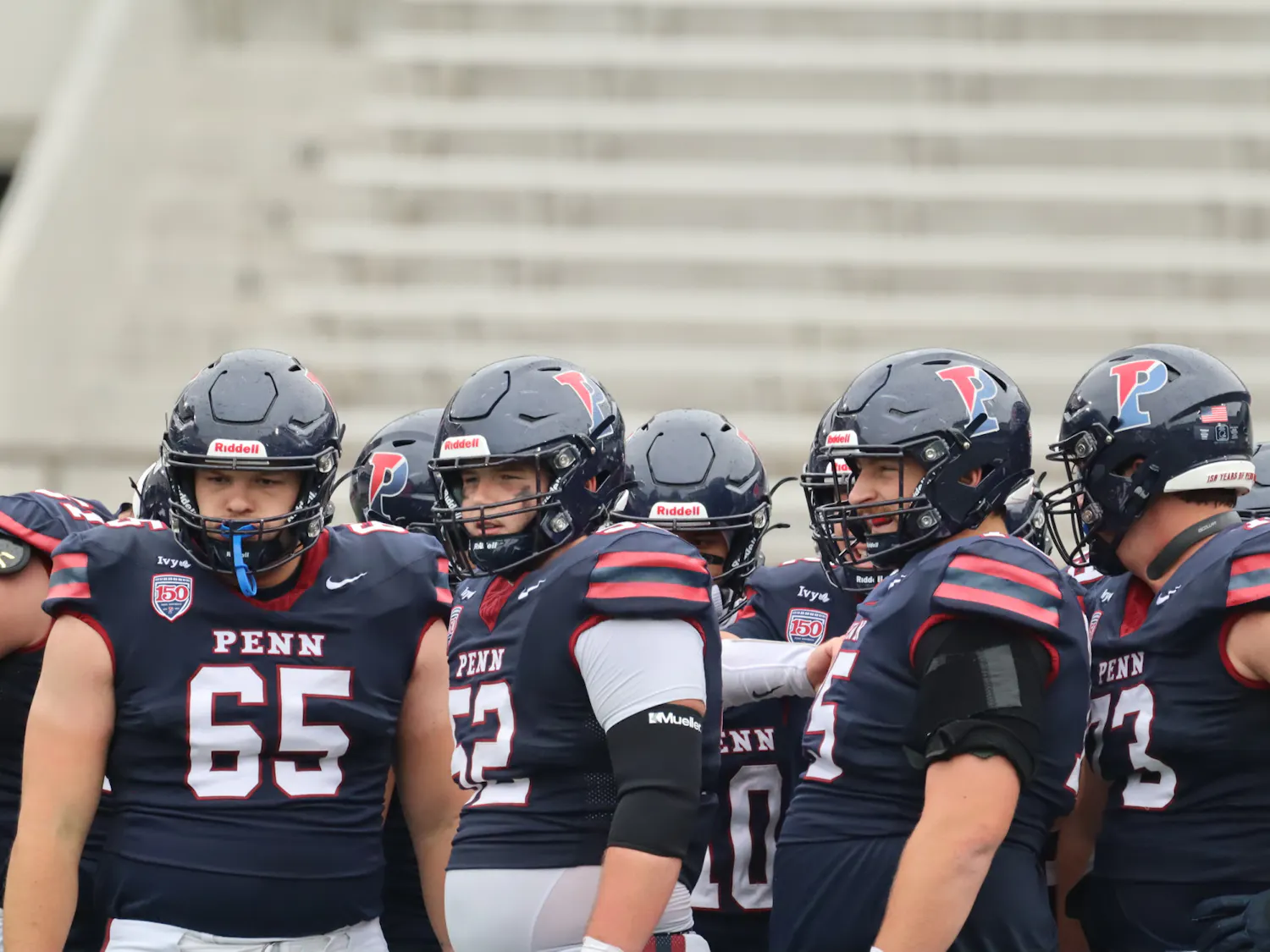
Ugonna Onyekwe demanded the ball in the post in Penn's win over Princeton. He just kept on demanding it straight through the Quakers' weekend sweep over a dangerous Yale team and a Brown side that had been undefeated in Ivy League play. Penn's offense was run to perfection. It was run through Onyekwe. This is not to say Penn got assists on all their baskets and never missed a three. That sort of performance comes very rarely (and since Penn already had an offensive showing for the ages at USC, is not likely to happen again this year). Andrew Toole was sick and played sparingly against Brown. Jeff Schiffner and Tim Begley, normally reliable marksmen, shot a combined 2-for-12 from behind the arc. This was perfection? Yes. Penn optimized the advantage it has over every Ivy League team. Namely, Onyekwe. The Quakers' guards fed him early and often, even if Brown and, to a lesser extent Yale and Princeton, consistently doubled and hacked the big man. Early in the season it seemed as if these efforts frustrated Onyekwe and his post-counterpart Koko Archibong. Soon enough Penn's big men stopped demanding the ball if they were occupied by opposing guards. Penn's guards were not blameless either, taking this as a cue to loft up many threes. Sometimes they hit shots, as they did in the big win over USC. Sometimes they did not, as in the early season loss to Delaware. However, pounding the ball inside is not hit-or-miss. Against Ivy opponents in particular, getting the ball to the big guy is always a winning proposition. In the last three games this tactic, or perhaps a re-emphasis on a tactic Penn coach Fran Dunphy has stressed all year, led to high-percentage shots -- even if those were three-point attempts -- and free throws in this critical three-game stretch of wins. The Quakers offense is based around the three-point shot, however the quality of looks that Penn gets from beyond the arc is predicated on what happens before the shot. What needs to happen is the ball going down into the post. Penn attempted 44 three-pointers over the weekend and made 15 of them for a healthy, if somewhat below Penn's average on the season, 35 percent. Two plays emphasize the superior results of Penn's renewed commitment in the last three games to pounding the ball down low. With 4:35 remaining and Penn trailing Brown by five -- its largest deficit of the game -- Onyekwe received the ball in the post. Brown, as it did the entire second half, doubled down on him. He threw the ball to a wide open David Klatsky on the three point line. Two point margin. With 2:42 to play and Penn still trailing by two, Schiffner was the recipient of Onyekwe's outlet from the double team and gave Penn a 67-66 lead it would not relinquish. Forcing the ball inside against an unwilling defense has its benefits on higher percentage shots than the three-point line as well. Free throws -- an obviously high percentage shot -- are taken with much higher frequency when going inside. Against Brown and Yale, Penn shot 36-for-48 from the free throw line. Despite Brown coach Glenn Miller's conspiracy theories, this did not have to do with the referees' Penn bias. It had to due with getting the ball to Onykewe and forcing Brown to stop him. One of the few ways they could was to foul him. By contrast, against Harvard and Dartmouth in two Ivy games earlier this year Penn went to the line 29 times against teams with clearly inferior frontcourts. After those games, both Quakers wins, I was critical of Penn for not exploiting the biggest mismatch on the floor whenever it is out there. And should Penn continue to run their offense through the post, there is little reason to forsee the Quakers' winning streak against Ivy competition stopping at 17 this season.
The Daily Pennsylvanian is an independent, student-run newspaper. Please consider making a donation to support the coverage that shapes the University. Your generosity ensures a future of strong journalism at Penn.
Donate