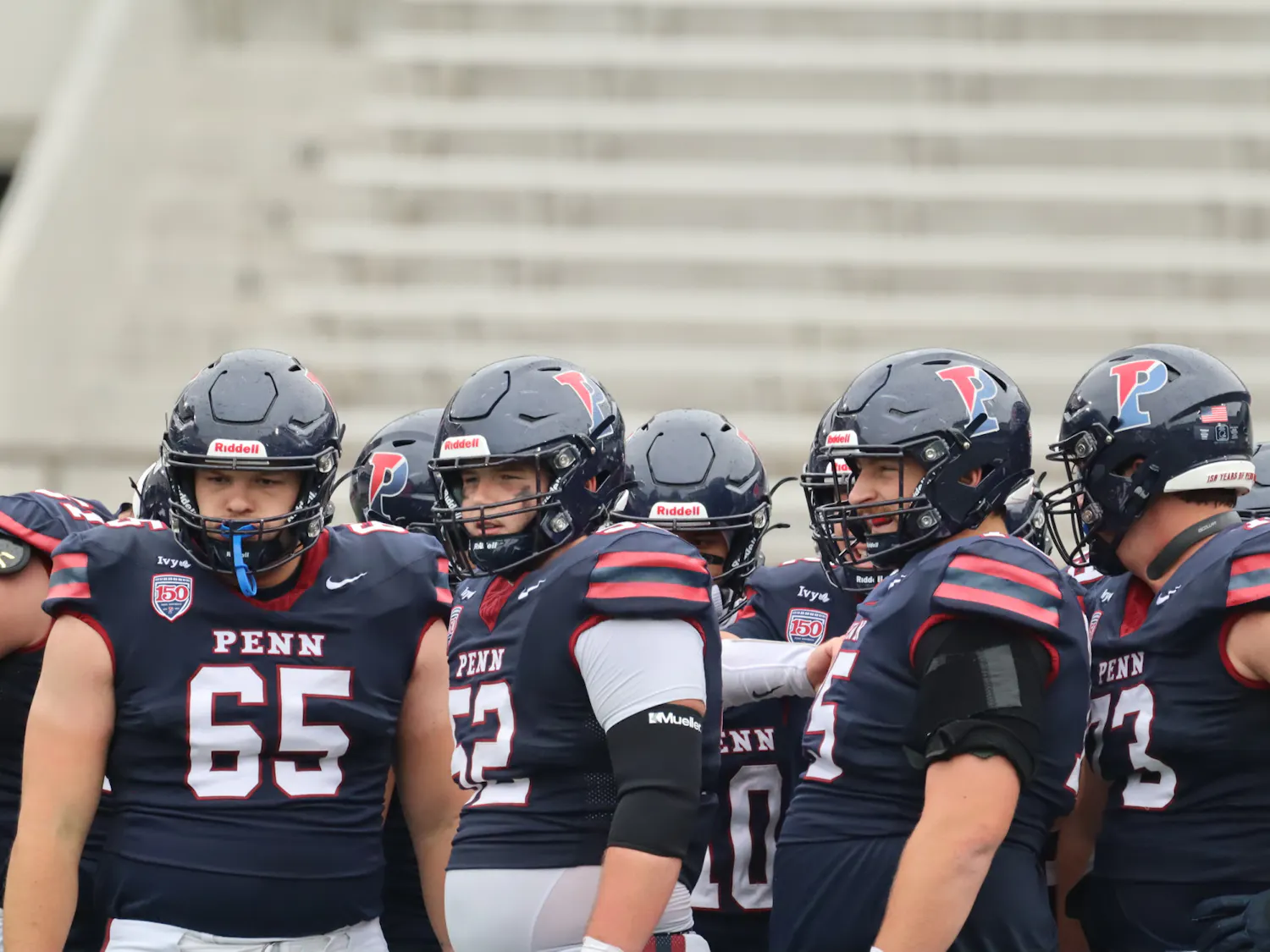
The Penn football team raced through the Ivy season undefeated.
So what?
The Quakers placed 18 players on the All-Ivy team.
Great. And?
This team may very well be one of the best teams in the 126-year history of the program.
Yeah, but what does that mean?
The problem is there's just no way to judge how this team compares to other great teams.
The reason is simple. The Penn football team, like the rest of its Ancient Eight brethren, is not allowed to go to Division I-AA playoffs, an archaic and ridiculous rule that needs to be changed.
Before the game against Villanova earlier in the season, Penn football coach Al Bagnoli scoffed at the notion that his team was ranked in the Top 25.
It's not that he wasn't flattered, it's just that he knew that it meant absolutely nothing.
What difference does it make how the Quakers compare with the rest of Division I-AA when they can't even test their mettle against them in the postseason?
Bagnoli told me then that he'd like to see his team eligible for the playoffs, and I'm guessing all the other Ivy coaches and players would say the same.
Why, then, aren't they eligible?
Here's the basic history:
When the Ivy League was created in 1954, the original group of presidents decided that there would be no football postseason play, just like there would be no scholarships and no spring practices.
"So the issue has always been," Ivy League Executive Director Jeff Orleans told the Daily Pennsylvanian in 1999, "are we going to change one of the founding tenets of the Ivy League approach to athletics or not?"
But don't be mistaken, this is not one of those idiosyncrasies that makes the Ivy League lovably unique, like not having a postseason basketball conference tournament.
It's just plain unfair. And it's something that needs to be changed.
The primary reason that Ivy League teams cannot compete in the playoffs is that the presidents believe it would conflict with the students' final schedules.
However, the 16-team playoff begins Nov. 30, two weeks before finals at Penn even begin. The quarterfinals are on Dec. 7, the semis on Dec. 14 and the championship Dec. 21.
Only the final two rounds would be during the same time as final exams, and even then I'm skeptical how much the games would actually interfere.
The games would be on Saturday, and the team would leave on Friday. What's the problem? That's the exact same schedule the team has throughout the season, and they're able to manage their academics then.
Another concern is whether the teams would be competitive. Well, there's no way to know for sure how well the Quakers would do against McNeese St. and Georgia Southern, two of the top teams in Division I-AA. But I'm willing to bet that this Penn team, which outscored its opponents by more than 30 points per game, would at least hold its own.
Still not convinced? Take this into consideration: Each of the other 32 Penn athletic teams that are not football are allowed to compete in their respective postseason tournaments.
This is one of the best Penn teams ever to grace Franklin Field. Therefore, that is where the Quakers season should end, not in the Ivy League presidents' offices, but competing on the playing field.