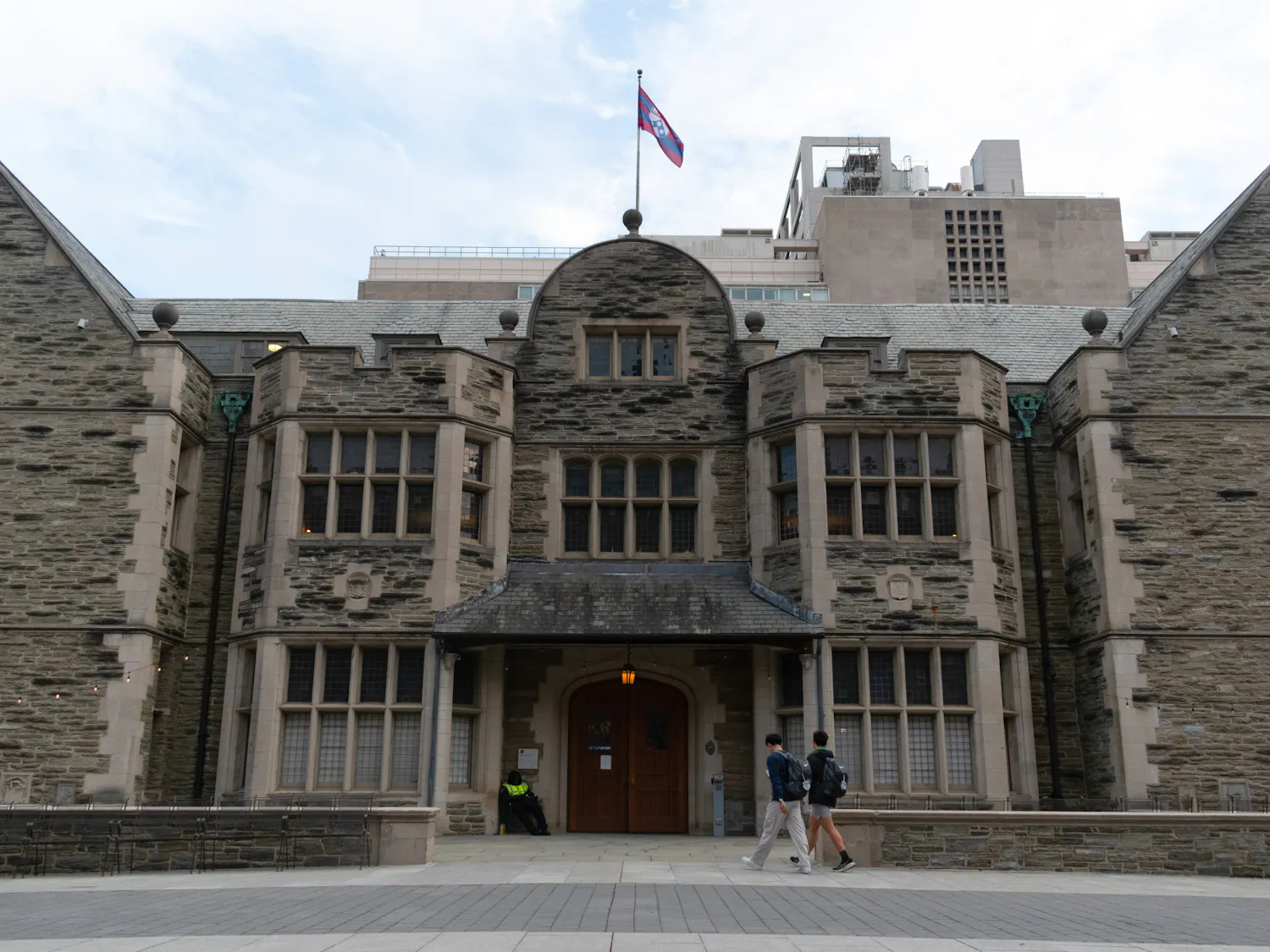
Everyday, students pass by the barbed wire and white cinder block of the Thoroughgood Home at 40th and Pine streets. But they likely have little knowledge of what went on inside its crumbling walls.
For the residents, filthy and inhumane conditions were a part of everyday life, according to state inspection reports and an advocacy group for the elderly and mentally ill.
On Aug. 26, the state's Department of Public Welfare finally closed the home after finding what the city Department of Licenses and Inspections called "conditions dangerous to human life."
Thoroughgood, a personal care boarding home licensed by the state, was better known to neighborhood residents by its unofficial name, Azalea Court.
Personal care homes like Thoroughgood provide elderly and mentally and physically disabled persons with a place to live and assistance with basic tasks like eating, bathing, dressing and taking medication. The homes are regulated and inspected by the Department of Public Welfare.
Over the past five years, the DPW cited Thoroughgood for more than 40 different violations and fined the home more than any other in the region, according to Kathy Gerrity, a DPW official who worked to close the home.
But DPW inspection reports provide only a glimpse of the actual conditions inside.
Thoroughgood's residents wore tattered clothes often soaked or stained with their own urine, ate substandard food and took the wrong medications -- when they got their medications at all, according to Millie Ofray, a government-employed ombudsman who handled complaints from the home's residents.
Residents, most of whom received welfare, lived in a home falling down around them. The building was pockmarked with holes in the walls and ceilings and often without running water, toilet paper or other basic hygienic items, according to Ofray and an independent coalition of advocates that works for the rights of the elderly and mentally ill.
"The home was usually in a poor condition," Ofray said. "You could see lint and dirt accumulating in the stairwells and hallways. In general, the place was filthy."
Ofray recalled an incident when she found a resident she knew picking up trash in the backyard and parking lot.
"The resident expressed some reluctance in doing that type of manual labor," she said. When she asked the resident why he was picking up trash, Ofray said that the resident told her that he had been asked by the home's administrators to do the work.
"They should not be doing that type of work," Ofray said. "But residents felt coerced to do certain tasks and duties in the facility."
On other occasions, Ofray said, residents complained that they were not receiving their prescribed medications. Many of the residents were schizophrenic and bipolar, according to those involved with the home.
State reports often fail to mention incidents like these because of the state's laxity in enforcing regulations, according to Eleanor Daly, the director of advocacy services with the Mental Health Association of Southeastern Pennsylvania. "They always took the interpretation that required the least work... the least enforcement."
But Ofray added that what she knows may only be a fraction of what actually went on at the home.
"We personally did not get that many complaints over the years" about the facility, Ofray said. "But, at times, there was a certain general feel that the residents... were not always comfortable complaining about the situations at the home."
But perhaps more shocking than the conditions inside the home was the death of a male resident during the home's final months of operation -- an incident not mentioned in state reports, but later confirmed by state officials. A member of the independent advocacy group involved in the home's closure alleges that, before the man died, he moaned in pain for hours as the staff ignored him.
The resident died on the night of Aug. 12, during the final weeks of Thoroughgood Home's shutdown and the relocation of its residents. The 40-year-old man, whose name could not be released because of privacy reasons, had a variety of mental and physical ailments.
On Aug. 12, after a visit from his mother, the man began complaining of pains. According to state officials who interviewed both home staff and the man's mother, the man was given the opportunity to call 9-1-1 and refused. Later that evening, he was found dead in an armchair, state officials said.
But Corey Rogers, a consumer advocate at the Mental Health Association of Southeastern Pennsylvania, alleges that part of the story is missing.
According to a female resident Rogers interviewed, "the staff basically ignored [the man], and for about four hours before he died, [the man] was lying in bed, screaming at the top of his lungs that he was in pain."
"The staff basically told him to quit whining and shut his door," Rogers said the female resident told him.
Thoroughgood's owner, Rosalind Lavin, did not return repeated phone calls to comment on the death or Thoroughgood's other alleged violations, and the female resident could not be reached for comment.
The death report, filled out by physician Joel Snyder, says that the resident died of a heart attack. However, in an interview Snyder admitted, "I don't know what he died of. I wasn't there."
Snyder worked at several of the Lavin family's other personal care homes. All but one of the homes have now been closed by the state.
A cardiologist at the Hospital of the University of Pennsylvania, who did not want his name disclosed, questioned whether the home did everything it could to prevent the man's death when presented with the account given by the advocacy group.
"If [the man] really did have four hours of pain, there was plenty of time to administer emergency medical care," the cardiologist said. "He was what, 10 blocks from the hospital?"
The man apparently had a history of complaining of pain. According to the DPW, he called 9-1-1 several times a month to go to the hospital.
Snyder maintains that "there was no foul play" involved in the death and questions the validity of the female resident's allegations.
"The other residents are not at a very high level, either mentally or physically, and are in no condition to make any kind of judgement about what kind of pain that [the man] was in," Snyder said.
Weeks before the man's death, officials from the Philadelphia Corporation of the Aging, which assesses residents' medical conditions, determined that he should have been placed in a nursing home. There, he would have had better medical supervision than he had at a personal care home like Thoroughgood.
The paperwork to move him was still being processed when he died.
Personal care homes are responsible for alerting health officials if a resident's condition worsens to a degree that the resident needs to be re-evaluated for a higher level of care. There is no record that Thoroughgood asked for a re-evaluation of the man prior to the state's intervention or his death.
According to the advocacy coalition, state officials acknowledged that they were satisfied with the account of the man's death given by the home and saw no need for a formal investigation.
While Lavin has lost her license from the state to operate a personal care home, Thoroughgood remains in operation as an apartment complex, according to the state and the advocacy coalition. State law prevents Lavin from getting another personal care home license for five years.
To date, poor conditions have led to the closure of three of the Lavin family's four personal care homes and the relocation of the residents.
But in the case of Thoroughgood, many of the residents will be moving to the Lavins' only remaining home -- Ivy Ridge. How they'll be treated by the Lavins there, and whether they'll be subjected to the same conditions that led the state to close Thoroughgood, remains unknown.