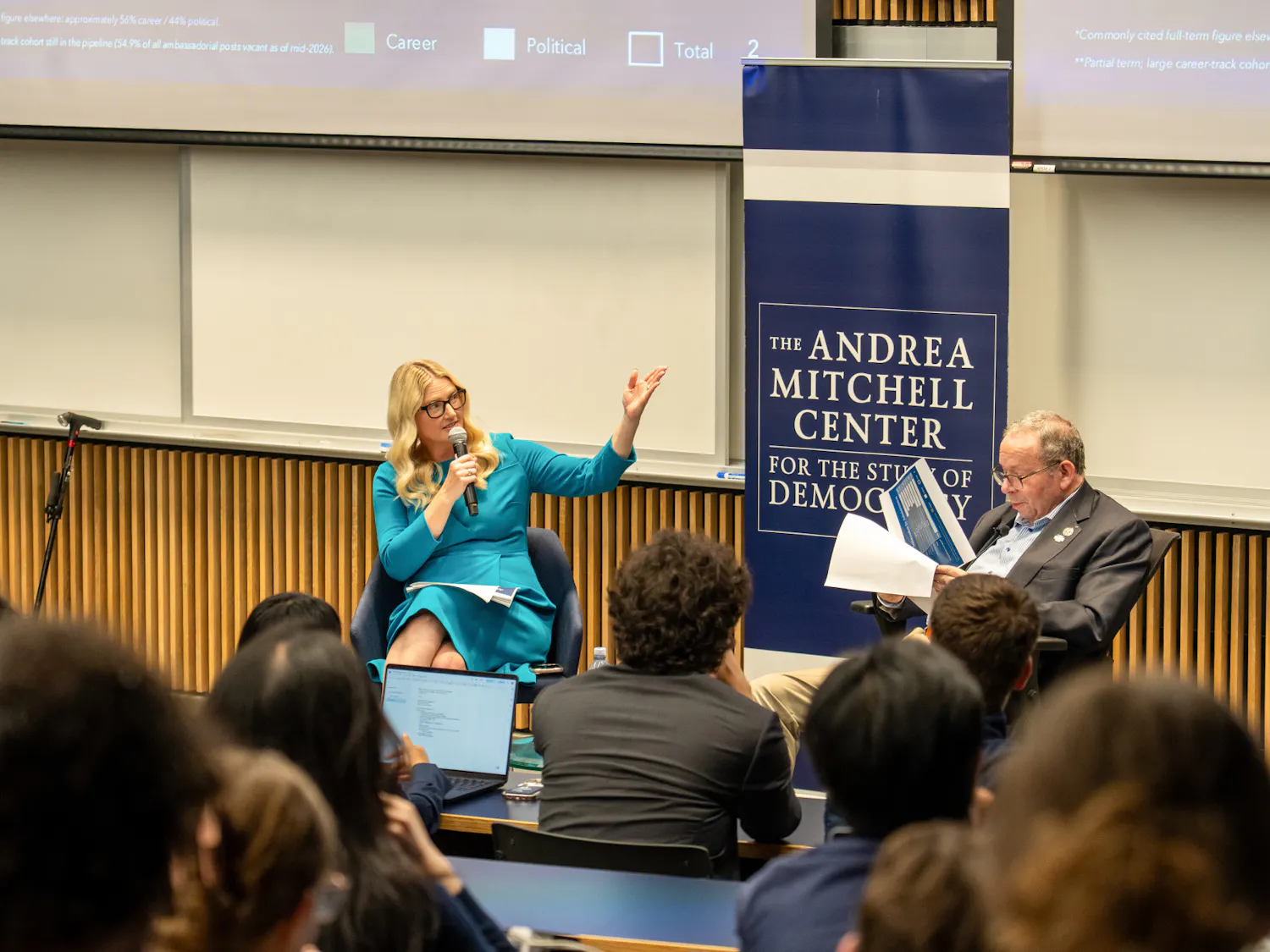
Two legal masterminds sparred yesterday, debating whether the U.S. should ratify United Nations conventions on the rights of women and children. Jeremy Rabkin, associate professor of government at Cornell University, and Teri Himebaugh, legal support network coordinator for Amnesty International, outlined the arguments and challenged each other to provide evidence. The debate was sponsored by the Federalist Society for Law and Policy. Himebaugh, who argued for the ratification of the treaty, began the debate by addressing the need for the treaty on the international level. "Women are routinely tortured and discriminated against throughout the world," Himebaugh said. "Because of this wide spread pervasive violation of human rights, international law is needed." Himebaugh went on to say that the U.N. treaty would not force countries to give up their culture. "[The treaty] is not designed to impose the will of one culture on to another. It's designed, simply, to maintain certain basic, minimum standards for human rights." Himebaugh also added that the treaty did not mandate abortion, as many critics claimed, nor did it force women to serve in the military. Himebaugh said the treaty's language allowed countries to apply "their own legal and cultural values." Himebaugh concluded the first round of the debate by saying that the U.S. needed to ratify the treaty to "reaffirm the principles we have relied upon in our constitution, in our laws, and in our lives, count for something." Rabkin rebuted Himebaugh's remarks in three stages. First, he said that many of the countries who have already signed the treaty do not plan to uphold it. "It's a real question whether or not we want to strengthen organizations who are corrupt," Rabkin said yesterday. Rabkin added that it would be more effective for the U.S. to use leverage, instead of the prestige the treaty would give, to influence the countries who violate human rights. "We already have a lot of leverage," Rabkin said. "We can refuse these countries loans, arm sales, or trade status." Rabkin also said that the treaty makes no distinction between individual privacy and the government. This would cause difficulties with enforcing the treaty in the U.S. "I think we should go into it with our eyes open," Rabkin said. First year Law student Sandra Libeson said the debate was "very enlightening." Libeson added that she would not support signing the treaty. "There's too much left open to argue about," Libeson said. But Michelle Lee, another first year Law student, said that the debate strayed from the issue of the human rights treaty and focused more on the issue of what kind of policies work on the international level.
The Daily Pennsylvanian is an independent, student-run newspaper. Please consider making a donation to support the coverage that shapes the University. Your generosity ensures a future of strong journalism at Penn.
DonateMore Like This

A history of the Penn presidency
By
Aidan Shaughnessy
·
13 hours ago

No — AI will not wipe out humanity by 2030, Penn experts say
By
Addison Saji
·
13 hours ago

Penn student groups promote voter registration on Locust Walk
By
Mara Flores
·
13 hours ago