

In the early hours of Feb. 28, the United States launched drone strikes on multiple targets in Iran — a move that marked a significant military escalation and prompted various reactions from members of the Penn community.
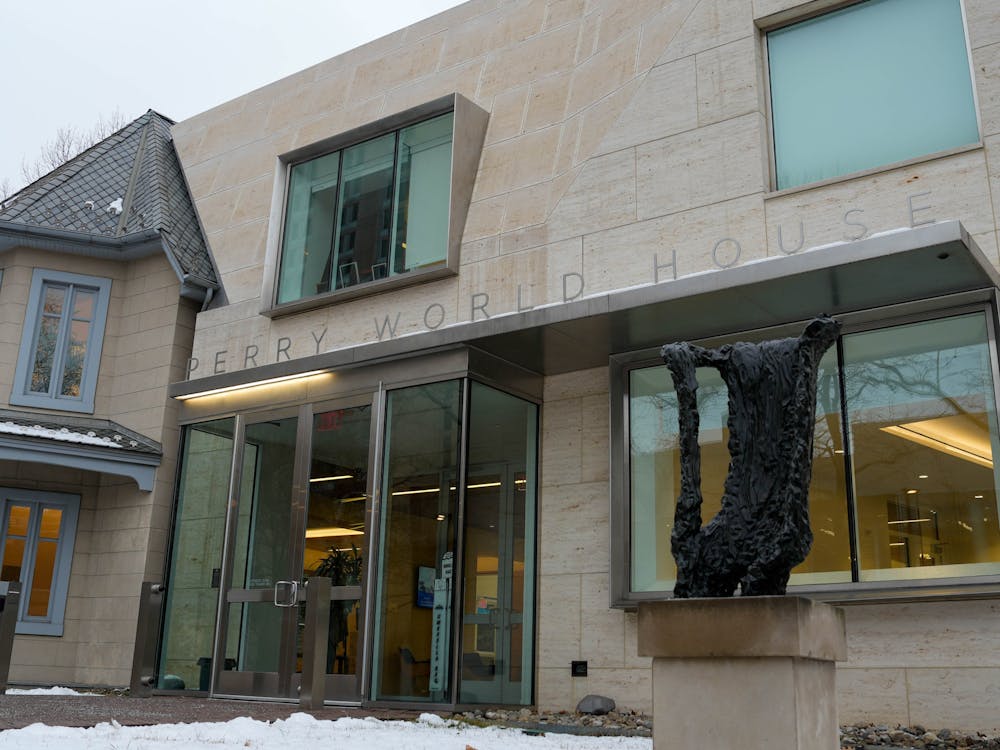
Leaders at Perry World House and Penn Washington, alongside faculty experts and campus centers, weighed in on the potential geopolitical fallout of the conflict. As a result of the U.S. intervention, Penn Global also “strongly advised” students to defer travel to and transit through the Middle East region.
Just after the bombing was reported, members of PWH’s leadership released a statement responding to 1968 Wharton graduate and President Donald Trump’s strikes on Iran that morning.
PWH Executive Director Marie Harf, Faculty Director Michael Horowitz, and Penn Washington Director of Global Policy Programs Daniel Schneiderman were quoted in a social media post on official PWH accounts.
“This is a war of choice that puts Americans and our friends in the region in danger,” Harf wrote in the post. “With little public debate, President Trump has taken the nation into a military conflict unlikely to produce an Iranian government that is more pro-U.S. or respectful of its people.”
In a conversation with The Daily Pennsylvanian, Harf emphasized that if Trump’s goal is “a democratic, free Iran,” there is “no evidence in history” that military campaigns which overthrow regimes lead to “that kind of outcome.”
“Overthrowing the Taliban, overthrowing Muammar Gaddafi, and overthrowing Saddam Hussein — none of those resulted in thriving pro-U.S. democracies,” Harf said. “The best way to transition from authoritarian government to a democracy is for a homegrown movement of people inside the country, not with the military force from outside, but I don’t even know that that’s the administration’s objective.”
Schneiderman — a former senior coordinator for Afghanistan, Department of State official, and National Security Council member — warned in the PWH post that the “follow-on risks” of the conflict “are myriad.”
RELATED:
Pentagon drops Penn from list of ‘woke’ universities set to lose military tuition aid
Penn School of Arts and Sciences hosts panel on United States intervention in Venezuela
“The war is already expanding regionally and enmeshing U.S. partners; this will drive a cycle of strike and counter that will be hard to break,” Schneiderman wrote.
“I’m really skeptical that military force is going to achieve the desired effect that the administration is going for, to ensure some kind of democratic transition in place,” he told the DP. “In fact, the president said that this is the moment for the Iranian people to rise up and take their own government into their own hands, which also implies that the United States has limited political and military will to take action to try to make that happen.”
He added that he doesn’t “think there’s any question that Iran’s regime and the elements of the IRGC that control Iran’s military forces have done a significant amount to imbue instability across the region.” Still, Schneiderman expressed concern with the United States’ “resources to execute the campaign,” such as “air assets, carrier strike groups, intelligence collection platforms, and time and attention of senior leaders.”
While Penn and its organizations, institutes, schools, and official programs are bound by the University’s policy of institutional neutrality, Penn Washington Executive Director Celeste Wallander told the DP that the “opinions and expertise” of those at the program “are their own” and “do not reflect any policy of Penn Washington on any issue.”
Harf — who also moderated a PWH rapid response panel regarding Iran on March 3 — said that the “bread and butter” of PWH is bringing “current events to our community.”
The panel focused primarily on the intricacies of the conflict, as well as the possible next steps for the region. Schneiderman spoke on the panel, along with PWH non-resident senior advisor Hussein Banai and Dalia Dassa Kaye, a senior fellow at the Burkle Center for International Relations at the University of California, Los Angeles.
Kaye compared Trump’s Iran strategy to U.S. action in Venezuela.
“The Trump administration was perfectly fine for an outcome in Venezuela that was not a democratic and free Venezuela,” Kaye said. “It did not bring in the opposition and elections … and nothing else has changed.”
Other panelists spoke on the succession plans following the death of Supreme Leader Ali Khamenei, scenarios for regime change, and foreign policy.
That same afternoon, Penn’s Center for Ethics and the Rule of Law hosted a discussion on the conflict in terms of military response, international law, and Israeli involvement.
“As members of the voting public, it is important for the Penn community to be aware of the military operations that our government is engaging in in our names,” CERL Faculty Director and professor Claire Finkelstein wrote to the DP. “This could be a protracted military conflict, and the impact on our lives could extend to posterity.”
Finklestein — who also moderated the panel — spoke with retired General Joseph Votel, former Israel Defense Forces legal advisor Ben Wahlhaus, and Texas Tech University professor Geoffrey Corn about how the conflict related to each of their specialties. Votel covered the military aspects, Wahlhaus the Israeli aspects, and Corn the legal aspects.
“What CERL wants to achieve is to better inform the public and the Penn community about events in the Middle East connected with Operation Epic Fury,” she wrote. “The way we achieve that is by leveraging CERL’s extensive military and national security expertise to provide commentary about ongoing developing events.”
During the panel, Corn emphasized that “our situation would be stronger if the War Powers Resolution were actually complied with by its terms.”
Wahlhaus, who is currently located in Israel, mentioned that he may need to leave the call to seek shelter if there is an attack.
“Since the operation started on Saturday, every few hours we’ve had siren alerts,” Wahlhaus said. “We get them directly to our phone, a blaring noise and gives a bit headway before the rockets or the armed drones reach Israel, and we’re all in close proximity to bomb shelters because the entire country has come under attack from Iran since the operation started.”
Iran’s airspace closed following the initial bombings, and Penn Global issued extended travel guidance.
“As of March 2, 2026, Penn travelers are strongly advised to defer travel to and transit through the Middle East region until further notice,” the webpage reads. “Penn-affiliated undergraduate travel to the Middle East is currently prohibited until March 15, 2026, at which time this stance will be reassessed.”
A request for comment was left with a Penn Global spokesperson.
In a statement to the DP, the board of the Persian Students Association at Penn wrote that the group “wants to make clear it stands with the people of Iran.”
“On the one hand, we feel a profound sense of relief that the central figure associated with decades of repression is no longer in power,” the board wrote. “Yet, at the same time, we worry seeing our hometown in smoke and our loved ones under threat.”
The board noted its belief that “Iranians deserve peace, freedom, prosperity, and a future without fear” with free speech, civilian protections, and removal of censorship. Engineering junior and the group’s Cultural Vice President Sasan Sedighi also told the DP that the club organized a “protest” at Penn for the “same reason.”
The rally, where nearly 100 demonstrators gathered on Jan. 16, stressed the need for increased awareness on Penn’s campus surrounding recent protests in Tehran which have faced harsh retaliation from the Iranian government.
Penn international relations lecturer Farah Jan also described the circumstances of the bombing in an article for The Conversation. She specifically connected the current action to the “Shock and Awe” campaign in Iraq — which had the “explicit aim of regime change,” but failed to produce its “political objective.”
Outside of the political and military realm, Schneiderman also mentioned the potential effects of this conflict on global markets.
“I think there are real potential energy market implications, and as a result, global economic implications, especially if this war drags on for several weeks or even into several months,” he added.
RELATED:
Pentagon drops Penn from list of ‘woke’ universities set to lose military tuition aid
Penn School of Arts and Sciences hosts panel on United States intervention in Venezuela
Staff reporter Luke Petersen covers politics and can be reached at petersen@thedp.com. At Penn, he studies philosophy, politics, and economics. Follow him on X @LukePetersen06.


