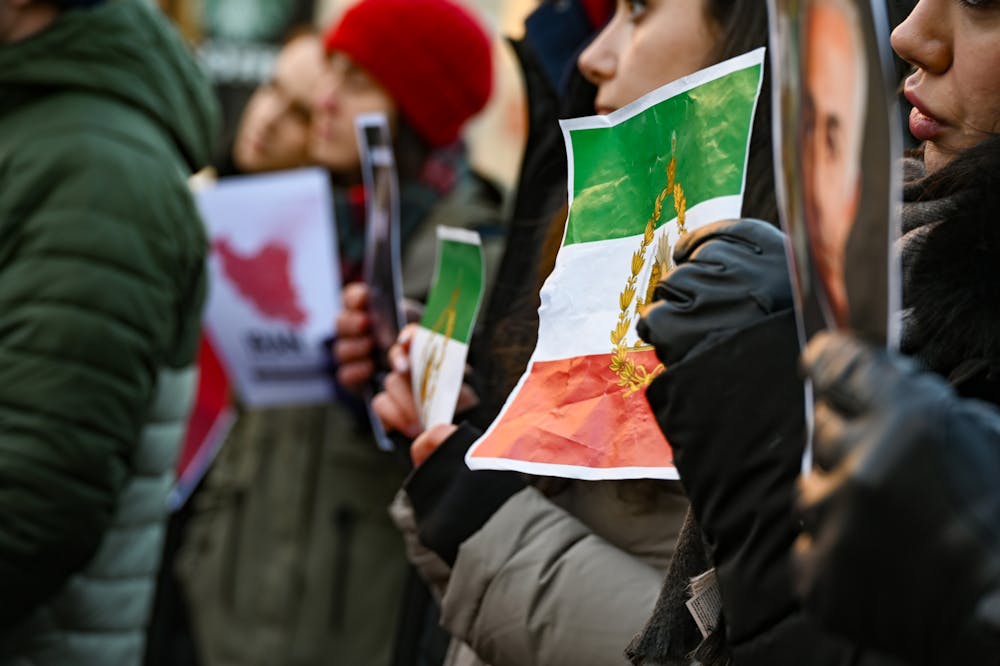
Nearly 100 demonstrators gathered at 34th and Walnut streets on Friday in support of ongoing political protests in Iran.
The Jan. 16 rally — organized by the Penn Persian Society — drew students, faculty, and local community members. Several speakers emphasized the need for increased awareness on Penn’s campus surrounding recent protests in Tehran, which have faced harsh retaliation from the Iranian government.
“This is the first time in a while we’ve had to do this,” Wharton senior and Penn Persian Society president Adrian Rafizadeh — who is also a DP staffer — said during the rally. “We’re not professional activists, we’re not political people. We’re just angry and motivated.”
Several speakers at the rally criticized 1968 Wharton graduate and President Donald Trump’s refusal to take military action against the Iranian government.
“Shame on the president of the United States,” Fatemeh Shams, a professor of Persian literature at Penn, said. “Look at this maniac who has changed his mind 50 times — playing with people’s lives.”
While an ongoing internet blackout in Iran has hindered the flow of information, some estimates have put the death toll of the protests, which began in Tehran last December, at nearly 12,000.
“When we say the U.S. needs to intervene, we are not calling for invasion,” College sophomore Sana Dezhabad said. “We are calling for strategic action that saves lives across the globe.”
In an interview with The Daily Pennsylvanian, Rafizadeh highlighted the “grassroots” planning of the rally, which he said occurred within 48 hours. He explained that the group initially requested to host the rally in front of the LOVE statue, but that the University said it “needed more time to assess the threat or risk of the protest.”
Penn graduate student union announces Feb. 17 strike deadline
Thousands rally against Trump administration at Philadelphia ‘No Kings’ protest
Rafizadeh called the University’s decision “fair,” citing violent reactions to a Los Angeles protest in support of Iranian demonstrators. Still, he said the response felt “a bit like a slap in the face, because it's so difficult to actually describe the scale of the tragedy.”
A University spokesperson referred the DP to Penn’s Division of Public Safety in response to a request for comment. A request was left with a spokesperson for the Division of Public Safety.
“My reality is that I don't know if my family is alive,” Rafizadeh told the DP. “I have aunts, uncles, cousins, and grandparents in Iran and Tehran. I don’t know if they’re alive. There’s no Internet, and they’ve killed 12,000 people, and the fact that people don’t know that’s happening is shocking, and that's one of the main reasons why we’re doing this.”
Penn graduate student union announces Feb. 17 strike deadline
Thousands rally against Trump administration at Philadelphia ‘No Kings’ protest
Isha Chitirala is a News Editor at The Daily Pennsylvanian and can be reached at chitirala@thedp.com. At Penn, she studies economics and political science. Follow her on X @IshaChitirala.
Finn Ryan is the Summer Editor-in-Chief at The Daily Pennsylvanian and can be reached at ryan@thedp.com. At Penn, he studies political science and Russian. Follow him on X @FinnRyan_.