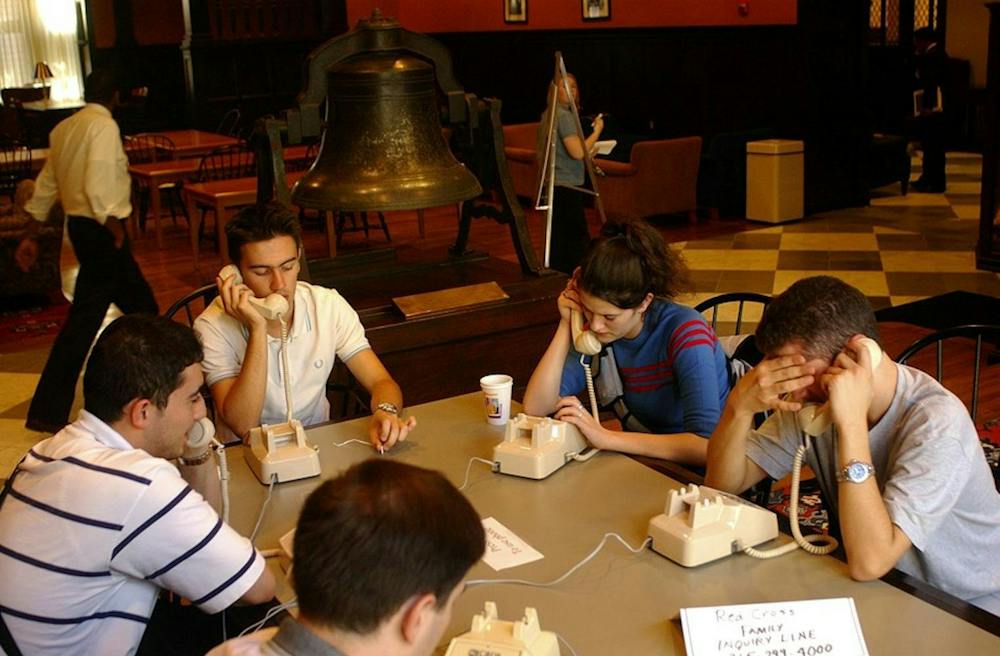
It has been 25 years since Sept. 11, 2001.
A quarter-century since the deadliest terrorist attack on American soil, much of the world has transformed in the shadow of that day. Faculty members and policy experts say the effects of the attacks still reverberate through Penn’s campus, reshaping everything from security practices to academic curricula.
Penn had started working on a crisis management plan prior to 9/11, according to Vice President of Public Safety Kathleen Shields Anderson. Those plans, however, were made more urgent by the attacks.
That summer, the University established an “Emergency Preparedness Plan” that included tailored preparations for each school and center.
According to Chief of Fire and Emergency Services Eugene Janda, each location’s plans are shared with fire and police departments so they can “quickly get access to the information they need about that building in case of an emergency.”
For events that draw large crowds — such as graduation, Convocation, and The Penn Relay Carnival — the attacks fundamentally transformed the University’s approach to security. Penn began working with the Philadelphia Police Department’s Ordnance Disposal Unit and bomb unit, and collaborated with the City of Philadelphia, Amtrak, and SEPTA police to conduct sweeps of the area.
Currently, Janda said, the department assesses threats based on “situational awareness.”
Prior to the attacks, the University also did not maintain an active K-9 unit, Chief of Police for the Penn Police Department Derrick Wood said in an interview. As of 2025, the Penn Vet Working Dog Center has graduated nearly 200 detection dogs.
Frank Plantan, an international relations lecturer emeritus at Penn who also received a Ph.D. from the University, said that potential security risks at the University prompted the installation of surveillance cameras across a campus.
“There had been massive resistance by students and faculty to closed-circuit TV cameras,” he said. “Penn Security had been trying to put them on campus for years — then after 9/11, the resistance to that broke down.”
According to Anderson, the expansion of CCTV cameras began well before Sept. 11, 2001.
“I understand how people would see a correlation,” she acknowledged, but clarified that the purpose of the CCTV program is “primarily investigation” and not surveillance.
“After 9/11, the risk was thought to be high enough that people were willing to experience lots of disruptions to decrease the potential risk of another attack,” Michael Horowitz, director of Perry World House and a Political Science professor, said in an interview. “The issue is that at some point you have diminishing marginal returns.”
Given Penn’s urban setting, Horowitz said it was difficult to “barricade campus off from the community.” College campuses, he added, are supposed to be “accessible places where lots of different people come and teach and work and take classes.”
Within a few years, Horowitz noted that police departments across the country had SWAT teams and armored vehicles. The federal government funded local response in a way that “didn’t exist before 9/11,” he added.
***
Horowitz argued that the attacks “shattered the post-Cold War illusion that American power would insulate the United States from consequential attacks.”
“It illustrated that there was a new kind of adversary that everybody knew existed but that was capable of hitting the United States in a way that very few people thought was really possible before,” he said.
Six weeks after the attacks, then-President George W. Bush signed the USA PATRIOT Act into law, dramatically expanding the surveillance power of the federal government. The act broadened the legal definition of terrorism and made it easier for the government to wiretap suspects, collect records, and share intelligence.
The way 9/11 reshaped the nation’s understanding of free speech, civil rights, and police activity may be “one of the most significant impacts of 9/11,” according to Professor Emeritus in Political Science Robert Vitalis.
Beth Simmons, a Law and Political Science professor, wrote in a statement to The Daily Pennsylvanian that Americans have “internalized all of this border enforcement and surveillance with an ‘oh well’ shrug” without realizing how “drastically different” things are in comparison to before the attacks.
“Debates swirl around whether these changes have been overkill or wise investments in national security,” she continued. “But, hey, there has never been another 9/11-like attack.”
***
Plantan was working on campus at the time. Administrators were navigating how the attacks should be taught to students, and soon after, the question was passed down to faculty: “What were we doing to respond to the crisis?”
Before the attacks, terrorism was hardly a marquee subject at Penn. The Political Science department offered a course on terrorism, but Plantan said it struggled to draw major interest. After 9/11, it “became the most popular class on the campus,” Plantan recalled, a trend that continued for nearly a decade.
The University’s curriculum soon reflected that shift. Professors developed a course titled “Political Risk Analysis” in direct response to the attacks, and in 2011, launched a course on counterterrorism.
According to Vitalis, there was a particular interest in Middle Eastern studies. Before the attacks, the department was struggling with funding. Soon after, Vitalis said it was “able to fund 20 more fellowships than we needed to beforehand.”
***
Many current Penn students were born after the attack. They often learn about the events through retellings from family members or history classes.
This year, the Graduate School of Education launched a “Teaching Beyond September 11th” program that educates teachers on how to “explore the longer-term consequences” of the event.
“Students need a clear account of the attacks, the people who were killed, including first responders, the culpability of al-Qaeda under the leadership of Osama bin Laden, and the immediate national and international response,” the program’s webpage reads.
Each September on the anniversary, students hear about the attacks, Plantan said. They know about the monuments and the new World Trade Center erected at Ground Zero in New York, he continued, but they “didn’t live it or have that experience, so it becomes history.”
Plantan still teaches at Penn and described how it is jarring to see his students no longer share the same “cultural-based reference point.”
“Sometimes you say something about 9/11, people stare at you, and you realize they don't know what I’m talking about,” he said.
Cinema and Media Studies lecturer Kathleen DeMarco Van Cleve said in an interview that “it’s super difficult to communicate the effect and the visceral feeling when you are alive for that kind of catastrophe.”
“Things changed on college campuses in the immediate aftermath of 9/11, but those events have now been overwhelmed by other things,” Vitalis said. “The Middle East Center at Penn, it’s going to be gone. It’s hanging on by a thread.”
In 2022, the federal government pulled its funding for the Middle East Center due to insufficient institutional support from the University.
“That’s one of the challenges with bureaucracies and big institutions: Who carries the historical memory?” Plantan said.
Senior reporter Arti Jain leads politics reporting and can be reached at jain@thedp.com. At Penn, she studies economics and political science. Follow her on X @arti_jain_.