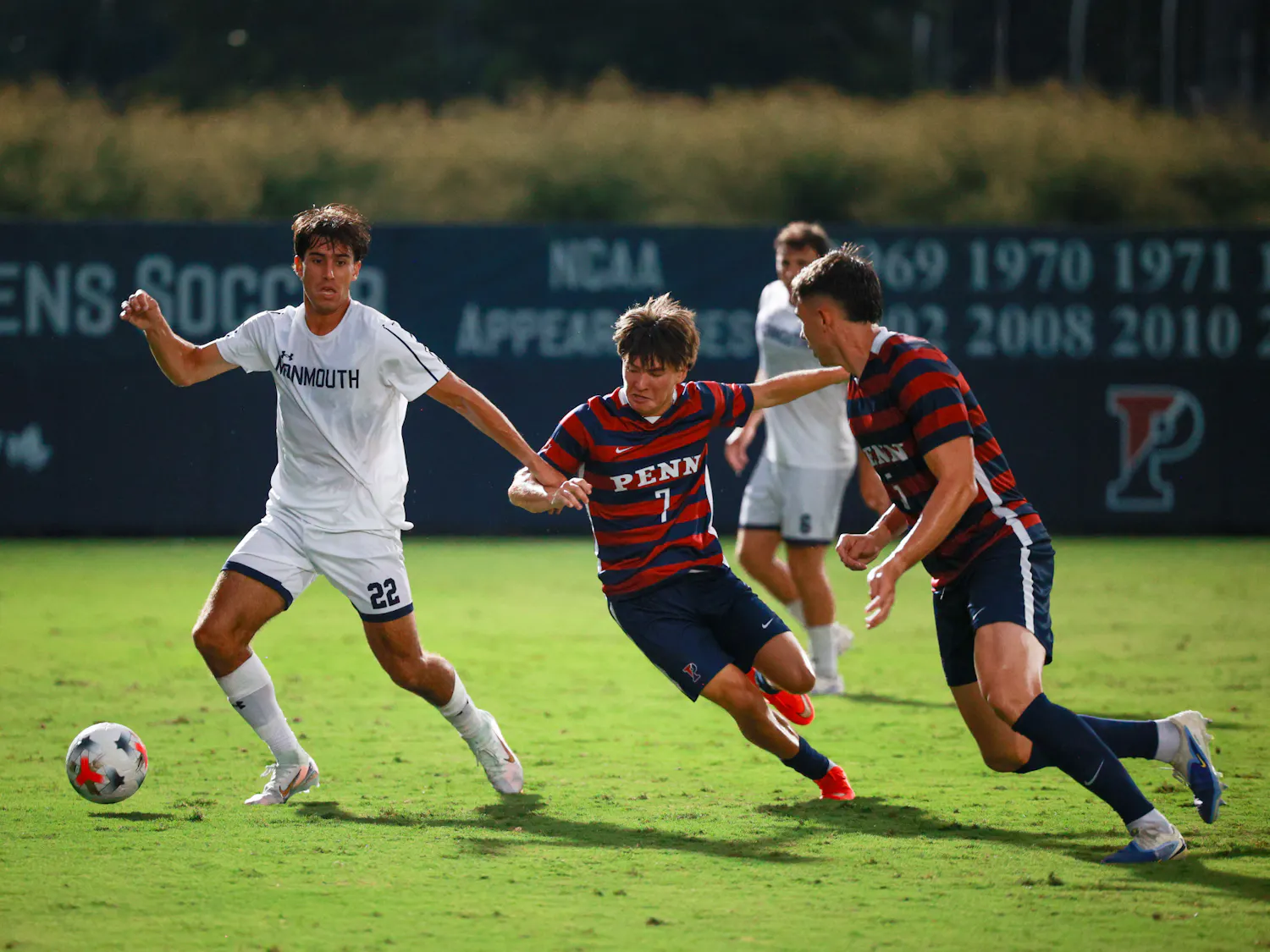
In an athletic conference known more for its academics than its sports, Penn students too often adopt the mentality that our teams “never win” and that the Ivy League “isn’t good at sports.”
After all, Penn prides itself on its education and status as one of the best academic institutions in the world. However, the overdone trope that the Ivy League lacks the athletic talent plentiful in Power Four conferences is simply wrong.
Year after year, we receive news of several athletes transferring out of the Ivy League to a high major Division I program. Of those who transfer, it is not uncommon to see them have continued success in these high-major conferences.
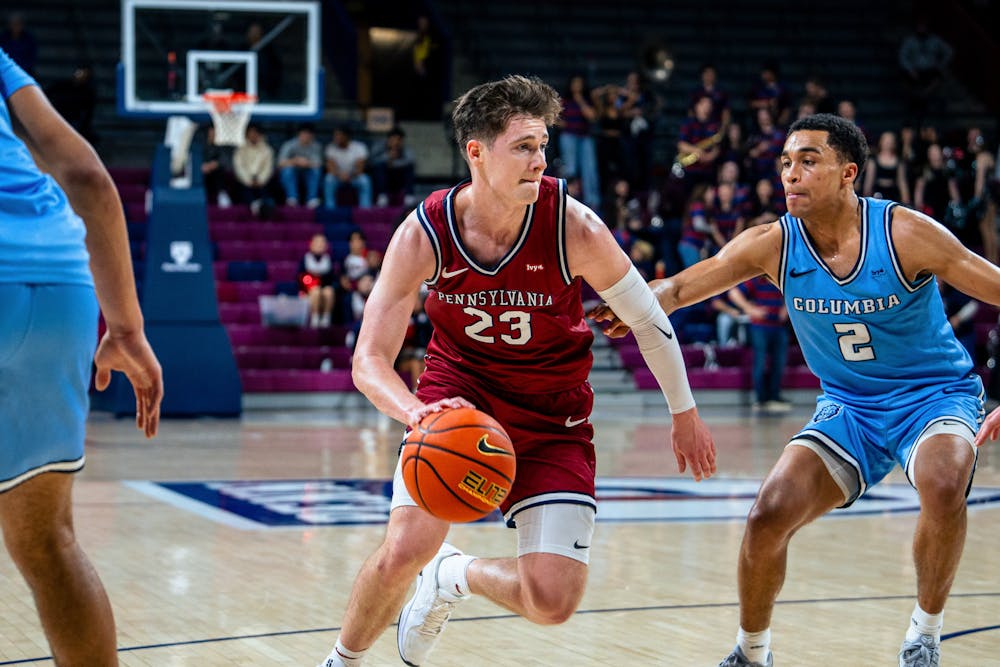
Take Villanova guard Tyler Perkins, for example. Perkins spent his freshman year with the Quakers, where he was second on the team in scoring, averaging 13.7 points per game with an effective field goal percentage of 39.1%. Perkins had several big moments on an 11-18 Quaker squad, most notably his 22-point performance where he shot 60% from deep in an upset Big 5 victory over Villanova. This game foreshadowed Perkins’ basketball career as the guard transferred to Villanova the following season.
Perkins didn’t quite show the upside he did in his lone season at Penn in his first year with the Wildcats. Though his effective field goal percentage increased significantly to 40.0%, his overall scoring production dipped from the 13.7 points he averaged in 2023-24 to just 6.3 points per game in 2024-25.
Whether this dip in production was due to him adjusting to a more competitive conference or playing alongside the nation’s leading scorer Villanova forward Eric Dixon, Perkins wouldn’t stay quiet his following year at Villanova. He broke out his junior season, leading the Wildcats in scoring with 13.7 points per game on his best effective field goal percentage yet at 53.2%.
With Perkins at the helm of the program, the Wildcats earned their first NCAA tournament appearance in four years.
The now-Wildcat senior transferred from Penn to a major conference and, in two seasons, saw great success in a conference with basketball goliaths like UConn and St. John’s.
But this is an anomaly, right?
Wrong.
Ivy athletes consistently show upside after transferring to Power Four programs.
Georgia Tech running back Malachi Hosley had two successful seasons at Penn, where he rushed for 723 yards on 6.0 yards per carry in his rookie season. Hosley upped the ante his sophomore year, rushing 1,192 yards on 6.2 yards per carry to earn Ivy League Offensive Player of the Year honors and become a finalist for the Walter Payton Award.
After two strong seasons at Penn, Hosley entered the transfer portal and committed to Georgia Tech. There was no doubt that Hosley was nothing short of dominant in his time in the Ivy League, but could his talent translate to a Power Four school? The answer is a resounding “yes.” Hosley was second on the 9-4 Yellow Jackets squad in total rushing yards, finishing fifth in the nation in rushing yards per attempt all while sharing the backfield with now Cincinnati Bengals running back Jamal Haynes.
Penn’s athletic talent doesn’t stop at just football and basketball, as the historic Franklin Field has been home to world-class athletes previewing their greatness in the Red and Blue.
Before she ran the second-fastest time in world history over 400 meters indoors, 2024 College graduate Isabella Whittaker was bringing the heat on Franklin Field, displaying her greatness at every meet. She holds four program records, including both the indoor and outdoor 400 meters.
Before transferring to track and field powerhouse Arkansas for her final year of eligibility, Whittaker had already qualified for the NCAA Championships every outdoor season. Just a few months after graduating, Whittaker finished sixth at the United States Olympic trials in the 400-meter run, earning a spot on the Olympic roster as a member of the 4x400-meter relay pool.
As for her transition to an SEC school, Whittaker did more than excel; she broke records. At the NCAA Indoor Track and Field Championships, she ran not only the fastest indoor 400-meter run in the history of the program, but her blazing time of 49.24 was the best by any North American in the history of the event.
Whittaker is not only an example of national-level talent showcasing her greatness at an Ivy League school, but a world-class talent.
The trend is the same at other Ivies. Current Miami wide receiver Cooper Barkate, who transferred in after spending last season at Duke, spent his first three years at Harvard. He broke out in his third year, putting up 1,084 receiving yards and eight receiving touchdowns.
So how did the Ivy standout fare when he joined the Blue Devils for his senior season? He was second in the entire ACC in receiving yards on a Duke squad that ultimately claimed the ACC Championship.
This decade alone, we have seen several Ivy League stars make major contributions at Power Four schools — whether that be former Princeton guard Xaivian Lee starting every game he played at then-reigning national champion Florida last season or fellow former Princeton guard Kaitlyn Chen earning a national championship at UConn before getting drafted by the Golden State Valkyries — the last five years are filled with examples of Ivy League athletes competing and excelling amongst the best collegiate athletes in the nation.
With the NCAA’s new five-year eligibility rule, I predict this trend will continue. Now that the NCAA is allowing all collegiate athletes five years of eligibility while the Ivy League’s four-in-four standards only allow undergraduates to compete in varsity athletics, the Ancient Eight has put itself in a unique position to acquire and develop talent.
The Ivy League offers the unique opportunity to secure a world-class education while leaving athletes with an extra year of eligibility after they graduate, which could be used at a high major.
In January, unanimous first team All-Ivy wide receiver and Walter Payton Award finalist Jared Richardson announced his graduate transfer to Duke. In April, Penn men’s basketball’s leading scorer over the last two seasons, Ethan Roberts, announced his graduate transfer to Notre Dame. I project the trend of Penn’s best athletes grad-transferring to high major conferences will continue as we progress further into this new era of the NCAA.
Is this to say that Penn football could go toe to toe with the Ohio State Buckeyes? Not quite. But the last five years have shown that the best athletes in the Ivy League can hold their own in an elite athletic conference.
There is immense talent in the Ivy, and schools like Penn, Princeton, and Harvard are at the forefront of it. The so-called talent gap between the high-major conferences and the Ivy is naturally shrinking, with the top athletes in the Ancient Eight proving they can compete with the best in the nation.
It’s time to recognize the athletic talent we have at Penn and support some of the best athletes in the NCAA.
Javier St. Remy is a College senior from Norfolk, Va., studying Psychology and Spanish. He serves as a Daily Pennsylvanian Sports associate, and hosts the Quaker Nation podcast. All comments should be directed to dpsports@thedp.com.