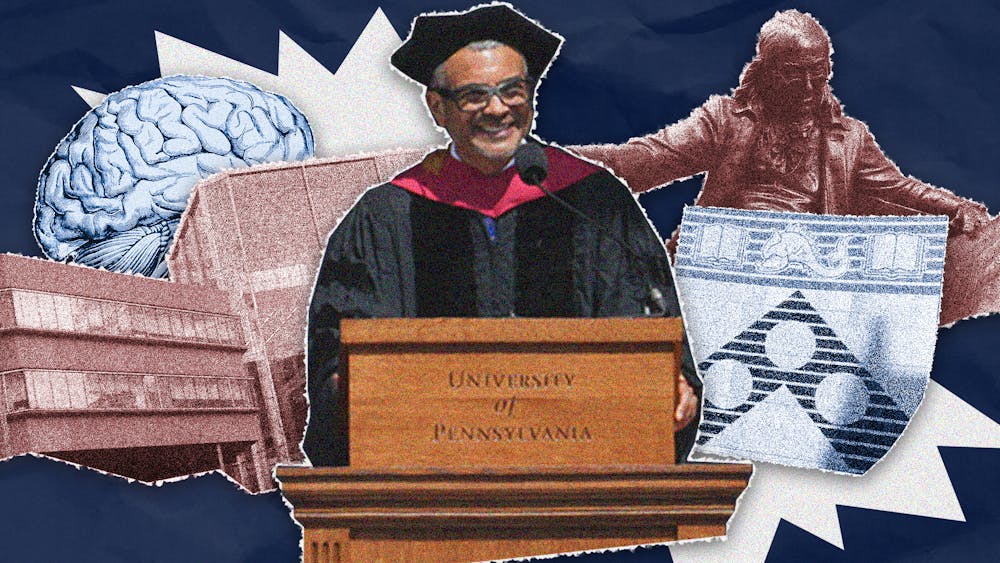
Neurology professor and former diversity, equity, and inclusion head Roy Hamilton plans to prioritize balance and transparency while leading the Faculty Senate, he said in an interview with The Daily Pennsylvanian.
Hamilton, who works at the Perelman School of Medicine, will serve as Faculty Senate chair for the 2026-27 academic year. He emphasized “effectiveness and legitimacy” when approaching the role and leading Penn’s diverse standing faculty body.
“It requires the ability to work effectively with the school and the administration,” Hamilton told the DP, adding that the organization’s leaders “derive their legitimacy from the degree to which they represent the faculty.”
For Hamilton, striking a balance between the University and its faculty requires “a certain degree of openness to communication and transparency.”
“Unless you rely on the expertise and knowledge of your representatives and constituencies, then you’re just limited by your own knowledge, intellect, and networks,” Hamilton said. “For any individual faculty member, there’s so little you know about the entire scope of this institution.”
Effective leadership accordingly requires “a process that is open and more democratic” to “coordinate good decisions and reasonable collective action on the part of the faculty.”
Hamilton’s approach to governance has been shaped by experience leading diversity, equity, and inclusion initiatives, he told the DP. In the past, Hamilton served as the Penn Medicine’s Assistant Dean for Cultural Affairs and Diversity and the Neurology department’s Vice Chair for Diversity and Inclusion.
In 2024, Hamilton was tapped for the role of Vice Dean for Inclusion, Diversity, and Equity in the Medical School — a position he said he held until “the change in priorities put forth by the Trump administration.”
RELATED:
Penn student groups push for changes to draft open expression guidelines as feedback period closes
Since Trump entered his second term in January 2025, Penn and peer institutions have faced funding threats over DEI initiatives. The University subsequently scrubbed references to DEI across its website and changed several staff titles — including Hamilton’s own, which is now “Special Advisor to the Dean.”
Trump graduated from the Wharton School in 1968 with a Bachelor of Science in economics.
The University Council’s Committee on Diversity and Equity — which Hamilton formerly chaired — was renamed to the Committee on Community and Equal Opportunity in December 2025. The removal of DEI references at Penn, Hamilton said, “has been an arduous set of transitions.”
He expressed optimism, however, in “the spirit and values” of inclusion.
“I still see the passion, commitment, and values of this community,” Hamilton said. “I want to believe that it’s something that we can and will endure and that the core values will persist.”
Hamilton credited his predecessor, History professor Kathleen Brown, with “building processes in shared governance” that have “a democratic quality to them.”
“One of the things that Kathy did a great job of was opening spaces for dialogue and opening spaces for mutual perspective-taking,” Hamilton said.
Few University issues have tested this shared governance as severely as open expression. The University’s draft Guidelines on Open Expression have prompted widespread criticism across the campus community, particularly regarding the revision process and restructuring of authority.
Additionally, some faculty have expressed feeling sidelined from Penn’s development of the guidelines. Throughout the feedback process, the Senate Executive Committee has acted as an intermediary between the Penn community and administration, hosting listening sessions and advocating for a public summary of community suggestions.
SEC is led by the Faculty Senate’s tri-chairs — Hamilton, Brown, and Chair-elect Eileen Lake.
Hamilton characterized open expression as one of the Faculty Senate’s major issues in the upcoming academic year, adding that the next steps forward are still “being deliberated over.”
“The concerns that I hear amongst faculty seem to mirror a lot of the concerns that I’ve heard from other constituencies,” Hamilton said. “There will be continued engagement on that front.”
Artificial intelligence and its impact on education present another topic that the Faculty Senate will take up, Hamilton said, describing ongoing discourse as “illustrative of how diverse a place like a university is.”
The University recently launched Penn AI and expanded course offerings related to the technology.
Hamilton also predicted that the structure of non-tenure faculty tracks will be “worth institutional consideration moving forward,” particularly regarding what “protections” such faculty receive.
In its May report, the Senate Executive Committee recommended the creation of “a new, tiered Teaching Faculty track.”
When handling a wide range of opinions, Hamilton said his background as a behavioral neurologist gave him a “predisposition” to believe that the “mechanisms that drive my thinking are going to be pretty similar to the mechanisms that are driving your thinking.”
“It gives rise to a kind of equanimity about viewpoint and a willingness to accept multiplicity of viewpoint,” Hamilton said. “Since I’m working with the same hardware you’re working with, chances are if I were subjected to your experiences and in your environment, I would think what you think.”
As for his leadership of the Faculty Senate, Hamilton stated that his “intuition is not who’s right and who’s wrong” but rather to “understand the different microclimates that give rise to this range of opinions.”
* * *
Just days after becoming chair of the Faculty Senate, Hamilton spoke at Penn’s 270th Commencement about “the transformative power of education” in the context of his family background.
Born and raised in Long Beach, Calif. by a Black father and a Japanese immigrant mother, Hamilton said that it was “not commonplace to pursue higher education” in his family and community.
No one on his father’s side of the family had attended college, Hamilton explained, and although his mother had received higher education, “things didn’t initially work out the way she had planned.” Hamilton’s mother earned money sewing and doing alterations, while his father worked in a brewery.
Hamilton was raised as one of Jehovah’s Witnesses and said that “it was not part of that religious tradition to encourage people to pursue higher education.”
“But I lived with the encouragement of both of my parents and their inspiration and support,” he said. “We made a very conscientious decision that we would live a different life.”
When he was in middle school, Hamilton’s mother earned a master’s degree and became a Japanese teacher at local colleges. Hamilton himself ultimately attended Harvard University, calling his admission “a big shift.”
Upon arriving at Harvard, Hamilton found that he did not “fit in socially” at first because few of his peers shared his background. Many students he met came from families where attending college was “completely normative.”
Eventually, however, Hamilton found his place at Harvard. He said that the experience of “otherness” and “a sense of struggle, feeling like you’re the first to pursue things” have shaped his career and motivated him to work on “outreach, engagement, and mentorship programs.”
In light of these experiences, Hamilton said that a “motivating factor” has been “mentoring the cascade of people” around him.
Hamilton, who has always been interested in “thoughts and thinking,” was drawn to neurology for its focus on “what’s under the hood.” As a medical student at Harvard, he attended a lecture series on behavioral neurology that piqued his interest.
At the time, Harvard Medical School professor Alvaro Pascual-Leone had recently joined the faculty and was using a “relatively new” practice of discharging a magnet on people’s heads to alter how they think. Hamilton explained that the procedure allowed him to “study what different parts of the brain are good for by manipulating them focally.”
“I was like, ‘That is the most amazing thing I’ve ever heard, and I want to do that for the rest of my life,’” Hamilton said.
To this day, Hamilton’s research centers around non-invasive neuromodulation, including magnetic and electrical brain stimulation. His work includes directing the Laboratory for Cognition and Neural Stimulation and the Penn Brain Science, Translation, Innovation and Modulation Center.
As he mentors students, trainees, and junior faculty, Hamilton has aimed to “support all students to create an inclusive environment.”
“There’s a lineage there motivated by my own interest in helping individuals have an easier path to opportunity,” he said.
Senior reporter James Wan leads administration reporting and can be reached at wan@thedp.com. At Penn, he studies communication and computer science. Follow him on X @JamesWan__.