

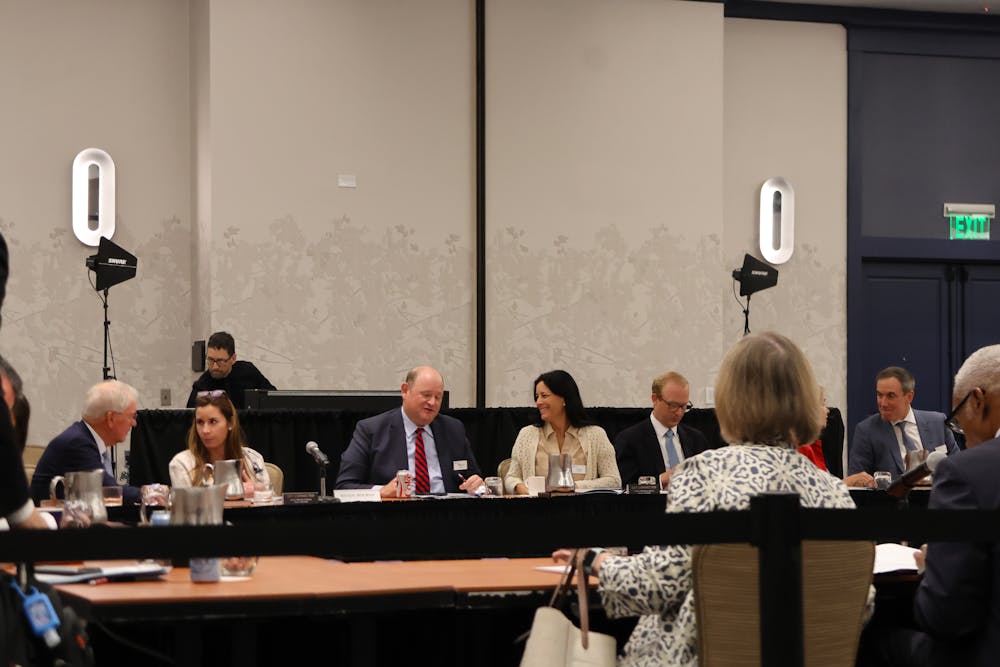
The University’s Board of Trustees discussed federal and financial pressures at its annual spring meeting last week.
On June 11 and 12, the board, which is charged with overseeing Penn’s “formal institutional governance and fiduciary responsibility,” convened on campus to hear briefings from senior administrators about University developments over the last year and plans going forward. The trustees passed 41 resolutions across eight committees, five of which opened their meetings to the public.
At the June 12 meeting, Penn President Larry Jameson emphasized the University’s commitment to a “high degree of excellence” as Penn navigates “rapid changes.”
Jameson celebrated several recent developments — such as the University’s 270th Commencement ceremony and the creation of a consolidated Center for Civil Rights — in his opening speech.
An hour after addressing the board, Jameson announced that he will step down as planned from his role as president in June 2027.
“When I accepted the honor of leading Penn, my goal was to help restore stability during unanticipated leadership transitions, refocus our community on Penn’s mission, and strengthen Penn for the future during a challenging time for higher education,” Jameson wrote in the June 12 message to the Penn community.
Here are five key takeaways from the 2026 Spring Full Board Meeting of Penn’s Board of Trustees.
Federal pressures on research and immigration
RELATED:
Penn Board of Trustees approves library renovation, new veterinary laboratory
Board of Trustees discusses Penn’s financial future, global tensions at winter meeting
Vice President of Government and Community Affairs Leigh Whitaker reported on “lots of issues” Penn faces from the federal government at the Local, National, and Global Engagement Committee meeting on June 11.
Whitaker began by discussing state Rep. Chris Rabb’s (D-200) Democratic primary win in Pennsylvania’s third congressional district last month.
Rabb — who is currently running unopposed in November’s general election — is all but guaranteed to go on to represent Penn and University City in Congress for the next two years. Whitaker said her office plans to “reach out to his team this summer” to build the University’s relationship with Rabb.
Whitaker also discussed ongoing budget deliberations in the United States House Committee on Appropriations, including a proposal for a 30% cap on indirect costs from National Institutes of Health funding.
In February 2025, the NIH implemented a 15% cap on indirect costs — which provide funding for expenses such as lab spaces and support staff — that threatened to cost Penn $240 million. A ruling blocking the NIH order was upheld by a federal appeals court earlier this year.
Whitaker explained that Penn would continue to work with its partner associations and programs in Congress to explain the issue and “get them to understand why those caps don’t work.”
She also said that the Trump administration’s recently proposed changes to uniform guidance — the set of rules that govern requirements for non-federal entities to receive federal grants — would “essentially impose a political litmus test on future grants.”
Trump graduated from the Wharton School in 1968 with a Bachelor of Science in economics.
Whitaker explained that under the changed policy, “peer reviewed grants wouldn’t be final until a political appointee approved the grants” and “grants deemed inconsistent with this administration's policy priorities” could be terminated.
She added that her office was working with Penn Medicine and Penn’s Office of General Counsel to provide information to deans and faculty on how they can submit their public comments about the proposed rule change.
At the meeting, Whitaker also discussed how the Trump administration’s immigration policy affects international students at Penn.
She explained that the Department of Homeland Security is “expected to finalize their duration of status rule” later this year. The new policy would abolish the “duration of status” period — which allows international students to stay in the United States through the length of their academic program — and replace it with a fixed four-year timeline for all foreign students and exchange visitors.
In October 2025, Penn argued that the change would have “unnecessary negative consequences” in a public comment.
Whitaker added that while she did not have exact figures on changes to international student enrollment since President Donald Trump’s presidency began, she believes that travel restrictions and visa delays will particularly deter graduate student enrollment.
“The reality of it is our international students are our friends, our neighbors,” Whitaker said at the June 11 meeting. “People talk about in terms of all of the tuition that they pay, or how they contribute to economy, but I think more importantly, they bring culture and language benefits to our student populations that make our campus better. We have to continue to work to protect them and figure out how to work through these challenges with immigration.”
Penn’s budget management
Vice President for Budget Planning and Analysis Trevor Lewis discussed the University’s proposed operating budget for fiscal year 2027 at the Budget and Finance Committee on June 11.
“The main theme of the 2027 budget is that we’re continuing to tightly manage our expenses,” Lewis said at the meeting. “We’re anticipating below average expenses for the second consecutive year. That’s going to take a lot of effort.”
Lewis referenced financial measures the University introduced in spring 2025 — which included a hiring freeze and a capital spending review — as well as additional budget reductions announced this year.
In January, Provost John Jackson Jr. and Executive Vice President Mark Dingfield outlined steps for the University’s updated financial planning, including a 4% reduction to certain expenditures across all schools and centers. Months later, they confirmed Penn would move forward with budget reductions that may include staffing changes or modifications to programs and services.
Earlier this month, Penn’s Graduate School of Education laid off several staff members. In a statement to The Daily Pennsylvanian, a GSE spokesperson described the reductions as a “multi-year effort” coordinated by the school and “informed by extensive planning.”
Executive Vice President Mark Dingfield emphasized the importance of allowing the University to have “flexibility” to “withstand uncertainty and new headwinds” in the next fiscal year.
“I think it’s important context is that we’ve achieved these results in the face of pretty substantial uncertainty and headwinds in our external financial environment,” Dingfield said at the June 11 meeting. “We need to continue this operating discipline into FY27. They can’t be one time adjustments — they need to be sustained operating measures that we’re continuing into FY27 and beyond.”
Events in Philadelphia this summer
Vice President of the Division of Safety Kathleen Shields Anderson discussed how Penn is preparing for two major events in Philadelphia this summer — the FIFA World Cup and the celebration of America’s 250th anniversary — at the Local, National, and Global Engagement Committee on June 11.
Anderson said that while she does not “anticipate” that the University will need to “suspend operations” when Philadelphia is hosting World Cup matches, Penn will welcome a “lot of visitors,” and faculty and staff should “expect extra commute times.”
She added that Penn’s Division of Safety created a “resource page” for faculty and staff with recommendations about possible traffic during games, and also said Penn’s Allied Security officers have undergone preparation to better assist the influx of international visitors expected during the tournament.
“They’re trained on how to communicate, talking about the differences between law enforcement here and perhaps where someone is visiting from,” she explained. “We’re going to have a lot of people who aren’t going to know where they are, or why they’re here, or where to go, and so we’ve added additional resources on the street to be able to help people navigate.”
Anderson also reported on the country’s 250th anniversary.
While acknowledging that the week of July 4 “is always a busy week here in Philadelphia,” Anderson discussed several specific events Penn is preparing for — including a joint session of Congress on July 2 and a citywide concert at the Benjamin Franklin Parkway on July 4.
New construction across campus
Executive Director of Design and Construction Chris Kern discussed updates to several ongoing campus construction projects at the June 11 meeting of the Facilities and Campus Planning Committee.
Kern explained that the University is in the final stages of construction for projects expected to be completed this year, including the Reiki Center for Advanced Veterinary Education and the 3600 Civic Center Boulevard building.
The third and final stage of construction in the Quadrangle — a $230 million renovations project — is also expected to be completed this August. Previously, first-year students told the DP that the renovations, which began in May 2023, significantly impacted their social and residential experiences at Penn.
“This has been an enormous project through multiple stages,” Jameson said about the renovations. “The inside is totally transformed, a really nice iconic facility.”
Kern also noted new construction projects the University is undertaking this summer, including renovations to the 1920 Commons.
The project — which Kern described as having a roughly three-year timeline — will include renovating the main facility to provide “significantly more seating than currently exists.”
According to the proposal presented at a Facilities and Campus Planning Committee in November 2025, the first phase of construction will include a western addition that will serve as the main building entrance and a green roof designed to manage stormwater, increase natural daylight, and reduce energy costs.
Several speakers, including Jameson, also referenced Penn’s proposal to renovate the David Rittenhouse Laboratory. The proposition — first mentioned during the March meeting of Penn’s Board of Trustees — includes plans to add a $520 million, 325,000 square foot Physical Science Building to the existing north wing of the David Rittenhouse Laboratory.
Changes to the Board of Trustees’ committee structure
The University’s Board of Trustees voted to adopt a resolution to revise its committee structure on June 12, dissolving seven existing committees and replacing them with five new ones.
“After extensive discussions with University leadership, the Governance Committee of the Board has developed a revised committee structure for the Board’s consideration that will better align Board committees with institutional priorities, and will foster a more productive and dynamic engagement between the Board and the University’s President and senior leadership,” the resolution read.
The dissolved committees — Student Life; Academic Policy; Audit and Compliance; Facilities and Campus Planning; Local, National, and Global Engagement; Honorary Degrees and Awards; and Development — will be replaced by the Education; Research; Frontiers; External Affairs; and Audit, Compliance and Risk committees.
RELATED:
Penn Board of Trustees approves library renovation, new veterinary laboratory
Board of Trustees discusses Penn’s financial future, global tensions at winter meeting
Isha Chitirala is a News Editor at The Daily Pennsylvanian and can be reached at chitirala@thedp.com. At Penn, she studies economics and political science. Follow her on X @IshaChitirala.


