

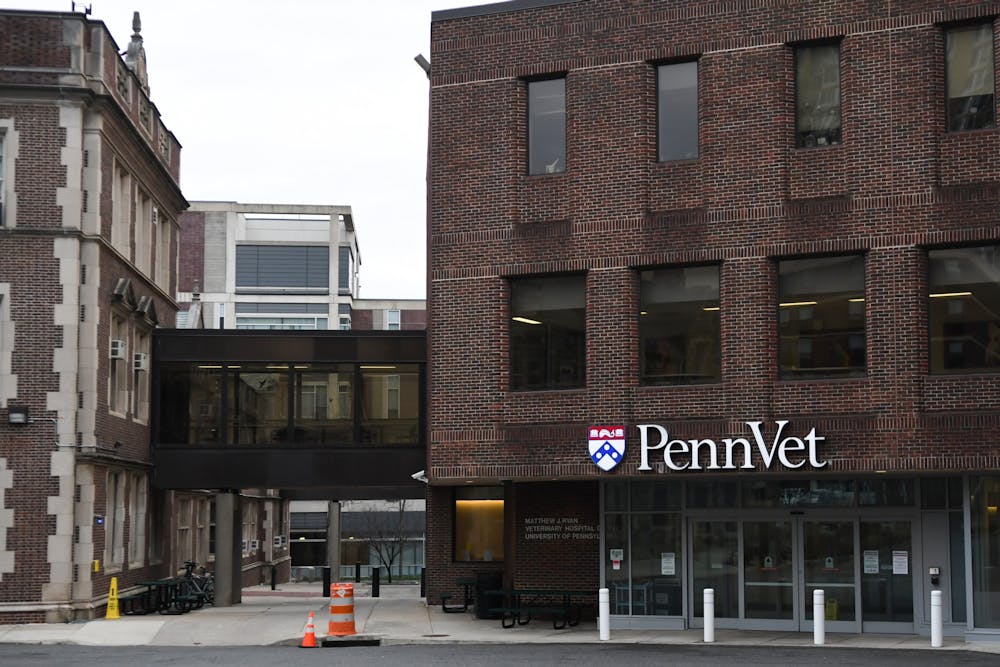
Two School of Veterinary Medicine professors received national awards last month for their work on viral evolution and cancer research.
Pathobiology professor Louise Moncla was named a recipient of the American Society for Virology’s 2026 Ann Palmenberg Junior Investigator Award for her examination of how zoonotic viruses emerge and transmit scross populations. Biomedical Sciences professor Timour Baslan was named a recipient of the 2026 Damon Runyon-Rachleff Innovation Award for his research developing targeted therapeutics for a special class of cancer mutations.
In an interview with The Daily Pennsylvanian, Moncla explained that her lab focuses on understanding “how viruses evolve and transmit across species and population groups” — including zoonotic and endemic respiratory viruses.
According to Moncla, the Ann Palmenberg award recognizes two “upcoming virologists” each year who have applied for the honor and been nominated by other scientists in their field.
Moncla said that her lab has “matured quite a bit” since she launched it in 2022. Over the past year, the lab published its first papers and has expanded its research output. It also maintains a public website that is regularly updated to track “ongoing viral evolution and transmission” across global populations.
“When there’s new outbreaks, we can kind of rapidly update those resources and give real time information about how outbreaks are spreading or changing, which can then be used to inform kind of research efforts as well as public health actions,” Moncla explained.
College junior Ireland Gorecki, who joined Moncla’s lab as a first-year student, explained that much of her research happens on computers rather than at a traditional lab bench.
The work is “very computational,” she said, highlighting that researchers analyze large sets of viral genetic data to understand how viruses change and spread.
RELATED:
Penn researchers find link between Long COVID symptoms, body mass index
Team of Penn first years win $15,000 engineering prize for best emerging technology
By collaborating with other institutions to access viral sequences and related background information, the lab studies what Gorecki described as “evolutionary, phylogenetic and phylogenomic patterns for different viruses.”
Gorecki told the DP that the collaborative culture in Moncla’s lab made the research process more accessible.
“It makes me really enjoy the research process,” Gorecki said. “I feel comfortable to ask questions, comfortable to make mistakes.”
Baslan received the Damon Runyon-Rachleff award for his research on genetic changes that shape how aggressive cancers develop. The award supports “extraordinary early career researchers” seeking to pursue “high-risk, high-reward” ideas for prevention, diagnosis, or treatment of cancer.
Baslan examines special mutations — “copy number alterations” — that result in cancer cells with “more or fewer copies of a gene than a normal genome.” He uses “a combination of advanced algorithms and chemical biology tools” to develop therapies that target these mutations — beginning with those contributing to pancreatic cancers. He then aims to test “the generalizability” of these strategies across cancer types.





