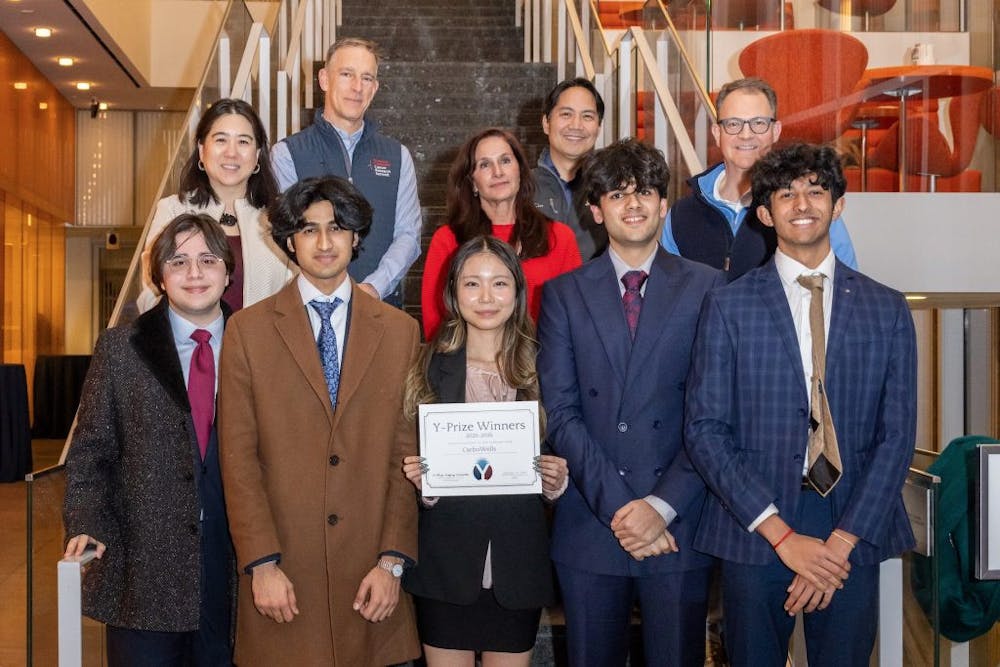
A team of five first-year Penn students won the University’s annual Y-Prize competition, receiving $15,000 for their proposal to mitigate the environmental hazards posed by abandoned oil and gas wells.
The Y-Prize competition — now in its thirteenth year — challenges student-led teams to develop a commercial use for an emerging technology developed at Penn. Sponsored by the School of Engineering and Applied Science, the Wharton School, the Mack Institute for Innovation Management, Venture Lab, and the Penn Center for Innovation, the competition awards funding to the team that judges believe best translates the research into a viable real-world solution.
This year’s competition asked students to find a use for a newly developed carbon-capturing technology — a 3D-printed concrete developed by Material Sciences and Engineering Department Chair Shu Yang.
The porous concrete was designed to reduce carbon emissions and improve structural performance. Unlike traditional concrete, the material forms internal lattices that increase surface area, enhance carbon capture, and distribute mechanical stress.
Teams were tasked with adapting the material to a case they believed could be adopted beyond a research setting.
The winning team, CarboWells — which included College and Engineering first years Yuki Qian, Ronith Lahoti, and Ali Altan Yilmaz, alongside Wharton first years Bhuranyu Mahajan and Yash Iyer — focused on the issue of abandoned oil and gas wells, which often contain concrete plugs that can fail over time.
In their proposal, the team cited more than two million abandoned wells nationwide — including about 350,000 in Pennsylvania — where leaking plugs can release methane, contaminate groundwater, and cost operators between $500,000 and $1 million per repair.
In an interview with The Daily Pennsylvanian, Qian said the team initially explored cooling systems and filtration before deciding on their final proposal.
RELATED:
College senior receives Gates Cambridge Scholarship to pursue Ph.D. in psychiatry
Sixth annual Energy Week at Penn set to focus on AI, climate action on campus
“We started researching, ‘where does concrete really fail?’” Qian said. “We wanted to think of something to increase the rate at which wells are being plugged, by decreasing the cost and decreasing the failures by a significant amount.”
The team’s design creates a structure that forms a series of closed chambers within the concrete, which prevents cracks from spreading through the entire well and traps gas locally to stop it from migrating upward. Because the plug uses diatomaceous earth materials, it can strengthen over time.
Mahajan and Iyer led the team’s financial modeling, pricing strategy, and customer analysis.
CarboWells hopes to generate revenue through direct sales to well-plugging contractors and through full-service plugging contracts with oil companies and government-based well programs.
Iyer explained that the team’s biggest challenge will be entering a “relationship-based” industry, but added that “minimal” switching costs, “similar” workflows, and the potential carbon-credit revenue may accelerate early adoption.
After the win, the team plans to use the $15,000 award primarily for prototype testing and lab validation.
Lahoti and Iyer emphasized that CarboWells will likely need to incorporate and raise external capital, potentially through early-stage venture funding, to scale testing, regulatory approvals, and manufacturing before beginning deployment.
“I was really happy, but honestly, I also expected it,” Lahoti told the DP. “It was the amount of effort, the amount of engineering designs we came up with, and the financials. I knew we had a solid bet.”
“I think it’s very important to take bets on yourself,” Iyer said, echoing a similar sentiment. “It’s very important to know what motivates you. For me, it’s legacy, and the way you leave one is by making a positive impact on people’s lives around you and around the communities you interact with.”
RELATED:
College senior receives Gates Cambridge Scholarship to pursue Ph.D. in psychiatry
Sixth annual Energy Week at Penn set to focus on AI, climate action on campus
Staff reporter Advita Mundhra covers student life and can be reached at mundhra@thedp.com. At Penn, she studies cognitive science and economics.