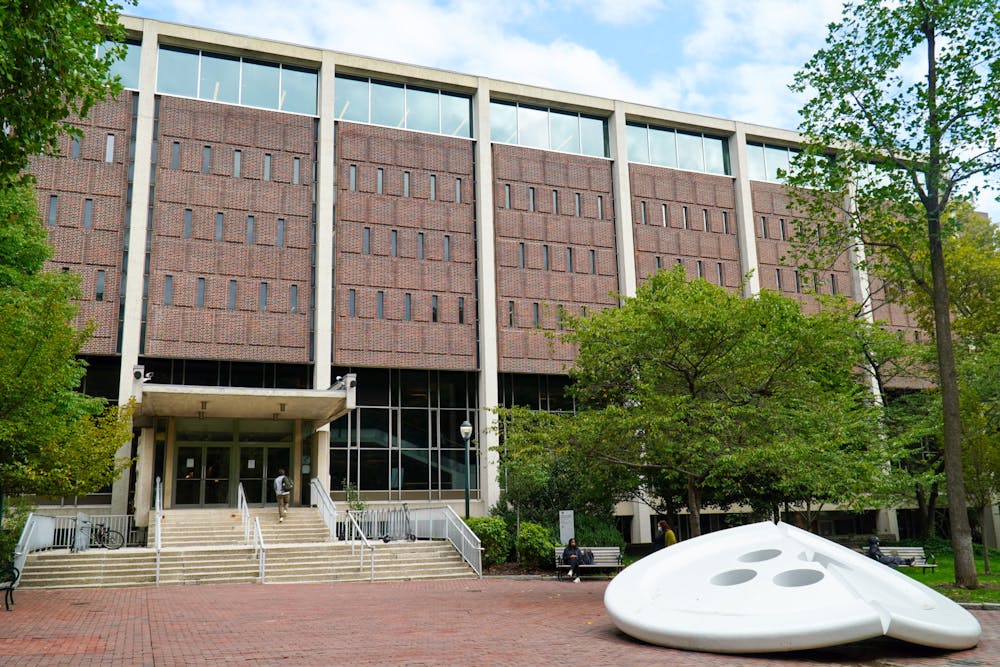
The Kislak Center for Special Collections, Rare Books and Manuscripts hosted photographer Leandre Jackson for a discussion on how his work has captured and contributed to Black history.
The Feb. 6 event was co-sponsored by Penn’s Greenfield Intercultural Center and led by 2004 College graduate and award-winning historian and curator Samir Meghelli. It spotlighted Jackson’s photography of prominent Black individuals ranging from James Baldwin and Rosa Parks to Dizzy Gillespie and Jay-Z.
During the event, Jackson emphasized that he focused on capturing the everyday lives of “people that deserved attention but were not getting it because they were Black.”
“I wanted it to be important, and I wanted more than anything to be able to show people this is somebody you should know about,” Jackson said.
In an interview with The Daily Pennsylvanian, Jackson explained his preference for using natural light over flash photography.
“I’m trying to communicate with an audience, I’m trying to tell them a story, and that’s one reason why I didn’t use flash photography,” he said. “I use regular photography because when I talk to you, it’s in this light.”
While speaking to the audience, Jackson joked that he initially worked in black-and-white because “college students don’t have a lot of money,” but later embraced the style, inspired by photographers such as Ansel Adams.
Jackson spent his career photographing Black musicians, athletes, authors, and activists — and worked alongside James Spady, an award-winning journalist whose reporting for the Philadelphia New Observer was often accompanied with Jackson’s images before Spady passed in 2020.
RELATED:
Here’s how Penn plans to celebrate America’s 250th anniversary
McNeil Center Consortium fellow researches English literature in the Black Atlantic World
Meghelli told the DP that the Jackson and Spady’s collaborations encouraged interviewees to “deeply reflect on their craft as musicians,” while helping readers understand “the social, political context that they came out of.”
The event focused on Jackson’s involvement with Black cultural activism — which included serving as director of Swarthmore College’s then newly founded Black Cultural Center from 1975 to 1977, where he helped organize conferences on Black culture and scholarship.
The Kislak Center acquired several of Jackson’s photographs in 2023 and plans to showcase his collection in future exhibits.
Samantha Hill, the Kislak Center’s curator of civic engagement, told the DP that the collection consists of about 10 cases, each containing “between 800 and 1000” photographic “negatives” — which refers to a reversed image on transparent film.
Meghelli told the DP that Friday’s exhibit was “just a sampling” of Jackson’s collection, and emphasized the program’s importance in “open[ing] up a dialog not just about Leandre Jackson’s work and its significance, but also about the potential and the power of the arts to build community and build bridges today and in the future.”
Sean Quimby, associate vice provost and director of the Kislak Center, described the event as part of the center’s efforts to “engage with communities across the city to help them preserve their cultural heritage.”
Jackson’s photography has also documented many moments tied to Penn’s history — such as composer William L. Dawson’s 1981 masterclasses with the Penn Glee Club, and author and 1963 College graduate John Edgar Wideman, the first director of Penn’s Afro-American Studies Program.
In an interview with the DP, College senior Ari Ketchum explained how “inspiring” it was to see “all these people who just walk the same streets as I do, being documented as ‘important’ for the work they do.”
Valerie De Cruz, director of the Greenfield Intercultural Center, highlighted the importance of students learning about influential artists like Jackson.
“What better time to highlight all these incredible black movers and shakers than this month, February,” De Cruz said. “Although we shouldn’t be doing it just in February, this was a unique opportunity to both introduce folks to what’s in the archives, but also to introduce them to the speakers.”
Jackson emphasized that research gives journalists and photographers “a perspective on the world that you don’t normally have.”
Jackson recalled his own efforts to conduct research before taking early-career photographs of reggae songwriter Bob Marley.
“When Bob came on the stage, I already knew who he was — but that’s because I had asked questions about who Bob Marley was,” Jackson said. “I was only interested in capturing what it was like for him to be a person, not just Bob Marley recording reggae music.”
Jackson concluded the event with a clear message to students: “Be curious. That’s a directive: be curious.”
RELATED:
Here’s how Penn plans to celebrate America’s 250th anniversary
McNeil Center Consortium fellow researches English literature in the Black Atlantic World
Staff reporter Can Doga Bolukbasi covers science and health and can be reached at bolukbasi@thedp.com. At Penn, he studies biochemistry. Follow him on X @cdbolukbasi.