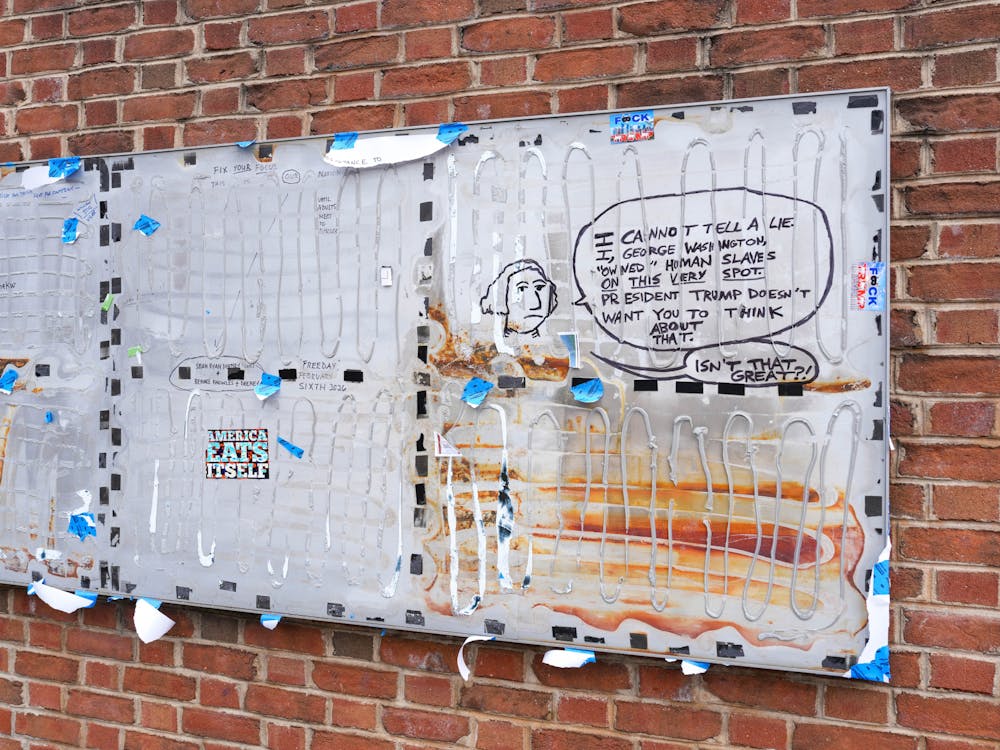
The National Park Service began reinstalling over two dozen panels of a slavery exhibit in Independence National Historic Park on Friday after a federal judge’s ruling.
The panels — which depict the lives of enslaved people owned by George Washington during his presidency — were removed in January as part of an executive order signed by 1968 Wharton graduate and President Donald Trump. Although a recent order required the return of the exhibits by Feb. 20, a federal judge paused the restoration after the government filed an appeal.
The President’s House opened in 2010 after an archaeological project found remains of slaves’ quarters in one of Washington’s residences. More than a dozen displays about slavery were flagged by the Trump administration’s July 2025 review and initially slated for removal in September 2025.
According to the Feb. 16 ruling, the federal government does not have the power “to dissemble and disassemble historical truths when it has some domain over historical facts.”
A request for comment was left with the Department of the Interior.
Graduate School of Education professor Jonathan Zimmerman, who focuses on the history of education, called the order to restore the panels “very welcome decision,” and added that the move shows that “the federal courts are not always going to be supine to Trump.”
“I think that it’s yet another reminder of how significant independent courts are to our entire system of government and democracy,” he said.
Zimmerman highlighted that the Trump administration is “trying to the subject because they understand it's negative.”
RELATED:
Shapiro backs city challenge against Trump administration’s dismantling of slavery exhibits
Independence National Park dismantles slavery exhibits following Trump directive
“The goal here is to remove information that people will perceive as negative about the country, and obviously, you can’t have an honest history on that basis,” he said.
Zimmerman also addressed the importance of the exhibit’s restoration ahead of the nation’s upcoming semiquincentennial.
“I think the idea that the federal government should be the sole interpreter runs against a long tradition of American federalism,” he said. “It’s been an educational moment despite the best efforts of the Trump administration to prevent that kind of education.”
1991 School of Arts and Sciences Ph.D. graduate Sharon Holt — who helped create the President’s House Site while serving as editor of the Pennsylvania Magazine of History and Biography — called the ruling “enormous.”
“I think now that the panels are being tested with this scrutiny, it’s wonderful to be able to be confident that the content is tip top,” Holt said. “One of the things that jumps out from this research is that we have names.”
Holt added that having access to names and biographies “is really unusual in the history of 18th-century African Americans, because it was the purpose of slavery to erase all of that, certainly from the historical record and hopefully from the people themselves.”
She described the administration’s efforts to remove the exhibits “fundamentally sick.”
“If you take away all those stories of the struggle to perfect what was a very bumpy beginning for the country, then you take away the meaning of democratic citizenship,” she continued.
History and Sociology of Science professor Rana Hogarth, who works with the Penn and Slavery Project, similarly told the DP that the exhibit shed light on the stories of slaves who were not able to leave behind their own historical record.
“They did not have the same ability to leave anything behind in terms of written accounts,” Hogarth said. “When you have an attempt to bring to the fore the experiences and contributions of people who have been historically marginalized, that is part of giving a full story of what America was like in the past.”
The city of Philadelphia sued the administration on Jan. 22 after the removal of the exhibits. Pennsylvania Gov. Josh Shapiro later submitted an amicus brief backing the city’s suit.
“Today we celebrate the return of our history at this important site,” Philadelphia mayor and 2016 Fels Institute of Government graduate Cherelle Parker wrote in a social media statement after the order to restore the panels. “We know that this is not the end of the legal road.”
United States Rep. Brendan Boyle (D-Pa.) — whose district contains Independence Park — also emphasized how “Philadelphians fought back and rejected Donald Trump’s attempt to censor our history” in a statement to The Daily Pennsylvanian.
“I am proud of our nation’s founding ideals, and preserving those ideals requires telling the full truth about our history, both the good and the bad,” Boyle said. “I won’t stop fighting to ensure these exhibits are fully restored and accessible to the public.”
The Department of the Interior appealed the ruling to restore the exhibits on Feb. 20.
RELATED:
Shapiro backs city challenge against Trump administration’s dismantling of slavery exhibits
Independence National Park dismantles slavery exhibits following Trump directive
Staff reporter Gabrielle Ostad covers campus politics and can be reached at ostad@dailypennsylvanian.com. At Penn, she studies Middle Eastern studies and international relations.