

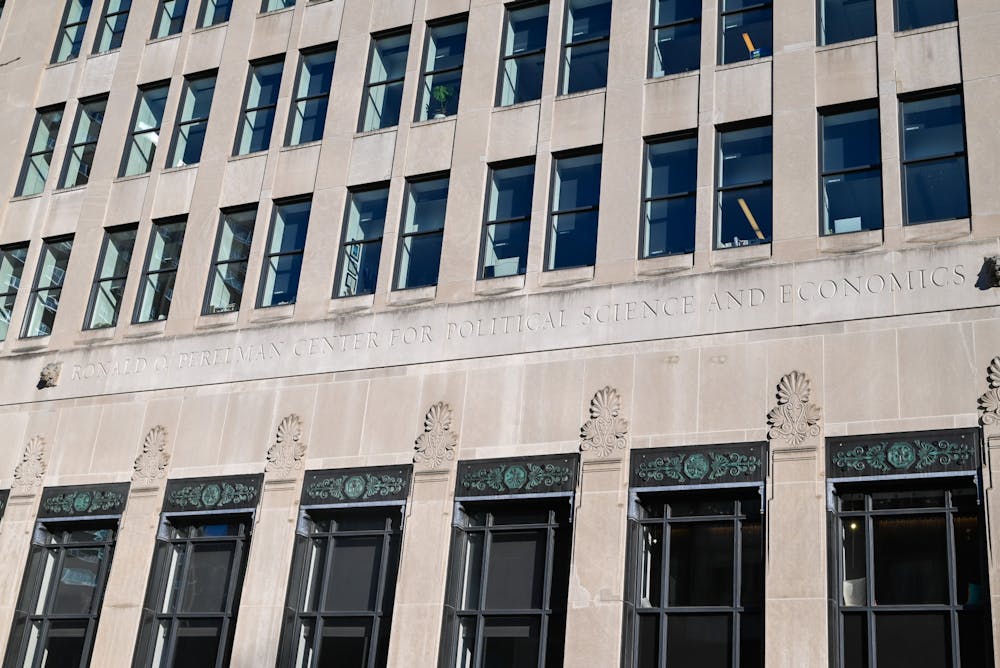
The Andrea Mitchell Center for the Study of Democracy hosted a film screening and conversation about the legacy of apartheid in South Africa on Wednesday.
The Feb. 25 event displayed Tara Erica Moore’s film, “Legacy: Apartheid’s Shadow,” which features key figures from the history of apartheid and shows the current landscape of South African society. The screening was hosted at Public Trust and concluded with a question and answer session facilitated by the Director of the Andrea Mitchell Center, Jeffrey Green.
Moore, the film’s director, editor, and producer, told The Daily Pennsylvanian that the documentary focuses on the “psychological remnants of systems of hierarchy” from apartheid.
She expressed hope that the film’s audience would “realize that the world works very systemically, and it’s not an equal opportunity landscape,” after watching it.
Moore added that students should make parallels “to their own country” from what they see in the film because “most countries today suffer from inequality, and there aren’t easy ways out from it.”
“It’s hard not to think that things are the way they are because there is an inherent skill set or attribute that you have that made you higher on the scale of equality, and not understand that it’s a systemic reason,” she said.
Green told the DP that the Andrea Mitchell Center saw the event as an opportunity to present a “deeply political” film that might otherwise not be available to the Penn community.
The film addresses “the difference between seeking political liberation from a situation of gross oppression on the one hand and free and equal citizenship on the other,” according to Green. It “deals with profound challenges of lack of equality of opportunity, problem of corruption, and various other ills.”
During the question and answer session, Moore said diving into the research for the film was “heartbreaking and illuminating.”
Wilhelm Verwoerd, the grandson of former Prime Minister of South Africa Hendrik Frensch Verwoerd — often called the “architect of apartheid” — reflects his family’s role in the issue throughout the film. The documentary also features historical players who share their “stories of resilience and struggle” during the time period.
Moore told the DP that apartheid is “not so well known” even within South Africa, because the history has become “hazy.”
Green echoed her sentiment, expressing hope that the screening would “inspire thought and reflection,” educating students about the “important history” of South Africa that “sheds a light on the commitment to democracy and liberty throughout the world.”
Moore shared a message for the student audience with the DP.
“I hope they are activated to be community leaders and know that there’s power in grassroots activism,” she said. “I hope that they are curious about accountability work and looking inside and seeing how you can make sure that you challenge yourself to think even bigger and more empathetically about the world around you.”
The film premiered at the Durban Film Festival, where it opened the night and won Best South African Documentary, which qualified it for the long list of Best Documentary Feature at the Oscars.
The documentary has been screened at several other universities, including the University of Windsor and the University of Illinois Chicago. Moore will continue to bring the film to other universities, including Princeton University, Brown University, and Duke University, in September.
Staff reporter Mbresa Simnica covers administration and can be reached at simnica@thedp.com. At Penn, she studies economics and political science.


