

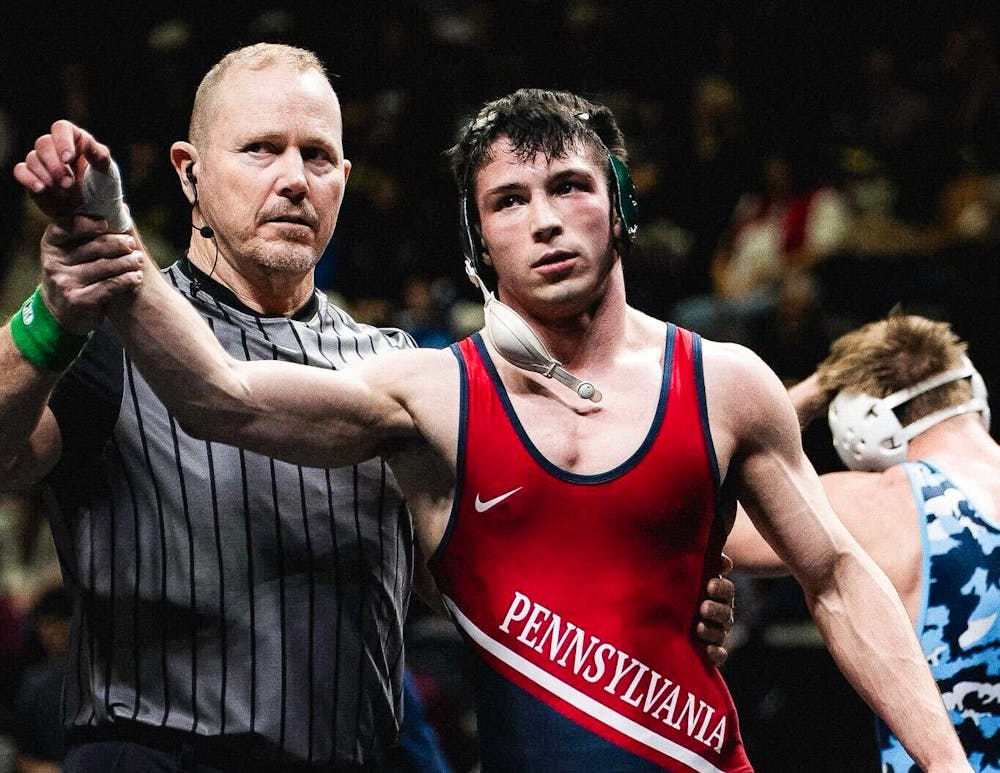
“Why would I know?”
It’s Penn wrestling sophomore Cross Wasilewski’s gut reaction when a teammate asks him a question. And then he realizes.
“Oh man, wait. I’m like, ‘I’m the guy people should be asking questions [to].’”
All these years in the Penn locker room, Wasilewski has looked up to former wrestling athlete Nick Incontrera, a 2025 College graduate and three-time NCAA qualifier. He’s looked up to former wrestling athlete Ryan Miller, a 2025 Wharton graduate, who is an Ivy League champion and a Unanimous first team All-Ivy selection. He’s trained with senior CJ Composto, who’s had a standout record last season. But now, before he knew it, he became the guy on the team many looked up to. Now a sophomore at Penn, the torch has passed, and Wasilewski is running with it.
He’s more than just a wrestler now. He’s a teammate.
When young Wasilewski first stepped onto the mat, he quickly realized wrestling was nothing like he’d imagined.
“I was six years old, and I thought they were talking about WWE,” Wasilewski recalled. “I remember showing up and there were these mats, and I had to put on these weird shoes, and it was just definitely a lot different of an experience.”
From this point on, Wasilewski began his journey in figuring out what it means to be a true wrestler. Unlike WWE, where you follow a script, wrestling meant “being able to adapt mid-match” and anticipating the opponent with each calculated move. It meant training in the summer even when competitions are in the winter, because “wrestling is a sport that never ends.” It meant crying after losses “just because it means so much … There’s so much work put into the sport, and you’re not relying on anyone.”
And you have to cry after losses, because during a match, “you have to stay stoic,” Wasilewski said. “And sometimes you might get your butt kicked, but that’s something to cry about after the match, not during.”
Though wrestling is an individual sport, and a mental sport, he learned the importance of finding his community, people who are there to support you no matter what. While he tirelessly practiced all season long, his parents were there to support him in every step.
“I’m so thankful for my parents driving me to offseason tournaments almost every weekend,” Wasilewski said. “So thankful for them being able to put me in that opportunity, in those shoes.”
Wasilewski also found his support group in eighth grade when he started training at Edge Wrestling.
“I had a group of five to six guys, and we just continued to push each other,” Wasilewski said. “We call it ‘#EdgeFamily.’ It’s a family. And like a sport so gruesome like wrestling, you need those people to support you and to be able to support someone else.”
“Being able to push through a time where maybe other kids were playing video games, … developing that discipline definitely shaped me as a person,” he added.
That same discipline helps him in the classroom.
“[I’m] putting in all the effort I can on the mat, and then [flipping] that switch in my mind, like, ‘Okay, now I’m a student going to class,’ making sure I’m present,” he said, “I’m like, trying to beat a guy up and then going to math class trying to rule out some derivatives. I honestly love it.”
Over the course of his high school years, Wasilewski faced some of his toughest challenges in wrestling at regional championships and state tournaments. But his biggest challenge came during his sophomore year when he fell short of winning semifinals in the national championship.
“I was up 8-0, and I blew it,” Wasilewski said. “Two points away from attack, which would have ended the match, and I absolutely blew it. And it’s one of those moments that definitely sticks with me.”
That setback may just have been a blessing in disguise.
After the tournament, then-Penn wrestling coach Roger Reina approached Wasilewski and the two quickly connected. Despite losing one of the biggest games of his career, Reina comforted Wasilewski with a more optimistic outlook on how far he had come in the tournament.
“I just broke down in tears, and it was kind of like a beautiful moment,” Wasilewski said. “I wasn’t committed at the time. I was still between Columbia and Penn, but that moment right there really reflected like, ‘Okay, I’m gonna come to Penn. I want coach Reina to be my coach, and he’s gonna be able to push me to push them to this next level.’”
Had Wasilewski chosen another school, Penn wrestling wouldn’t be the same team it is today.
Coming off a monstrous 13-1 dual record from last season, expectations were high — and Wasilewski hasn’t disappointed. With another win this past weekend during the Ivy Opener, he’s now a perfect 5‑0 in duals this season. Aside from his hard work and dedication, his success this season may all come down to his mindset.
“Something I’ve really tried to change while I’m in college is just being confident, enjoying the moment,” Wasilewski said. “You’ll see me hop around, kind of pace back and forth … doing that just instantly puts me in the zone.”
“Wrestling is a very mental sport,” he added, “so you really have to care for yourself in terms of taking care of your mind and sharpening it and being ready to go when that whistle blows.”
As an integral member of the team, Wasilewski’s eyes are set on helping his teammates. He’s doing what Reina recruited him to do.
“Something I really hold close to my heart is leading by example, really showing up every day, playing in a full effort … I’m trying to be able to create that strong culture that pushes this team to the next level.”
He’s come a long way from a six-year-old on a mat. Now his second season with the team, Wasilewski has matured in his sport and grown in his mindset.
“I remember early in my high school career, I just cared too much,” he said, “I held [wrestling] like my baby. It was me.”
Wasilewski is learning to “disconnect” wrestling from his identity and embrace his role as a mentor and friend on the team. Looking back now, he has been able to see the sport not as an “end all, be all” but for what it really is. A rock in his life, a discipline, a way to find community.
“Some people call it therapy. Some people call it art. But, you know, at the end of the day, it’s just wrestling.”


