

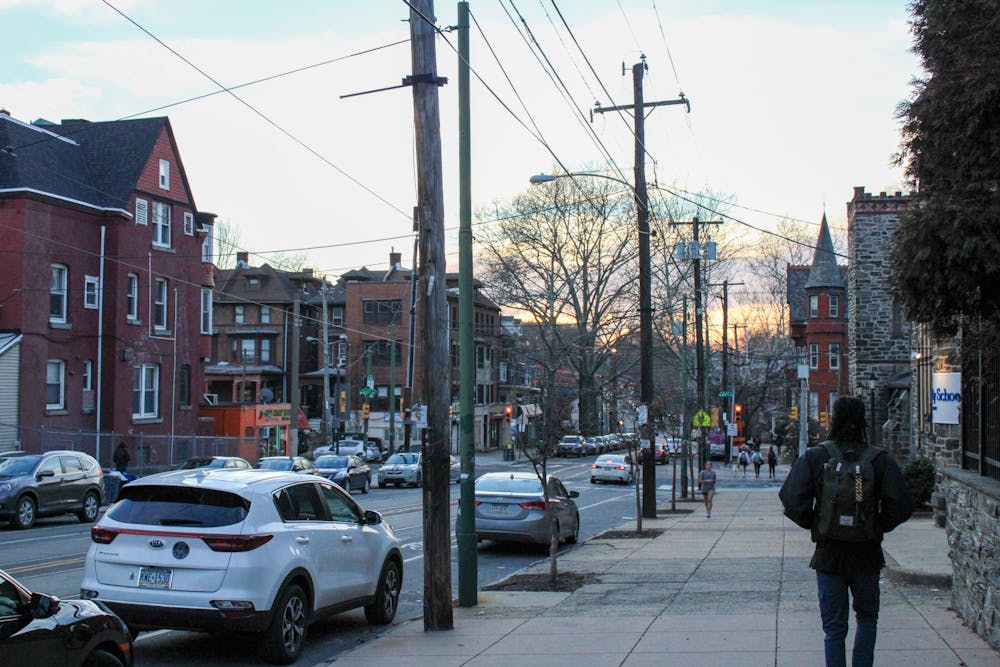
Amid citywide efforts to counteract crumbling infrastructure, professors and researchers associated with Penn’s Urban Planning and Criminology departments spoke to The Daily Pennsylvanian about how improving urban design can decrease crime.
Philadelphia’s violent crime rates dropped to record low levels in recent years, coinciding with nationwide trends. As city officials look for new ways to curb violence, Penn’s Crime and Justice Policy Lab has studied how block beautification — including community gardens, public art, and the restoration of abandoned buildings — can play a role.
“It changes the feeling of a block in important ways,” City and Regional Planning professor Vincent Reina — who serves as the faculty director of the Housing Initiative at Penn — said in an interview with the DP.
In a paper with Criminology professor John MacDonald and Perelman School of Medicine professor Eugenia South, Reina studied the impact of providing repair grants to deteriorating houses in low-income neighborhoods. According to their findings, such interventions were associated with a 21.9% reduction in crime.
Much of the lab’s research builds off of a 2016 study by MacDonald, who found that improving the aesthetics of abandoned buildings and lots reduced gun violence by 39%.
“The more we invest in places, the more opportunity it provides residents, and the more likely it is to do things like reduce exposure to crime or violence,” Reina said.
Maya Moritz — a Ph.D. candidate in Penn’s criminology program who studies how commissioning murals and public art can lead to reductions in crime — told the DP that beautification projects can be easier to implement than other crime policies.
“It’s not so high stakes as a policing thing where somebody might die,” she said. “Who doesn’t want to live in a beautiful, well lit, clean neighborhood?”
RELATED:
Here’s how Penn reports and tracks crime on and around campus
Despite Division of Public Safety warning, Penn students report confidence in campus safety
As with other crime reduction efforts, however, beautification projects can be challenging, according to Criminology professor Aaron Chalfin.
Chalfin — who also works at the Crime and Justice Policy Lab — told the DP that solutions for crime in cities are complex because they depend on the “local context.”
“What works in New York or Philly might not work as well in Dallas or Houston,” he said. “You really want local policymakers to be empowered to think strategically about what the problems are and how they might be solved.”
He added that while there is no “set of best practices” for reducing crime, areas that “seem as though they are cared for are places that are inhospitable to criminal activity, and that empower residents to take control over their communities to a greater degree.”
He also discussed how improving evening lighting across Philadelphia may help to reduce crime.
“When you make a sustained effort to improve lighting in an entire community, and in the case of Philadelphia, the entire city, that can really have an impact at scale,” Chalfin said. “Our research showed that as all these lights went into effect over the course of time throughout the city, you’re seeing sustained reductions in violent crime, including shootings.”
On Jan. 9, Philadelphia Mayor Cherelle Parker announced a new highway beautification project ahead of the nation’s semiquincentennial in 2026. The project is aimed at eliminating graffiti and improving Philadelphia’s highways, according to a press release.
RELATED:
Here’s how Penn reports and tracks crime on and around campus
Despite Division of Public Safety warning, Penn students report confidence in campus safety
Senior reporter Alex Dash covers administration and can be reached at dash@thedp.com. At Penn, he studies history and political science. Follow him on X @AlexBDash.


